The Aziza are forest spirits in the traditional stories of the Fon and neighbouring peoples, associated with hunters and with knowledge of the wild. The stories credit them with passing on knowledge of the forest, plants, hunting, and sometimes music. Tale, myth and cult must be distinguished.
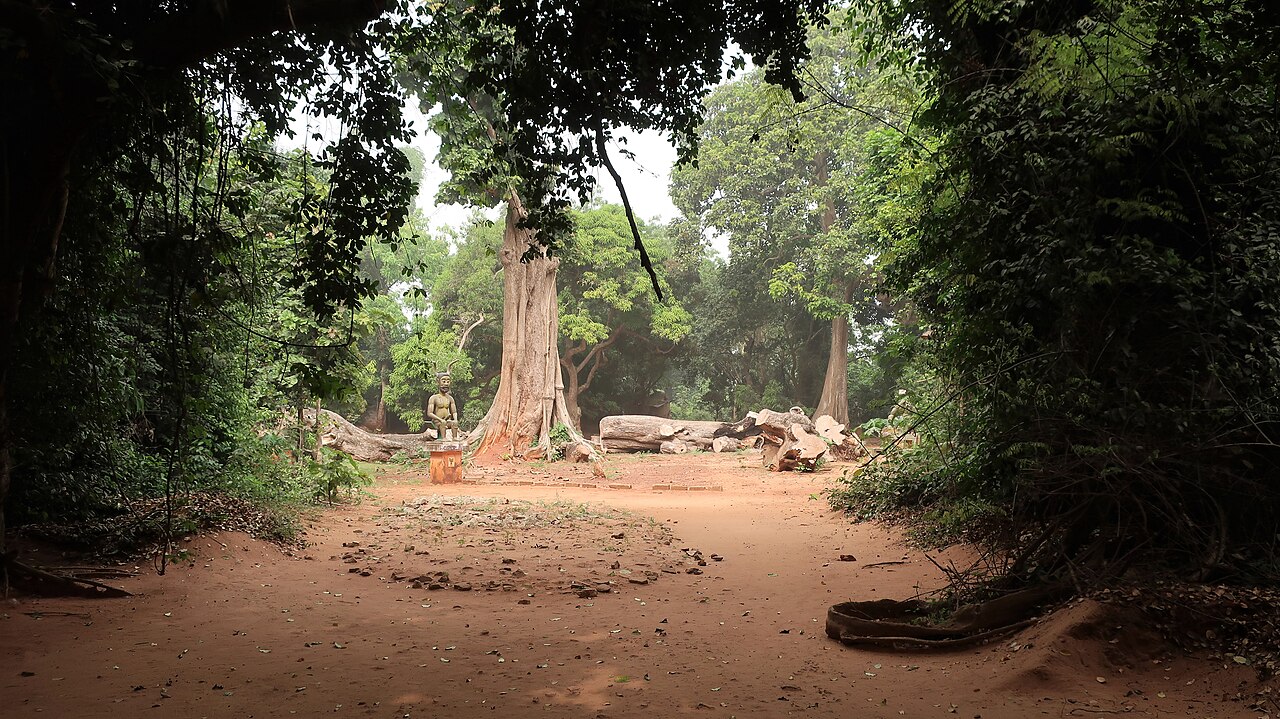
At the temple of Sakété, what the stories say

Direct observationWêtê Agbonon, vodun priest and bokonon of the Fâ, at the temple of Sakété
The Aziza belong to the world of traditional stories about the forest, among the Fon and in neighbouring traditions. They are often described as beings or spirits of the forest, associated with hunters and with knowledge of the wild. The stories credit them with passing on knowledge of the forest, plants and hunting, and sometimes of music and song. A university study from Abomey-Calavi that I know of is devoted to the myth of Aziza and the birth of music and song among the Fon and the Gun: the story of Aziza also touches on artistic inspiration[1].
Key points
- The Aziza are forest spirits, in the traditional stories of the Fon.
- The stories credit them with passing on the knowledge of the forest, hunting and sometimes music.
- Traditional stories must be distinguished from a community’s cult practices.
I prefer to say “according to such a traditional story”, without claiming “the Aziza always do this”[1].
What researchers say
The anthropologist Melville Herskovits, in Abomey in the 1930s, collected the stories of the Aziza, small beings of the forest said to have taught hunters the use of plants and the powers of the bush[2]. See also Agè, the vodun of the bush and of hunters.
Tale, myth and cult
When an elder tells that Aziza lives in the forest, appears in a certain form, passes knowledge to the hunter or teaches a song, we are in the realm of traditional story. That hardly makes it unimportant, on the contrary: a myth can explain how a society understands the forest, knowledge, the hunter, the artist, and the relationship between people and the invisible. Yet I advise against turning every detail of a story into a literal description of cult practice. In an oral tradition, there are also several versions of the same story[1].
Today one finds on the Internet Aziza drawn as small winged fairies, almost like figures of European folklore. These images call for caution: traditional descriptions vary, and modern representations have added elements foreign to the old stories. That is also why this entry shows no illustration[1].
Knowledge of the forest
For me, what matters above all in the story of the Aziza is the relationship with knowledge of the forest. The hunter must know the tracks, plants, animals, paths, dangers and rules of the natural world. The story of Aziza expresses this idea in spiritual form: knowledge of the forest never comes to people by itself; it must be passed on to them. See Traditional medicine and plants[1].
What we know, and how we know it
What comes from oral tradition
The stories of the Aziza, in several versions, are passed on orally[1].
What comes from direct observation
The distinction between story and cult, and caution towards modern images, come from my practice[1].
What is documented
The stories of the Aziza teaching hunters are reported by Melville Herskovits[2].
What is interpretation
Reading the Aziza as an image of the transmission of knowledge is a reading I defend[1].
What is still debated
The forms and functions attributed to the Aziza vary between stories[1].
Common misconceptions about the Aziza
Frequently asked questions
Who are the Aziza?
Forest spirits in the traditional stories of the Fon, associated with hunters and with knowledge of the wild.
What do the Aziza pass on, according to the stories?
Knowledge of the forest, plants and hunting, and sometimes music and song.
Are the Aziza fairies?
No: the image of winged fairies comes from modern representations.
Are the Aziza worshipped?
Traditional stories must be distinguished from the practices actually observed in a community.
Glossary
- Myth: a story that explains how a society understands the world.
Notes and references
[1] Direct observation and oral transmission, Wêtê Agbonon, bokonon, temple of Sakété.
[2] HERSKOVITS Melville J., Dahomey: An Ancient West African Kingdom, New York, J. J. Augustin, 1938, 2 vols.
Sources
- HERSKOVITS Melville J., Dahomey, 1938.
- Direct observation and oral transmission, temple of Sakété, 1994–2026
Cite this entry
Wêtê Agbonon, « The Aziza », dans Vodun Bénin, l’encyclopédie du vaudou béninois, entry no. 060, updated on 25 November 2026. Online: https://vodunbenin.org/en/aziza/ (accessed on 26 November 2026). Licence CC BY 4.0.
- Last checked : 7 October 2026
- Reuse : free, with attribution, under the licence CC BY 4.0
- A mistake? Report it · Method and corrections