
Legba stands at the threshold. In the vodun of Benin, the “voodoo” of English dictionaries, he is the guardian of passages, the bearer of the word and the intermediary between human beings and the other vodun. He is addressed first, because nothing passes without him. In Haiti he is known as Papa Legba.
At the temple of Sakété, the morning greeting to Legba
Direct observationWêtê Agbonon, vodun priest and bokonon of the Fâ, at the temple of Sakété
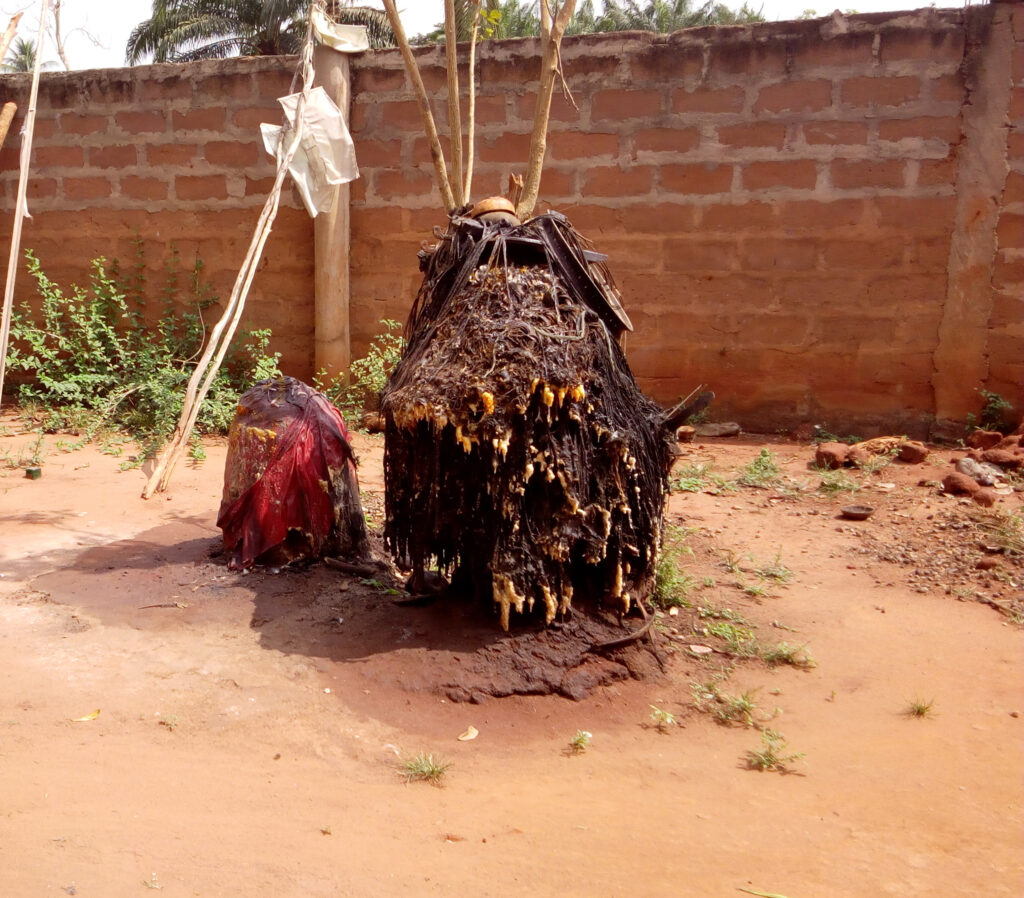
At the temple of Sakété, Legba stands at the threshold, in the space of passage between inside and outside. His traditional form is a mound of moulded earth, sometimes with a figure. In the tradition I practise, Legba belongs to the place where he stands: he is not moved around like a statue[1].
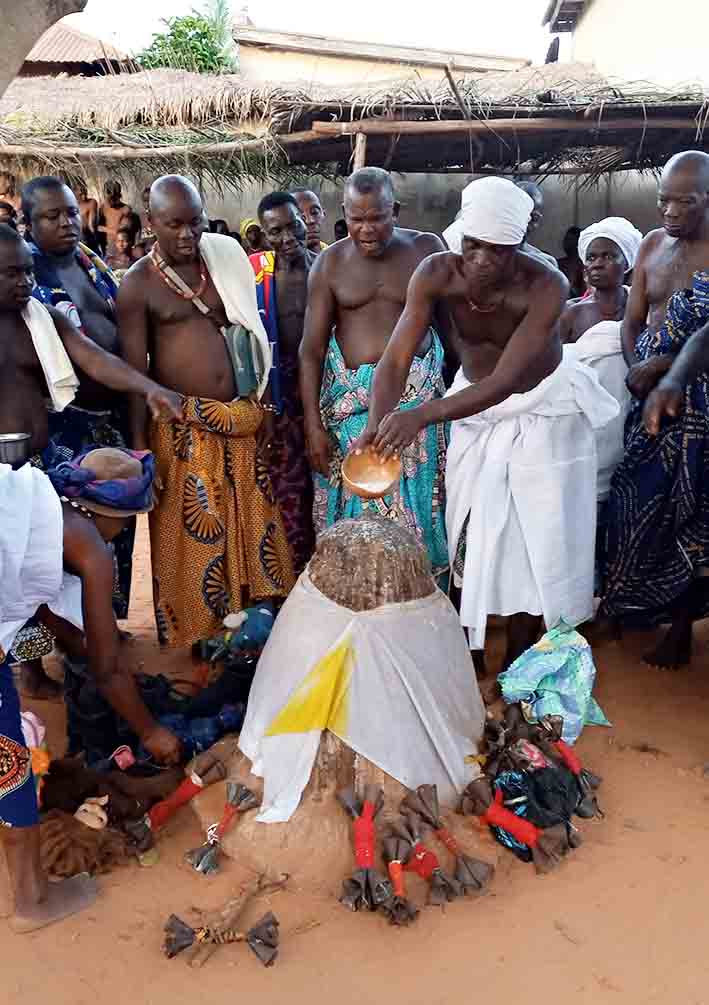
Legba is greeted every morning. When I go out, I stop at the threshold, greet him and tell him what I am going to do with my day. The gesture is simple and daily, and sometimes takes less than a minute; children learn it by watching adults. Most of the time this greeting asks for nothing: one greets, signals one’s presence, gives thanks, and goes on with the day. Red palm oil, poured on the mound, is part of Legba’s regular care; other offerings come according to ritual circumstances. I do not give on the Internet any formula or rite to reproduce at home: these practices are learned in a house, from someone who passes them on, with the prohibitions that go with them.
Key points
- Legba is the vodun of the threshold and of passage, greeted first in every ceremony and consultation.
- He knows every language and carries the word between people and the vodun.
- He is a trickster, a cunning figure, and has nothing to do with the Christian Devil.
Each definition lights up one of his faces; none is enough on its own[1].
Who is Legba?
Legba, Lɛgba in Fon, often written Legba outside Benin, is one of the major vodun of the Fon pantheon. His domain is passage in every form: the threshold of a house, the entrance of a village, the crossroads, the market, but also the word that goes from one person to another, and the message that rises from people to the vodun. A sociolinguistic study from the University of Abomey-Calavi sums up his functions in six words: sentinel, guardian, protector, revealer, leader and organiser, at the head of all groups of vodun, in the service of individuals, houses, kingdoms and villages[2].
Legba in Fon cosmology
The Fon stories collected in the twentieth century by the anthropologists Melville and Frances Herskovits make Legba the youngest child of Mawu-Lisa, the creator couple. When Mawu-Lisa divided the world among their children, each received a domain and its language: the earth, the sea, the sky, the thunder. Legba, the youngest, received instead the knowledge of all these languages. He became the interpreter of his elders and the messenger of his parents[3]. The scholar Robert Pelton sums up this role: after the birth of the gods, Mawu made Legba the translator of her will to all[4].
Another story told by the Herskovitses explains why the sky moved away from the earth. Legba, charged with carrying out Mawu’s orders, was blamed for everything that went wrong. He persuaded an old woman to throw her dirty water towards the sky; offended, Mawu withdrew higher, far from people. Legba stayed on earth, charged with reporting to her what happens there[3]. No story of Legba holds everywhere in Benin: stories and functions vary with regions, families and lineages, and those of Sakété have their own form[1].
The master of the word
Legba knows every language, that of people and that of each vodun. Every word addressed to the vodun therefore passes through him: he carries it, translates it, and brings back the answer. A study by psychiatrists in Cotonou describes him as the messenger, guide and interpreter of the other vodun, between the world of spirits and that of humans[5]. At the start of a ceremony or a consultation, Legba is greeted first. A ceremony that forgot him would have no recipient, like a letter entrusted to nobody[1].
The other vodun each have their own domain: thunder and justice for Hevioso, the earth for Sakpata, continuity and wealth for Dan. Legba links these domains to one another, and to people. The Beninese philosopher Honorat Aguessy devoted a study to this singular place, on Legba and the dynamics of the vodun pantheon in Dahomey[6]. On the creator couple, see Mawu-Lisa (in French).
Legba, the Fâ and destiny
The Fâ is the divination of Benin: it says what is, what threatens and what is asked. Legba makes things pass. The two functions answer each other so closely that tradition constantly associates them; Pelton titled one of his chapters “Legba and Eshu, writers of destiny”[4]. At the temple of Sakété, a consultation of the Fâ begins with the greeting to Legba. Legba does not give the answer of the Fâ: he opens the passage, and the divinatory question then belongs to another order. When the Fâ shows that a step makes sense, it passes first through Legba; when it shows that it does not, there is nothing to pass. That is why nothing is decided in advance[1]. According to a Beninese chronicle of the pantheon, each initiate of the Fâ receives his own Legba, and each bokonon has his Legba near the place where he consults[7]. On the divination itself, see Qu’est-ce que le Fâ ? (in French).
The places of Legba
Legba guards the points of passage: the door, the threshold, the crossroads where paths meet. The Legba of the house, the xwé-lègba, stands at the entrance of the family compound and filters what comes in. At the market, a Legba guards transactions and peace between sellers and buyers; at the entrance of districts and villages, the to-lègba watches over the whole community. From the house to the village and from the village to the kingdom, Legba draws a geography of protection: every threshold has its guardian[1][2].
The trickster, and why Legba is not the Devil
In the stories, Legba lies, diverts, provokes. He pushes others into error, then reveals the error. Anthropologists place him among the figures of the divine trickster found in many cultures; Pelton devotes a chapter to him as “master of Fon dialectic”, alongside Ananse among the Ashanti, Eshu among the Yoruba and Ogo-Yurugu among the Dogon[4]. This cunning has a meaning: whoever holds the passages knows that nothing is ever entirely closed or entirely open, and that a message always depends on who carries it.
The assimilation of Legba to the Devil comes from a Christian reading of an ambivalent, sexual and cunning vodun. The University of Abomey-Calavi study compares the two figures: the biblical Devil embodies the spirit of evil, while Legba fulfils the functions of guardian, protector and organiser; it concludes that the Devil belongs to beliefs foreign to the tradition of Dahomey[2]. Notably, one of the best scholars of Legba, Robert Pelton, is himself a Catholic priest, and takes the trickster seriously as a religious figure in his own right[4].
Fertility and representations
Many figures of Legba bear a marked male sexual attribute. The Art Institute of Chicago, which holds nineteenth-century terracotta shrine figures, sees in it a frequent symbol of Legba, which may also point to danger, deception and cunning[8]. For specialists, the attribute speaks first of vitality: desire, fertility, the encounter that gives birth; a commentary from Duke University’s centre on Afro-Atlantic religions reads it as the model of every fruitful encounter, between sexes, cultures, generations, the living and the dead[9]. The British traveller Richard Burton, in Dahomey in 1863 and 1864, already noted that Legba could be of either sex, though rarely female[10].
Most often, Legba is a mound of moulded laterite earth, adorned with cowries and wood, at the entrance of compounds, sometimes topped with a roughly shaped head or figure. There are also terracotta figures, wooden sculptures, and today concrete statues; the Nelson-Atkins Museum in Kansas City holds a nineteenth-century wooden shrine sculpture dedicated to Legba[11]. Each Legba is shaped by those who serve it, which is why no two are identical[1].
Papa Legba, across the Atlantic
Legba crossed the ocean with the slave trade. In Haitian vodou, Papa Legba opens the gate of the spirits and is greeted first in ceremonies; when the Haitian-born writer Dany Laferrière entered the Académie française in 2015, his academician’s sword bore the image of Legba[12]. In Brazil, Pierre Verger documented the cults of the orisha and vodun on both sides of the Atlantic, where Legba’s Yoruba relative, Exu, holds the same place at the crossroads[13]. See also Vodun in the Americas.
What we know, and how we know it
What comes from oral tradition
The stories of Legba, his cunning and his place among the children of Mawu-Lisa are passed down orally, with forms that vary between regions and lineages[3][1].
What comes from direct observation
The morning greeting, palm oil on the mound and Legba’s place at the start of a consultation of the Fâ come from my practice[1].
What is documented
His functions, his role as interpreter, his representations in museums and his presence in Haiti and Brazil are described by researchers and museums[2][5][11][13].
What is interpretation
Reading his sexual attribute as a sign of vitality and fruitful encounter is an interpretation shared by several specialists[9].
Common misconceptions about Legba
- “Legba is the Devil.” This assimilation comes from a Christian reading; Legba is a guardian, protector and organiser[2].
- “Legba only opens doors.” He can open and close, ease a passage or trouble it: this is part of his nature[1].
- “Legba answers in place of the Fâ.” He opens the passage; the answer belongs to the Fâ[1].
- “Every Legba looks the same.” Each is shaped by those who serve it[1].
Frequently asked questions
Who is Legba in voodoo?
The vodun of the threshold and of passage, guardian of doors and crossroads, bearer of the word between people and the other vodun; he is greeted first.
Is Legba the Devil?
No: the assimilation comes from a Christian reading; in the vodun tradition, Legba is a guardian, protector and organiser.
What is a Legba shrine?
Most often a mound of moulded earth at the entrance of a compound, a village or a market, sometimes with a figure.
Why is Legba greeted first?
Because every word addressed to the vodun passes through him: he opens the passage, translates and brings back the answer.
Who is Papa Legba?
The name of Legba in Haitian vodou, where he opens the gate of the spirits and is greeted first in ceremonies.
What is the link between Legba and the Fâ?
A consultation of the Fâ begins with the greeting to Legba; he opens the passage, and the Fâ gives the answer.
Glossary
- Lɛgba: the Fon spelling of Legba.
- To-lègba: the Legba of a village or district.
- Trickster: in anthropology, the figure of the divine cunning one.
- Xwé-lègba: the Legba of the house, at the entrance of the compound.
Notes and references
[1] Direct observation and oral transmission, Wêtê Agbonon, bokonon, temple of Sakété.
[2] University of Abomey-Calavi, « Études sociolinguistiques d’une présumée similitude entre le vodún Lɛgba et le Satan », institutional repository.
[3] HERSKOVITS Melville J., Dahomey: An Ancient West African Kingdom, New York, J. J. Augustin, 1938; HERSKOVITS Melville J. and Frances S., Dahomean Narrative, Evanston, Northwestern University Press, 1958.
[4] PELTON Robert D., The Trickster in West Africa: A Study of Mythic Irony and Sacred Delight, Berkeley, University of California Press, 1980.
[5] FIOSSI KPADONOU Émilie et al., « Lègba et son rôle dans la régulation psychosociale », Psy Art & Thérapie, no. 3, Cotonou, 2021.
[6] AGUESSY Honorat, « Legbá e a dinâmica do panteão Vodun no Daomé », Afro-Ásia, no. 10-11, Salvador, UFBA, 1970.
[7] « À l’occasion des Vodoun Days, une exploration du panthéon vodoun », Afrik.com.
[8] Art Institute of Chicago, « One of a Pair of Shrine Figures », terracotta, Ewe, Aja or Fon, late nineteenth or early twentieth century.
[9] Duke University, Center for Africana Art and Afro-Atlantic Religions, « Legba Statue » (work by Euloge Ahanhanzo Glèlè).
[10] BURTON Richard F., A Mission to Gelele, King of Dahome, London, Tinsley Brothers, 1864, 2 vols.
[11] Nelson-Atkins Museum of Art, « Shrine Sculpture to the God Legba », carved wood, nineteenth century.
[12] LAFERRIÈRE Dany, acceptance speech at the Académie française, 2015, reported by Le Temps, « Legba, un dieu vaudou sur l’épée de Dany Laferrière ».
[13] VERGER Pierre, Notes sur le culte des Orisa et Vodun à Bahia, la Baie de tous les Saints, au Brésil et à l’ancienne Côte des Esclaves en Afrique, Dakar, IFAN, 1957.
Sources
- PELTON Robert D., The Trickster in West Africa, University of California Press, 1980.
- HERSKOVITS Melville J., Dahomey, 1938.
- University of Abomey-Calavi, study on Lɛgba and Satan.
- Direct observation and oral transmission, temple of Sakété, 1994–2026
Cite this entry
Wêtê Agbonon, « Legba », dans Vodun Bénin, l’encyclopédie du vodun béninois, entry no. 001, updated on 28 October 2026. Online: https://vodunbenin.org/en/legba/ (accessed on 1 November 2026). Licence CC BY 4.0.
- Last checked : 7 October 2026
- Reuse : free, with attribution, under the licence CC BY 4.0
- A mistake? Report it · Method and corrections