A bocio is a sculpture from southern Benin and Togo, made of wood and often loaded with cords, nails, bones or offering materials, to which functions of protection, defence or ritual action are attributed. Its function depends on its context. Bocio have nothing to do with the “voodoo doll” of the films, and many are now held in Western museums.
At the temple of Sakété, what a bocio is

Direct observationWêtê Agbonon, vodun priest and bokonon of the Fâ, at the temple of Sakété
The word bocio refers to carved objects to which particular functions are attributed, in certain traditions of the Gulf of Benin. Reducing them to “magic statues” is already a mistake. A bocio can have different functions depending on its context: protection, defence, symbolic action, representing a person or a situation, or taking part in certain ritual relationships. The context in which the object was made and used must always be considered[1].
Key points
- The bocio is a sculpture with functions of protection, defence or ritual action, depending on its context.
- Cords, nails and added materials do not have a single meaning for every bocio.
- Before a museum bocio, ask where it comes from and how it got there.
One must start from the object and its history, rather than from an image made in the West[1].
What researchers say
The art historian Suzanne Preston Blier wrote the reference study of bocio in 1995: she reads them as sculptures of power, loaded with materials and bindings, expressing emotions, tensions and protections[2]. The Anne and Jacques Kerchache collection, shown by the Fondation Cartier in Paris in 2011, brought together nearly a hundred, from Benin and Togo[3]. The Metropolitan Museum of Art in New York holds several, from the nineteenth and early twentieth centuries[4].
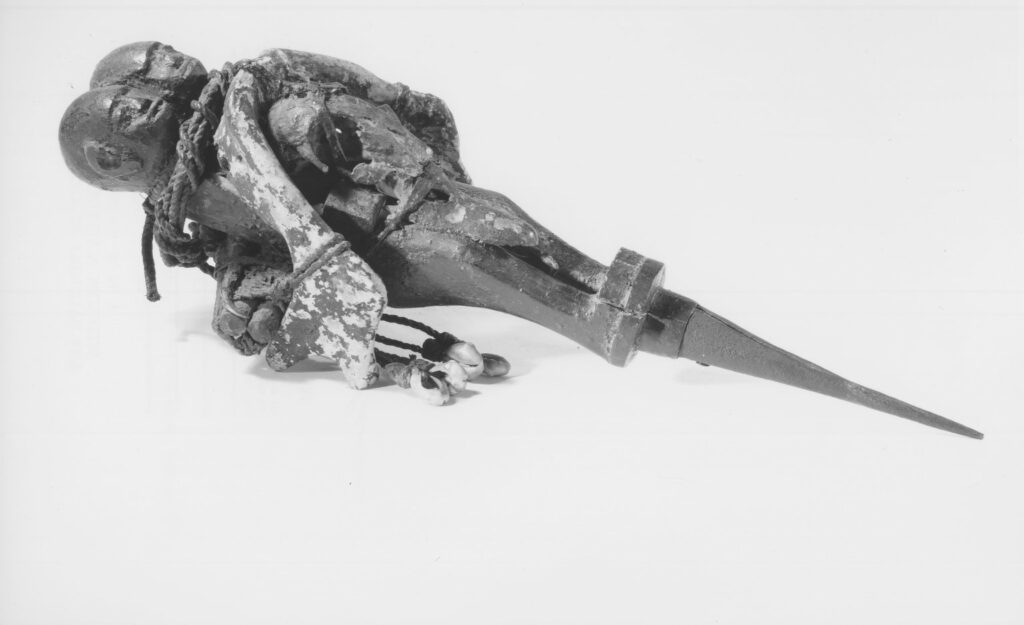
A bocio, not a voodoo doll
The “voodoo doll” of films and some Western shops has become a caricature: a small doll representing a person, stuck with needles to hurt them. That image does not help understand bocio. The problem comes partly from African objects being read through European or popular categories unrelated to their original function[1]. The archaeologist Natalie Armitage has shown that the image of the pin-stuck doll came mainly from European figural magic. See The voodoo doll[5].
Cords, nails and materials
The cords, bindings, nails, added materials and other visible elements on some objects do not automatically mean “someone who has been tied up” or “someone who has been pierced”. The object may have been built precisely that way for its ritual function. But any universal interpretation must be avoided: a binding on one bocio does not mean the same thing on every bocio. The meaning depends on the context, the tradition and the object itself; one must start from the object and its history, rather than from a popular image made in the West[1].
Bocio in museums
I am not against museums: a museum can let millions of people discover the art and history of Benin. But an essential question must be asked: how did the object get there? A religious or ritual object goes beyond an aesthetic work: it may have been used in a community, belonged to a family, or been removed from its context in particular historical circumstances[1]. Benin has begun an important restitution process, with the return of 26 works from French collections in 2021; that return showed that the question touches memory, cultural sovereignty and the relationship between peoples[6]. See also the statue of Gou, claimed by Benin.
The right question therefore goes beyond “is this piece beautiful?”. One must also ask: where does it come from, who made it, for whom, in what context, how did it reach this museum, and what does it mean for the descendants of those who made it?[1]
What we know, and how we know it
What comes from oral tradition
The function of each bocio is passed on among those who make and use it[1].
What comes from direct observation
The refusal of a universal reading of cords and nails, and the questions to ask of a museum object, come from my practice[1].
What is documented
The study of bocio, their presence in museums and the 2021 restitution are established by researchers, museums and official sources[2][4][6].
What is interpretation
Reading bocio as sculptures of power and emotion is Suzanne Preston Blier’s interpretation[2].
What is still debated
The provenance of many museum bocio remains to be established[1].
Common misconceptions about bocio
- “A bocio is a voodoo doll.” It is a sculpture with precise ritual functions, unrelated to the doll of the films[5].
- “A bound bocio represents someone tied up.” The meaning of a binding depends on the object and its context[1].
- “A museum bocio is just a work of art.” It often has a religious history and a provenance to question[1].
Frequently asked questions
What is a bocio?
A sculpture from southern Benin and Togo, often loaded with cords, nails or materials, with functions of protection, defence or ritual action.
Is a bocio a voodoo doll?
No: the pin-stuck doll comes mainly from European magic and the cinema; the bocio has other functions.
Why are some bocio bound with cords?
The object’s construction depends on its ritual function; the meaning of a binding varies from one bocio to another.
Where can you see bocio?
In major museums, such as the Metropolitan Museum of Art in New York, while asking where they come from.
Glossary
- Bocio: a sculpture of power, in southern Benin and Togo.
- Restitution: the return of an object to its country of origin.
Notes and references
[1] Direct observation and oral transmission, Wêtê Agbonon, bokonon, temple of Sakété.
[2] BLIER Suzanne Preston, African Vodun: Art, Psychology, and Power, Chicago, University of Chicago Press, 1995.
[3] Fondation Cartier pour l’art contemporain, Vaudou, catalogue of the Anne and Jacques Kerchache collection, Paris, 2011, with texts by Suzanne Preston Blier, Gabin Djimassé, Marc Augé and Patrick Vilaire.
[4] The Metropolitan Museum of Art, New York, Fon bocio of the nineteenth and early twentieth centuries, open-access collection. See
[5] ARMITAGE Natalie, « European and African Figural Ritual Magic: The Beginnings of the Voodoo Doll Myth », in HOULBROOK Ceri and ARMITAGE Natalie (eds.), The Materiality of Magic, Oxford, Oxbow Books, 2015.
[6] Government of Benin, return of the 26 works restituted by France, 2021. See (in French)
Sources
- BLIER Suzanne Preston, African Vodun: Art, Psychology, and Power, 1995.
- Government of Benin, restitution of the 26 works, 2021.
- Direct observation and oral transmission, temple of Sakété, 1994–2026
Cite this entry
Wêtê Agbonon, « Bocio, the statues of vodun », dans Vodun Bénin, l’encyclopédie du vodun béninois, entry no. 049, updated on 14 November 2026. Online: https://vodunbenin.org/en/bocio/ (accessed on 16 November 2026). Licence CC BY 4.0.
- Last checked : 7 October 2026
- Reuse : free, with attribution, under the licence CC BY 4.0
- A mistake? Report it · Method and corrections