
Gou is the vodun of iron: of the forge, tools, hunting and weapons, and today of every metal trade, from the blacksmith to the mechanic and the driver. He is also the subject of the masterpiece of vodun sculpture, the iron statue by Akati Ekplékendo, held at the Louvre and claimed by Benin. He corresponds to the Yoruba Ogun, Haitian Ogou and Brazilian Ogum.
At the temple of Sakété, far more than a god of war

Direct observationWêtê Agbonon, vodun priest and bokonon of the Fâ, at the temple of Sakété
When people speak to me of Gou, many think immediately of war. That is understandable, since Gou is indeed associated with weapons and strength. But reducing Gou to a god of war misses much of what he represents in our tradition. Gou is linked to iron, work, tools, the forge, hunting, weapons and, more broadly, to all whose activity depends on metal and technique[1].
In Sakété, I would not present Gou as a vodun whose offerings or ritual gestures I can simply list for the public; what is passed on in a house depends on the tradition, the family and the role of the place. What I can say publicly is that Gou belongs to the forces with which people have a particular relationship, because they touch their work and their safety directly. Iron is far more than a material: with iron one makes a hoe, a machete, a knife, a tool, a weapon, a machine part; with iron one works the land, builds, repairs, travels, and can also be hurt. This relationship between people, iron, work and danger is the key to Gou[1].
Key points
- Gou is the vodun of iron: the forge, tools, hunting, weapons and technique.
- Today he concerns every metal trade, from the blacksmith to the mechanic and the driver.
- He recalls people’s responsibility for the force they put in their own hands.
Working in a trade associated with Gou does not make one consecrated to Gou: serving a vodun is a matter of vocation, transmission and consecration[1].
From blacksmith to mechanic
Gou, a divinity of fire and war whose attribute is iron, is the patron of hunters and blacksmiths; since the arrival of cars, he is also that of drivers and mechanics. In southern Benin he has no temple of his own: he is found in courtyards, on small altars of iron spikes driven into the ground, and he tends to become a divinity of the iron trades, as the anthropologist Emmanuelle Kadya Tall observed in 1995[2]. The researchers gathered in Porto-Novo in 2016 describe him likewise as clearer of land, hunter, blacksmith, scout, soldier, and today driver, mechanic, aviator or computer scientist: metalworkers seek his goodwill and install him near their workshop[3].
The world has changed, and metal is everywhere: the mechanic, the welder, the driver surrounded by a machine that can become dangerous, the electrician and many technical trades belong to this universe. The tradition has adapted to the trades of our time. But not everyone who drives a car automatically becomes a servant of Gou: being concerned by the power of a vodun and being consecrated to it are two different things[1].
Gou and the road
That is why people associate Gou with accidents, and I understand the association: a car or a motorbike is a machine of metal, and the road brings together speed, machine, person and danger. But I refuse an overly simple interpretation that says: “There was an accident, so it is Gou.” An accident may have a mechanical, human, medical or environmental cause, and reality must first be examined seriously. Respecting Gou also means respecting the reality of the world we live in: whoever drives must maintain their vehicle, respect the road and avoid dangerous behaviour. Vodun does not exempt anyone from their responsibilities[1].
The statue by Akati Ekplékendo
The most famous image of Gou is a life-size iron statue attributed to Akati Ekplékendo, an artist from Doumé, north-west of Abomey, taken prisoner during a campaign of King Glele and brought to the court; the king is said to have commissioned it at the start of his reign, around 1858. It stands 178.5 centimetres tall[4][5].
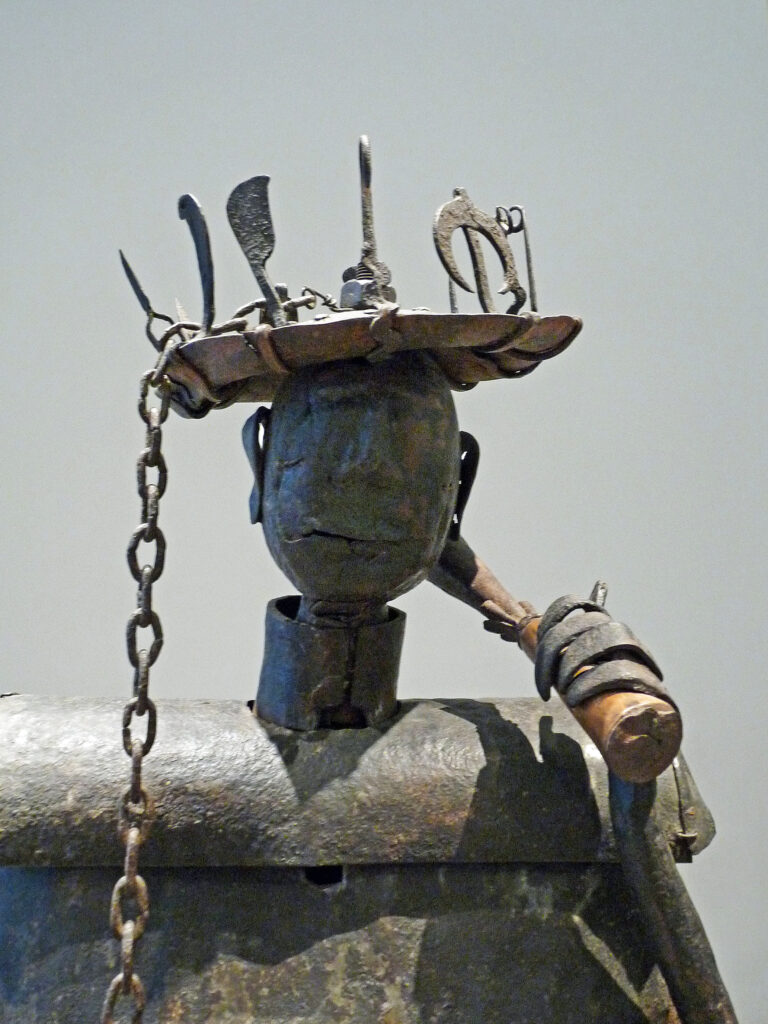
The statue is made entirely of European scrap iron, hammered, nailed and riveted, in plates or bars: a work of reuse in the true sense, where iron arriving from Europe through trade becomes the body of the vodun of iron[6]. During the conquest of the kingdom, Captain Eugène Fonssagrives found it in Ouidah and gave it to the Trocadéro ethnography museum, where it was registered in 1894; the same year, Maurice Delafosse presented it in La Nature as a “Dahomean statue in cast iron”. It then passed to the musée de l’Homme, then the musée du quai Branly; since 2000 it has been on display in the Pavillon des Sessions of the Louvre[7][8][5].
When I look at this statue, I see far more than a work of art. I see part of our history: the iron that composes it, the way it was worked, the weapons and tools in its representation all recall Gou’s place in the society and religious thought of the kingdom of Dahomey[1].
A statue claimed by Benin
Benin asked for the statue’s return as early as 2016, through its foreign minister, Aurélien Agbénonci[9]. Yet it was not among the 26 royal treasures of Abomey returned by France in 2021, which Beninese voices publicly questioned[10]. In July 2026, the Beninese government set up in Cotonou a national scientific committee to support a new request covering 35 cultural objects and archives held in French public collections; the request relies on a French framework law easing restitutions, in force since May 2026, and the sculpture of Gou is among the objects claimed[11][12].
Restitution matters to me. I fully understand that Benin asks for its cultural property to return to its territory: it allows the people who produced these works to recover part of their history and pass it on in their own environment. But I also distinguish the statue of Gou held at the Louvre from the living Gou in our temples. The statue is a historical and heritage object; the Gou we serve in the tradition is a religious reality. The two must not be confused[1].
Gou, Ogun, Ogou and Ogum
Gou is of Yoruba origin. Among the Yoruba he is Ogun; in the diaspora, Ogou in Haiti and Ogum in Brazil. Researchers have studied this spread from one continent to another, notably in the collective volume Africa’s Ogun, edited by the anthropologist Sandra Barnes[13]. Personally, I would not say they are exactly the same: there is a deep historical and religious kinship, with transformations according to peoples, languages, places and the histories of the diaspora. In Haiti, Ogou became a great family of lwa; in Brazil, Ogum developed its own forms in the Afro-Brazilian religions. There are origins and correspondences to study, without erasing the differences because the names are alike. See Vodun in the Americas[1].
What Gou teaches me
For me, Gou represents something very concrete: responsibility for the force people put in their own hands. Iron can build, work the land, protect, and also kill. A car can carry a family or cause an accident; a machine can earn a living or become dangerous when misused. That is where Gou becomes far more interesting than the image of a “god of war”: he reminds us that power must be mastered. Iron has changed form, trades and machines have changed, but the relationship between people, technique, force and danger remains[1].
What researchers say
Gou and his statue have been studied by art historians and anthropologists. The main works, in chronological order:
- 1894Maurice Delafosse publishes the first article on the statue, which he believes cast in iron[8].
- 1989Sandra Barnes brings together studies on Ogun, in Africa and the Americas[13].
- 1995Emmanuelle Kadya Tall describes Gou become patron of drivers and mechanics[2].
- 2009Maureen Murphy traces the statue’s journey from the battlefield to the museum[7].
- 2016A conference in Porto-Novo studies the figure of the god Gou, between royal heritage and contemporary creation[3].
What we know, and how we know it
What comes from oral tradition
What each house passes on about the service of Gou depends on its tradition and family[1].
What comes from direct observation
Gou as the vodun of all metal trades, and the refusal to blame Gou for every accident, come from my practice[1].
What is documented
The statue’s making around 1858, its journey to the Louvre and Benin’s requests for restitution are established by museums, researchers and the press[5][7][11][12].
What is interpretation
Seeing in Gou a responsibility for force rather than a god of war is a reading I defend[1].
Common misconceptions about Gou
- “Gou is the god of war.” He is the vodun of iron, work, tools and technique, far beyond war[1].
- “Every accident comes from Gou.” An accident may have a mechanical, human, medical or environmental cause[1].
- “Driving makes you a servant of Gou.” Serving a vodun is a matter of vocation, transmission and consecration[1].
- “The statue at the Louvre is cast iron.” It is made of hammered, nailed and riveted European scrap iron[6].
Frequently asked questions
Who is Gou in voodoo?
The vodun of iron in Benin: of the forge, tools, hunting and weapons, and today of every metal trade.
Is Gou the same as Ogun or Ogou?
He is of Yoruba origin, corresponding to Ogun, to Ogou in Haiti and Ogum in Brazil, with transformations in each society.
Where is the statue of Gou?
At the Louvre, in the Pavillon des Sessions, since 2000; it belongs to the musée du quai Branly.
Has Benin asked for the statue of Gou back?
Yes, since 2016; it is among the 35 objects claimed in the new request launched in July 2026.
Who made the statue of Gou?
Akati Ekplékendo, an artist from Doumé brought to the court of King Glele, around 1858.
Why is Gou the patron of drivers?
Because a car is a machine of metal; Gou has become the patron of all who work with iron.
Glossary
- Ogou: the family of Gou in Haitian vodou.
- Ogum: Gou in the Afro-Brazilian religions.
- Ogun: the Yoruba name of Gou.
- Pavillon des Sessions: the Louvre gallery displaying works from Africa, Asia, Oceania and the Americas.
Notes and references
[1] Direct observation and oral transmission, Wêtê Agbonon, bokonon, temple of Sakété.
[2] TALL Emmanuelle Kadya, « Dynamique des cultes voduns et du Christianisme céleste au Sud-Bénin », Cahiers des sciences humaines, vol. 31, no. 4, 1995.
[3] HOUÉNOUDÉ Didier and MURPHY Maureen (eds.), Création contemporaine et patrimoine royal au Bénin : autour de la figure du dieu Gou, proceedings of the Porto-Novo conference, HiCSA, 2018.
[4] « Double Trophy: “Gou” by Akati Ekplékendo », in Reading Objects, Heidelberg University Publishing, CC BY-SA 4.0.
[5] Musée du quai Branly-Jacques Chirac, record « Sculpture du dieu Gou par Akati Ekplékendo », inv. 71.1894.32.1, Pavillon des Sessions of the Louvre.
[6] BEAUJEAN Gaëlle, « La statue de fer dédiée à Gou. Sculpture d’Ekplékendo Akati », in HOUÉNOUDÉ Didier and MURPHY Maureen (eds.), 2018.
[7] MURPHY Maureen, « Du champ de bataille au musée : les tribulations d’une sculpture fon », in Histoire de l’art et anthropologie, Paris, INHA and musée du quai Branly, 2009.
[8] DELAFOSSE Maurice, « Une statue dahoméenne en fonte », La Nature, no. 1105, 1894, p. 145-147.
[9] RFI, « A. Agbénonci (Bénin) : “Nos biens culturels ont une valeur spirituelle importante” », 4 April 2017.
[10] Le Quotidien, « Restitution de 26 objets au Bénin : la France conserve la statue du dieu Gou ».
[11] APA, « Bénin : un comité pour la restitution de 35 biens culturels », 15 July 2026.
[12] France 24, « Le Bénin réclame à nouveau 35 œuvres et archives coloniales à la France », 6 August 2026.
[13] BARNES Sandra T. (ed.), Africa’s Ogun: Old World and New, Bloomington, Indiana University Press, 1989.
Sources
- MURPHY Maureen, « Du champ de bataille au musée », 2009.
- BARNES Sandra T. (ed.), Africa’s Ogun, 1989.
- APA and France 24, Benin’s 2026 restitution claim.
- Direct observation and oral transmission, temple of Sakété, 1994–2026
Cite this entry
Wêtê Agbonon, « Gou », dans Vodun Bénin, l’encyclopédie du vodun béninois, entry no. 009, updated on 28 October 2026. Online: https://vodunbenin.org/en/gou/ (accessed on 1 November 2026). Licence CC BY 4.0.
- Last checked : 7 October 2026
- Reuse : free, with attribution, under the licence CC BY 4.0
- A mistake? Report it · Method and corrections