
Gèlèdè is a masked ceremony of the Yoruba-Nago people, in Benin, Nigeria and Togo, which honours the primordial mother, Iyà Nlà, and the role of women in society. Its dances, songs and carved masks mix memory, poetry and satire. Proclaimed a masterpiece by UNESCO in 2001, it has been inscribed since 2008 on the Representative List of the Intangible Cultural Heritage of Humanity.
At the temple of Sakété, what I know of Gèlèdè

Direct observationWêtê Agbonon, vodun priest and bokonon of the Fâ, at the temple of Sakété
Gèlèdè belongs to the Yoruba-Nago cultural world, which reaches far beyond the present borders of Benin. In our region it must be seen in the light of the history of peoples and territories: the Beninese Plateau is particularly important for understanding this tradition. I know Gèlèdè as a tradition that brings together masks, songs, dance and memory, and a particular understanding of women and of feminine powers[1].
But I want to be precise on one point: I will not attribute to the temple of Sakété a particular Gèlèdè ceremony if I cannot establish it. Sakété has a strong Nago history and many cultural links with the traditions of the Plateau, but a Yoruba-Nago practice observed in Kétou, Savè or elsewhere is not thereby an identical practice of Sakété. That is a frequent mistake when people summarise Beninese traditions too quickly.
Key points
- Gèlèdè honours Iyà Nlà, the primordial mother, and the place of women in society.
- It is the only known masked society also led by women.
- Its songs and masks mix memory, poetry, humour and social criticism.
The mask matters, but Gèlèdè is also a memory, songs, an organisation and a transmission[1].
A heritage of humanity
According to UNESCO, Gèlèdè is practised by the Yoruba-Nago community of Benin, Nigeria and Togo. For more than a century, the ceremony has honoured the primordial mother, Iyà Nlà, and the role of women in the social organisation and development of Yoruba society. It takes place every year after the harvests, at important events, and in times of drought or epidemic. The ceremony is generally held at night, in a public square, near a house where the dancers get ready; the singers and drummers appear first. The songs, in Yoruba, recount the history and myths of the Yoruba-Nago people[2].
Why Gèlèdè honours the mothers
This is one of the most important things to understand. Gèlèdè honours Iyà Nlà, the primordial mother, and recognises the role of women in the organisation and development of Yoruba society. But one should not imagine a simple festival for “thanking mothers”: motherhood here is far deeper. It refers to feminine power, fertility, the continuity of society, the capacity to give life, and the place of women in the balance of the community[1].
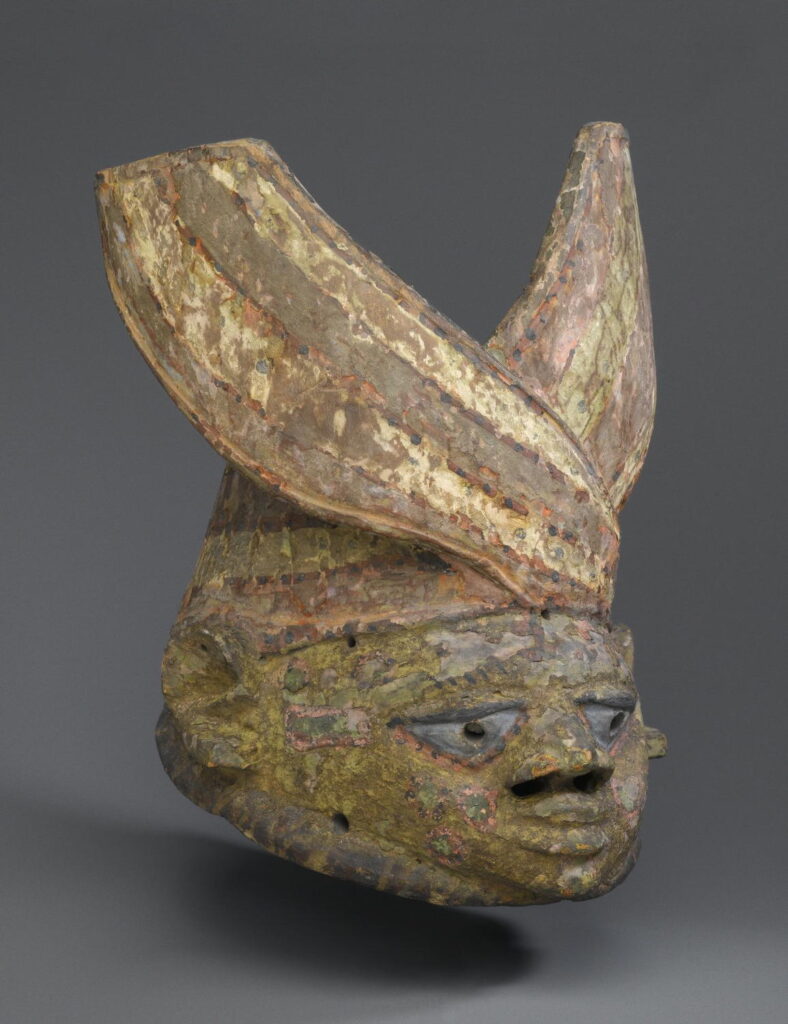
Museums say so too: Gèlèdè masks are worn by male dancers at festivals that honour the women of the community, living and dead, and especially the powerful “great mothers”, elderly women as well as ancestors[3]. UNESCO adds that the community is organised in groups of men and women, each led by a head, and that Gèlèdè is the only known masked society also led by women; although it has adapted to a more patriarchal society, its oral heritage and dances bear witness to an ancient matriarchal order[2].
The mask, satire and memory
Gèlèdè has a social dimension. The songs and performances can speak of collective life, human behaviour, relationships, and what needs correcting in the community; humour and satire have their place. UNESCO describes an oral heritage mixing epic and lyric poetry, irony and derision, carried by satirical masks[2][1].
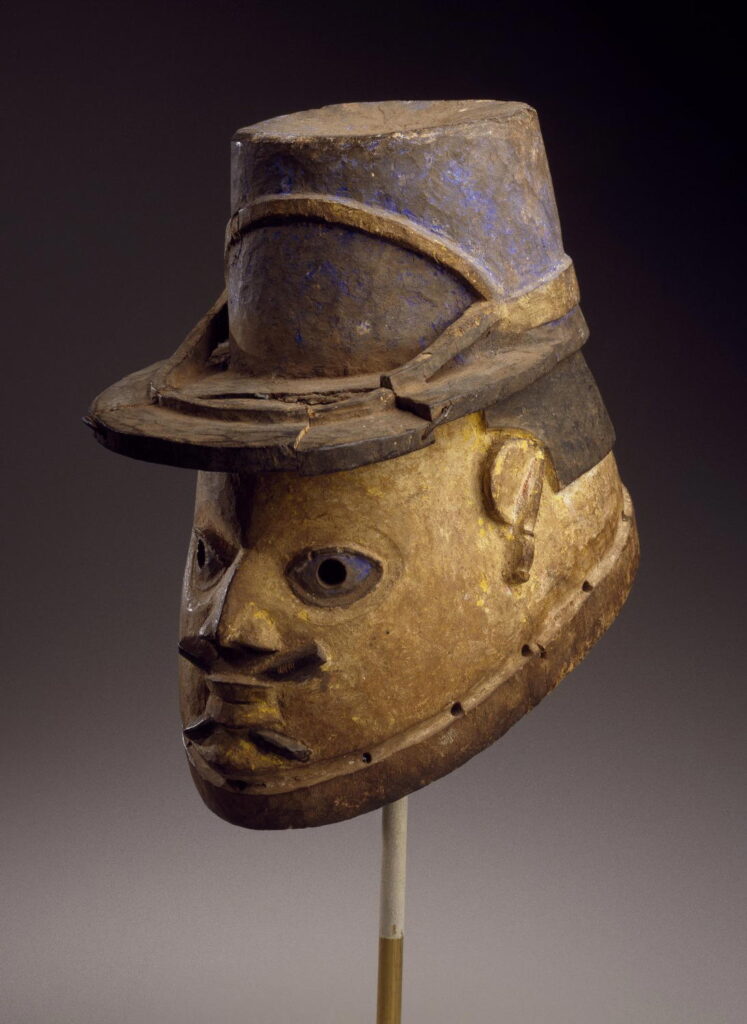
The masks give striking examples. At the Brooklyn Museum, an early twentieth-century mask represents a French gendarme: it probably served to criticise the conduct of the French during the colonial period[4]. Others reproduce women’s knotted headdresses, and so document everyday life[3].
A tradition to pass on
UNESCO points to two threats: technical change, which is gradually erasing traditional skills, and tourism, which risks reducing the ceremony to a folklore product. Yet the Gèlèdè community is keenly aware of the value of its heritage[2]. To safeguard it, Benin built an International House of Gèlèdè, and a programme run with UNESCO from 2003 to 2008 organised dance, sculpture and costume workshops for young people and masters, first in Kétou and Kilibo, with a partnership between the Association Groupe Gèlèdè of Savè and the University of Ife, in Nigeria[5]. Gèlèdè opened the way: after it, Benin is now preparing the nomination of Vodun[6].
When a religious and social tradition becomes visible to the public, it remains a tradition for those who carry it; it must not become a mere folklore show. See also the other masked societies: the Egungun and the Zangbéto[1].
What we know, and how we know it
What comes from oral tradition
The songs of Gèlèdè, in Yoruba, carry the history and myths of the Yoruba-Nago people[2].
What comes from direct observation
The caution about attributing Gèlèdè ceremonies to Sakété comes from my practice[1].
What is documented
The UNESCO inscription, the leadership of women, the masks in museums and the safeguarding programme are established by official sources and museums[2][3][4][5].
What is interpretation
Seeing motherhood in Gèlèdè as feminine power rather than a simple homage is a reading I defend[1].
What is still debated
The age of the ceremony, and its ancient matriarchal order, are discussed by researchers[2].
Common misconceptions about Gèlèdè
- “Gèlèdè is a mask show.” It is a memory, songs, an organisation and a transmission[1].
- “Gèlèdè is a festival for thanking mothers.” It honours feminine power, fertility and the continuity of society[1].
- “Every Nago town practises Gèlèdè the same way.” A practice observed in one town is not identical elsewhere[1].
Frequently asked questions
What is Gèlèdè?
A masked ceremony of the Yoruba-Nago people of Benin, Nigeria and Togo, honouring the primordial mother and the role of women.
Is Gèlèdè recognised by UNESCO?
Yes: proclaimed a masterpiece in 2001, it was inscribed in 2008 on the Representative List of the Intangible Cultural Heritage of Humanity.
Who wears the Gèlèdè masks?
Male dancers, at festivals that honour women, living and dead, and especially the “great mothers”.
Is Gèlèdè satirical?
Yes: its songs and masks mix poetry with irony and derision, such as a mask of a French gendarme from the colonial period.
Where can you see Gèlèdè in Benin?
In the Yoruba-Nago areas, notably on the Plateau, such as Kétou and Savè.
Glossary
- Iyà Nlà: the primordial mother honoured by Gèlèdè.
- Nago: the Yoruba of Benin.
Notes and references
[1] Direct observation and oral transmission, Wêtê Agbonon, bokonon, temple of Sakété.
[2] UNESCO, Intangible Cultural Heritage, « Oral heritage of Gelede », inscribed in 2008 (proclaimed in 2001). See (in French)
[3] Brooklyn Museum, « Gelede Mask », no. 22.227. See
[4] Brooklyn Museum, « Gelede Helmet Mask of a Gendarme », no. 1991.226.3. See
[5] UNESCO, « Action Plan for the Safeguarding and Promotion of the Oral Tradition of Gelede », 2003-2008. See
[6] Banouto, « Inscription du Vodun au patrimoine immatériel de l’humanité à l’UNESCO : le Bénin renforce ses acteurs », 18 November 2025. See (in French)
Sources
- UNESCO, « Oral heritage of Gelede », 2008.
- Brooklyn Museum, Gelede masks.
- Direct observation and oral transmission, temple of Sakété, 1994–2026
Cite this entry
Wêtê Agbonon, « Gèlèdè », dans Vodun Bénin, l’encyclopédie du vodun béninois, entry no. 023, updated on 28 October 2026. Online: https://vodunbenin.org/en/gelede/ (accessed on 1 November 2026). Licence CC BY 4.0.
- Last checked : 7 October 2026
- Reuse : free, with attribution, under the licence CC BY 4.0
- A mistake? Report it · Method and corrections