
The Egungun are the ancestors who return among the living, under a costume of cloth that entirely hides the wearer. A Yoruba tradition, they come out in Benin in the Nago towns, from Porto-Novo to Pobè and Sakété, where the great outing returns every three years. In Brazil, their cult lives on in Bahia.
At the temple of Sakété, what I can say about them

Direct observationWêtê Agbonon, vodun priest and bokonon of the Fâ, at the temple of Sakété
When I speak of the Egungun of Sakété, I speak of far more than a mask seen coming out in the street: a tradition that touches the family, the ancestors and transmission. With us, the Egungun is linked to the world of the ancestors, and its outing is not organised simply to entertain people. Behind it lies a family, religious and traditional organisation that outsiders do not always see. Everything concerning the words, certain prescriptions, the precise responsibilities of those who accompany the Egungun, or certain ritual gestures, is not meant to be exposed on the Internet[1].
The great outing of Sakété
In Sakété, the great festival of the Egungun follows a three-year cycle. The last great edition took place in 2026, so the next is expected in 2029. People sometimes speak of sixteen days; in the way the festival is organised, one must distinguish the opening day from the days of outings that follow. For me, the most important thing is the continuity of the tradition: a great outing is prepared long before the public sees the Egungun appear[1].
The place of the Fâ and the bokonon
The Fâ can play a part in the religious organisation of certain festivals; the bokonon then has a role of consultation and interpretation. But the bokonon is not the Egungun, and he does not decide everything alone. The Fâ seeks a direction, the bokonon interprets it according to his knowledge and transmission, and those responsible for the tradition, the families concerned and those who have received the necessary charges also have their role. It is a collective organisation. I will not publish here the signs, words or particular prescriptions that belong to religious transmission. See What is the Fâ?[1].
Key points
- The Egungun are the ancestors who return among the living, under a costume that hides the wearer.
- Their outings belong to families and lineages: they are prepared long before the public sees them.
- Do not touch, unmask or provoke an Egungun.
Behind the mask there is a history, a family, a memory and a transmission[1].
What an Egungun is
For a family, the Egungun represents a relationship with those who came before us. That is why I dislike it when the Egungun is reduced to someone who has simply put on a costume: the costume precisely stops the man from appearing as an ordinary individual. In the traditional understanding, the Egungun is a manifestation linked to the ancestors. When it comes out, the family recognises something that belongs to its history. A tradition is preserved because people learn, pass on, respect the prohibitions, and know what may be shown and what must stay within the family or religious frame[1].
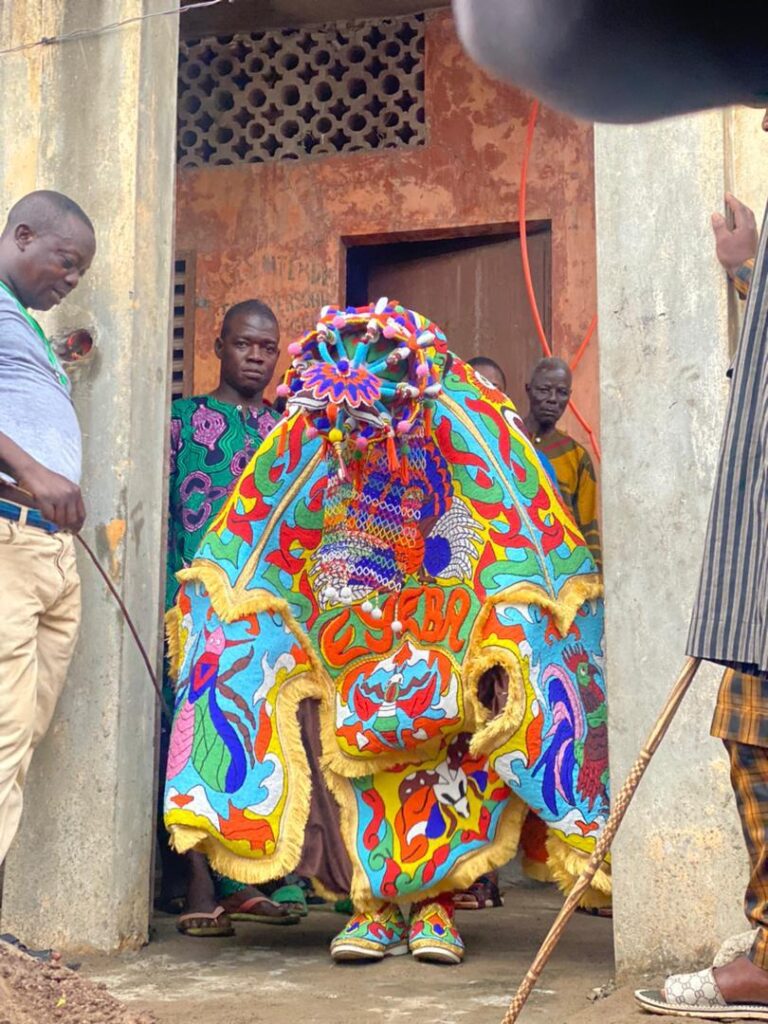
The art historian Henry Drewal, a specialist of Yoruba arts, translates their name as “concealed powers”. The Yoruba conceive of two worlds that answer each other, that of the living and the other world, where the ancestors go on guiding their descendants: “the world is a market, the other world is home,” says a proverb. Cloth is the first material of the Egungun, made of superimposed layers, and the wind it raises as it whirls is received as a breath of blessing[2][3].
Only men wear the costume. Women who can compose and sing form the chorus that sings the praises and stories of the lineage. Among the Yoruba of Oyo, two titles are reserved for them in the procession, Ìyá Àgan and Ìyá Mojè, given to women past menopause who accompany the Egungun and sing its praises[4]. In Benin, the heritage inventory notes likewise that the mask, reserved for men, is assisted by an elderly woman of recognised powers[5]. In the tradition I practise, I prefer to avoid general sentences such as “women are not allowed to”: the rules can depend on the ceremony, the function and the family, and there are different places and responsibilities[1].
From Oyo to the Nago towns of Benin
The cult is of Yoruba origin, and those responsible for it in Benin trace it to Oyo, in Nigeria. It is present in the Nago towns of Benin, and it also spread into the Adja-Tado area, among the Fon and the Gun, through conquests and alliances: there the Egungun became a deified ancestor of the community, honoured under the names kluto or kouvito[5][6]. In Ouidah, an oral tradition reported by those responsible for the cult links the arrival of the Egungun to captives from Nigeria under King Ghezo, who is said to have chosen the town to host their cult; this entry reports it without being able to date it from archives[6].
The outings are town events. In Pobè, in January 2018, the Agence Bénin Presse described the launch of an outing of some fifty Egungun from the sacred forest of Igbo-Agan, for three months of parades and prayers, following the vodun festival[7]. In Sakété, the photographer Michael Landau documented the great outing of 2017 in the art magazine Raw Vision: a festival returning every three years, opened by a ceremony conducted under the Fâ, followed by sixteen days of outings[8].
How an outing unfolds
According to Raw Vision, the Egungun of Sakété walk the streets from early afternoon to dusk, each surrounded by a procession of drums, songs and dances, and parades gather large crowds. The Egungun give blessings, but some chase “guilty” spectators with thin branches, and most are guided by an attendant with a stick, who also restrains violent gestures. The wearers, all men, speak in a strangled, high-pitched voice that hides their identity, and the spectators hold the Egungun to be fully divine[8].
Visitors often misunderstand the chases. When an Egungun chases someone with a branch, a spectator may think it is simply an aggression; I would present the scene differently. Egungun can behave differently according to their function and the context of their outing: some behaviours are sterner, others are associated with blessing, interaction with the people, or protection. But that never gives the public the right to provoke an Egungun. If you see a chase, respect what is happening and leave the space needed. As for the money some people give during an outing, it should not automatically be seen as paying for a show: a gift can accompany a request, a blessing or a participation in the festival[1].
The rules for those who watch
If you attend an outing of Egungun, the first rule is simple: keep your distance[1].
- Do not touch the Egungun.
- Do not try to lift its costume.
- Do not try to discover the person underneath.
- Do not provoke the Egungun to get a spectacular video.
For photographs and videos, use discernment too. A street event is public, but that does not mean every person, place and sequence may be photographed as one wishes[1].
Egungun, Kouvito, Zangbéto and Oro
These traditions must not be mixed up. The Egungun is linked to the ancestors. Kouvito refers, depending on usage and tradition, to the dead or to revenants, and should not automatically be used as a perfect synonym of Egungun. The Zangbéto belongs to another tradition, associated with watching over and protecting the community, particularly at night: see the entry on the Zangbéto. Oro is also distinct, with its own rules, periods and religious frame. These traditions can belong to the same cultural environment and the same regions without being one and the same[1].
The Egungun of Brazil
The cult crossed the Atlantic with Yoruba captives. In Bahia, it settled on the island of Itaparica, where the terreiro Ilê Agboulá, founded at the beginning of the twentieth century, descends in a direct line from houses established in the nineteenth century. In 1976, the anthropologist Juana Elbein dos Santos devoted a classic book to it, Os Nàgô e a morte, which describes the cult of the Égun as the means of making the spirits of the ancestors visible among the living[9][10]. In Brazil, the ancestors invoked are called Babá Egun, “father Egun”, and the cult is held in houses separate from those of the orixás; each 2 November, the day of the dead, the Ilê Agboulá celebrates its great festival[11].
The Egungun in the eyes of others
The Egungun fascinate artists and museums. The Porto-Novo photographer Léonce Raphaël Agbodjélou devoted his series “Egungun Project” to them, exhibited abroad[12]. Henry Drewal dedicated an exhibition to them, “Whirling Return of the Ancestors”, which invites everyone to think about how they honour their own ancestors[2]. For us, the Egungun belongs to a religious and family tradition: the public can see the dance, hear the drums and share the atmosphere of the festival, but behind this visible dimension lies a reality that goes far beyond what happens in the street[1].
What researchers say
The Egungun have been studied on both sides of the Atlantic. The main works, in chronological order:
- 1976Juana Elbein dos Santos publishes Os Nàgô e a morte, the reference study of the cult of the Égun in Bahia[9].
- 1978Henry Drewal edits a special issue of African Arts devoted to the Egungun of the Yoruba[13].
- 2019A study of the Egungun of Oyo describes the titles reserved for women in the procession[4].
- 2022Michael Landau publishes in Raw Vision his photographs of the great outing of Sakété in 2017[8].
What we know, and how we know it
What comes from oral tradition
The origin of the cult in Oyo, and its arrival in Ouidah under King Ghezo, come from traditions reported by those responsible for the cult[6].
What comes from direct observation
The three-year cycle of Sakété, the place of the Fâ and the rules for spectators come from my practice[1].
What is documented
The outings of Pobè and Sakété, the women’s titles at Oyo and the cult in Bahia are established by the press, researchers and institutions[7][8][4][9].
What is interpretation
Seeing the chases as part of the Egungun’s function rather than as aggression is a reading I defend[1].
Common misconceptions about the Egungun
- “An Egungun is just a man in a costume.” It is a manifestation linked to the ancestors, recognised by families[1].
- “The chases are aggressions.” They belong to the function of certain Egungun; never provoke them[1].
- “Egungun, Kouvito, Zangbéto and Oro are the same.” They are distinct traditions[1].
- “Money given during an outing pays for a show.” A gift can accompany a request or a blessing[1].
Frequently asked questions
What are the Egungun?
The ancestors who return among the living, under a costume of cloth that hides the wearer: a Yoruba tradition, alive in the Nago towns of Benin.
Where can you see the Egungun in Benin?
In the Nago towns, from Porto-Novo to Pobè and Sakété, where the great outing returns every three years; the next is expected in 2029.
Can you touch an Egungun?
No: do not touch it, do not try to lift its costume, and do not provoke it.
Why do some Egungun chase spectators?
It belongs to the function of certain Egungun; spectators must respect it and leave the space needed.
Are there Egungun in Brazil?
Yes: on the island of Itaparica, in Bahia, the terreiro Ilê Agboulá keeps the cult of the Babá Egun.
Who wears the Egungun costume?
Only men wear it; women have their own places, notably in the chorus that sings the praises of the lineage.
Glossary
- Babá Egun: “father Egun”, the ancestors invoked in Brazil.
- Kluto, kouvito: Fon words used for the Egungun and the dead.
- Nago: the Yoruba of Benin.
Notes and references
[1] Direct observation and oral transmission, Wêtê Agbonon, bokonon, temple of Sakété.
[2] DREWAL Henry John, Whirling Return of the Ancestors. Egúngún Arts of the Yorùbá in Africa and Beyond, exhibition presentation. See
[3] DREWAL Henry John, « Ancestral Masquerade Performance Among the Yoruba », teaching document accompanying an exhibition. See
[4] « Ará Òrun Kìn-ìn Kin-in: Òyó-Yòrùbá Egúngún Masquerade in Communion and Maintenance of Ontological Balance », Genealogy, 2019. See
[5] Patrimoine Bénin, « Egungun, société de masques, aire culturelle Adja-Tado, Yoruba-Nago ». See (in French)
[6] HOUNKONNOU Ange Yvon, « Les Egunguns, hier, aujourd’hui et demain », Shan Newspaper, 2013. See (in French)
[7] Agence Bénin Presse, « La sortie des Egoun-goun lancée à Pobè », 12 January 2018. See (in French)
[8] LANDAU Michael, « Egungun of Benin », Raw Vision, no. 112, autumn 2022, photographs from 2017. See
[9] ELBEIN DOS SANTOS Juana, Os Nàgô e a morte. Pàde, Àsèsè e o culto Égun na Bahia, Petrópolis, Vozes, 1976.
[10] Geledés, Instituto da Mulher Negra, « Eguguns: um culto sedimentado na crença de que laços ancestrais são eternos », 2017. See (in Portuguese)
[11] Geledés, Instituto da Mulher Negra, « Egungun ». See (in Portuguese)
[12] AnOther Magazine, « Egungun Project by Leonce Raphael Agbodjelou ». See
[13] DREWAL Henry John, « The Arts of Egungun among Yoruba Peoples », African Arts, vol. 11, no. 3, April 1978.
Sources
- DREWAL Henry John, « The Arts of Egungun among Yoruba Peoples », African Arts, 1978.
- ELBEIN DOS SANTOS Juana, Os Nàgô e a morte, 1976.
- LANDAU Michael, « Egungun of Benin », Raw Vision, 2022.
- Direct observation and oral transmission, temple of Sakété, 1994–2026
Cite this entry
Wêtê Agbonon, « The Egungun », dans Vodun Bénin, l’encyclopédie du vodun béninois, entry no. 007, updated on 28 October 2026. Online: https://vodunbenin.org/en/egungun/ (accessed on 1 November 2026). Licence CC BY 4.0.
- Last checked : 7 October 2026
- Reuse : free, with attribution, under the licence CC BY 4.0
- A mistake? Report it · Method and corrections