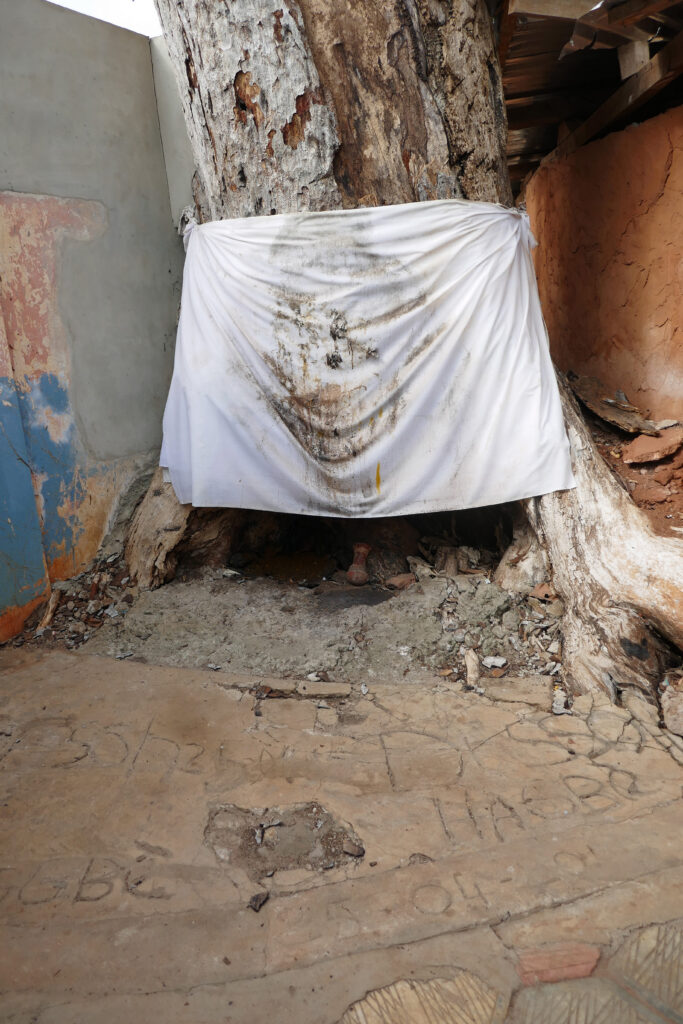
Loko is the vodun of the iroko, the great tree of the forests of tropical Africa: in some traditions of southern Benin, certain great irokos are recognised as Loko, trees endowed with a sacred presence. Only some irokos are places of worship. Before a tree wrapped in cloth, visitors touch nothing and ask before taking photographs.
At the temple of Sakété, a tree and a presence

Direct observationWêtê Agbonon, vodun priest and bokonon of the Fâ, at the temple of Sakété
Loko helps understand something fundamental in vodun: a tree can be both a tree and a place of sacred presence. The iroko is an imposing tree found in many regions of tropical Africa. In some traditions of southern Benin, certain great irokos are regarded as Loko, that is, trees endowed with a sacred dimension, linked to the forest, plants and medicinal knowledge[1].
Key points
- Some great irokos are recognised as Loko, sacred trees.
- Only some irokos are places of worship.
- Before a tree wrapped in cloth: touch nothing, and ask before taking photographs.
In our tradition, nature is often bound up with the sacred[1].
The iroko and its name
The iroko, Milicia excelsa, is one of the great trees of the African tropical forest, able to live for several centuries. The Yoruba call it ìrókò, logo or loko, and credit it with healing virtues[2]. The anthropologist Melville Herskovits already counted Loko among the powers honoured in Abomey in the 1930s[3]. In Ouidah, the iroko of the sacred forest of Kpassè is called Kpassè loko: see The sacred forest of Kpassè[4].
Only some irokos are sacred
One mistake must be avoided: only some irokos are places of worship. A tree is a living being, yet when a particular tree is recognised as sacred by a family, a community or a tradition, its status changes. It may be linked to a story, a spiritual presence, a vodun or an old place. That is why cloths, objects or other marks are seen around some trees, signalling a tree out of the ordinary for the community concerned[1].
Before a tree wrapped in cloth
What should a visitor do? Keep their hands off, leave the cloth in place, leave objects placed nearby where they are, stay off the tree, stage no photograph. Above all, never think that everything they see must be explained publicly. The cloth may be a sign of respect, a mark of consecration, or linked to a particular practice: its exact meaning depends on the place and the tradition. The attitude is always the same: observe with respect, and ask before photographing or touching. See Visiting a vodun temple and The colours of vodun[1].
What we know, and how we know it
What comes from oral tradition
The story of each sacred tree, and what is owed to it, are passed on in the community that recognises it[1].
What comes from direct observation
The rules of conduct before a sacred tree come from my practice[1].
What is documented
The species, its Yoruba names, Loko’s place in Abomey and the iroko of Kpassè are established by the sources cited[2][3][4].
What is interpretation
Seeing Loko as the presence of the sacred in a living being is a reading I defend[1].
What is still debated
The meaning of the cloths and objects around trees varies between families and places[1].
Common misconceptions about Loko
Frequently asked questions
What is Loko?
The vodun of the iroko: some great irokos are recognised as trees endowed with a sacred presence.
Why is the iroko sacred?
Because some great trees are linked, by a community, to a story, a spiritual presence or a vodun.
What does a cloth around a tree mean?
It may mark respect or a consecration; its exact meaning depends on the place and the tradition.
Can you photograph a sacred tree?
Only after asking, without touching it or staging the picture.
Glossary
- Iroko: the great tree Milicia excelsa, loko in Fon.
- Loko: the vodun of the iroko.
Notes and references
[1] Direct observation and oral transmission, Wêtê Agbonon, bokonon, temple of Sakété.
[2] Wikipedia, « Iroko », for the species and its Yoruba names: ìrókò, logo or loko. See
[3] HERSKOVITS Melville J., Dahomey: An Ancient West African Kingdom, New York, J. J. Augustin, 1938, 2 vols.
[4] JUHÉ-BEAULATON Dominique, « Forêt sacrée de Ouidah, Kpassèzoun », photographs and notes. See
Sources
- HERSKOVITS Melville J., Dahomey, 1938.
- JUHÉ-BEAULATON Dominique, « Forêt sacrée de Ouidah, Kpassèzoun ».
- Direct observation and oral transmission, temple of Sakété, 1994–2026
Cite this entry
Wêtê Agbonon, « Loko, the sacred iroko », dans Vodun Bénin, l’encyclopédie du vaudou béninois, entry no. 059, updated on 25 November 2026. Online: https://vodunbenin.org/en/loko/ (accessed on 26 November 2026). Licence CC BY 4.0.
- Last checked : 7 October 2026
- Reuse : free, with attribution, under the licence CC BY 4.0
- A mistake? Report it · Method and corrections