
The vodun festival is Benin’s national festival of traditional religions. Long celebrated on 10 January, it has fallen since 2025 on the second Friday of January, and Ouidah surrounds it with the Vodun Days: in 2027, from 2 to 9 January, with Thursday 7 and Friday 8 January as public holidays.
At the temple of Sakété, the festival from the inside
Direct observationWêtê Agbonon, vodun priest and bokonon of the Fâ, at the temple of Sakété
For a long time, when people spoke of the vodun festival in Benin, they simply spoke of 10 January. Today things have changed: the national holiday has moved, and Ouidah now surrounds it with a much larger event, the Vodun Days. For 2027, the official website announces them from 2 to 9 January in Ouidah[1][2].
But we must be careful not to confuse this great event with what happens in each vodun house. An official festival can have a programme, stages, visitors and journalists. A vodun house has its own life and its own transmission. In Sakété, I do not see this period as a mere show: there is the religious dimension, the family, the people who come to greet the vodun, and the different moments in the life of the house. I can explain this general dimension publicly, but I do not give here the gestures, words, objects or sequences that belong to our transmission[1].
Not every house celebrates in exactly the same way. A ceremony can be understood by those who know the tradition, while an outside visitor will sometimes see only a dance, songs or a procession of vodunsi. What the visitor sees is not necessarily all that is happening. And vodun did not become a tradition because public events began to be organised: it existed long before the Vodun Days.
Key points
- Since 2025, the national festival falls on the second Friday of January, with the Thursday before it; in 2027, on Friday 8 and Thursday 7 January.
- The Vodun Days are the festival organised by the state in Ouidah around the national holiday, from 2 to 9 January in 2027.
- A public ceremony is not an initiation: what is shown is framed, and part of the tradition stays within the houses.
Vodun can be presented to the world without all of its content being exposed[1].
One festival, several names
Its legal name is the “annual festival of traditional religions”. People speak of the vodun festival, or of the festival of endogenous religions. The Vodun Days are something else: the festival organised by the state in Ouidah since January 2024, around the national holiday. The festival is celebrated throughout the country; Ouidah hosts the official ceremonies, on the beach by the Door of No Return, but houses, convents and towns each live it in their own way[3].
From Ouidah 92 to 10 January
The festival was born with the return of democracy. President Nicéphore Soglo, elected in 1991, wanted to celebrate regained religious freedom and to reconnect with the diaspora in the Americas. A first milestone was Ouidah 92, the first international festival of vodun arts and cultures: prepared from 1992, hence its name, it was held in Ouidah in February 1993 and brought together artists and the diaspora[4]. Many websites therefore date the vodun festival to 1992 or 1993; but Ouidah 92 was a festival, and the national holiday came later.
The first official celebration of 10 January took place in 1996, on President Soglo’s initiative. Law no. 97-031 of 20 August 1997 then established an annual festival of traditional religions, set on 10 January[5]. It applied until January 2024.
Since 2025, the second Friday of January
Law no. 2024-32 of 2 September 2024 replaced the 1997 law: the festival of traditional religions now takes place on the second Friday of January, and the Thursday before it is also a paid public holiday. The date therefore changes every year[3].
| Year | Public holidays | Vodun Days in Ouidah |
|---|---|---|
| 2024 | Wednesday 10 January (1997 law) | 9 and 10 January, 1st edition |
| 2025 | Thursday 9 and Friday 10 January | 9 to 11 January, 2nd edition |
| 2026 | Thursday 8 and Friday 9 January | 8 to 10 January, 3rd edition |
| 2027 | Thursday 7 and Friday 8 January | 2 to 9 January, 4th edition |
| 2028 | Thursday 13 and Friday 14 January, under the law | Not yet announced |
In 2027 the Vodun Days last eight days, but only Thursday 7 and Friday 8 January are public holidays: from Monday 4 to Wednesday 6 January, people work as usual[2].
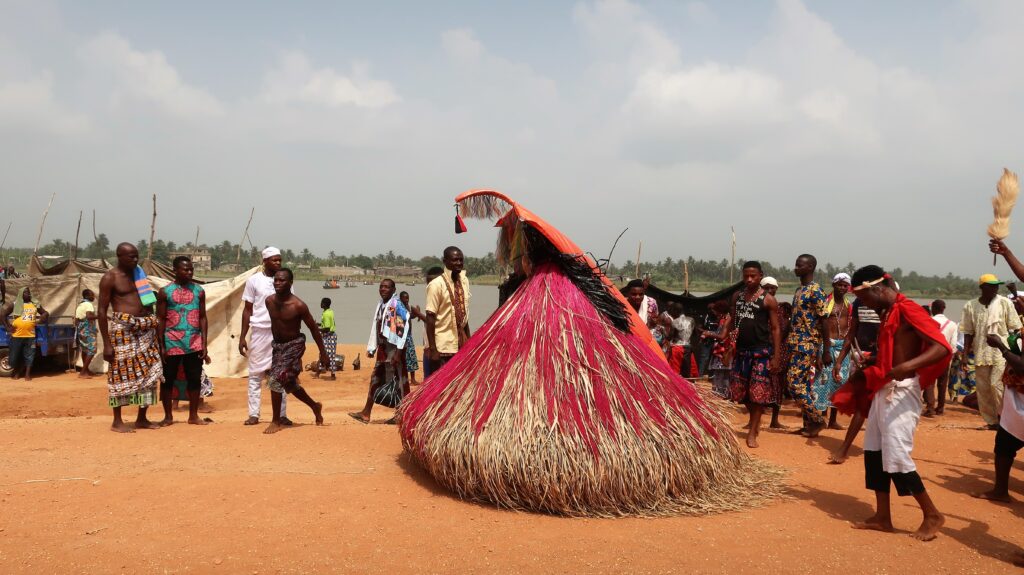
The Vodun Days in Ouidah
The Vodun Days bring together performances in the squares and processions from the convents in the historic town, a craft and food village, and a great ceremony in the presence of dignitaries. Attendance has grown sharply since 2024: more than 740,000 participants in 2026, according to the figures published by the government[6]. What may be shown is framed: a committee of vodun rites, created by presidential decree in September 2023, helps formalise the rites, ceremonies and practices that are presented[7].
I see three dimensions at once: religious, national and cultural. It is a religious festival, because vodun ceremonies and practices genuinely have their place there. It is a national event, because Benin has made it part of its policy of promoting endogenous religions and heritage. And it has also become an event open to visitors, with shows, concerts and an organisation designed to welcome a large audience, including from abroad. I see no contradiction between these dimensions, as long as vodun is not reduced to a show[1].
The Bénin Tofa, the Fâ consulted for the country
During the great ceremony, a college of bokonon consults the Fâ for the country: this is the Bénin Tofa. On Friday 9 January 2026, the sign revealed was Losso Sa; on Saturday 17 January, the rituals prescribed by this consultation were carried out in the sacred forest of Kpassè, in Ouidah[8].
For a bokonon, the Bénin Tofa is something other than a cultural attraction. It is a consultation of the Fâ carried out for the country, to bring out the main orientations of the year and what must be taken into account. It differs from an individual consultation, where a person asks about their own life: the bokonon involved speak for the national community, and their indications can lead to ritual prescriptions. I will not describe here how such a consultation is technically carried out. On the role of the bokonon, see Le bokonon (in French)[1].
Coming in January 2027
I am glad that people come to discover vodun. But I ask them one thing: come with respect and curiosity, not with the idea of attending an exotic show. A visitor may watch a dance or a procession, and photograph some scenes when they are open to the public. That does not mean that everything may be photographed: initiation spaces, some convents, some rites and some sequences are not meant for the public. And above all, never press anyone to explain something they consider reserved[1].
To journalists, I would say: do not look only for the spectacular image. Ask what the ceremony means, who is responsible for it, whether it is a public or an initiatory practice, and what place it holds in the life of the community. And ask before photographing or filming when you enter a religious space. A journalist can do their job without showing everything; I see it as a sign of respect for the subject[1].
What we know, and how we know it
What comes from oral tradition
How each house lives this period, what it celebrates and what it keeps to itself belong to the transmission of each family and convent[1].
What comes from direct observation
Life at the temple of Sakété during the festival, the difference between what a visitor sees and what really happens, and the place of the Bénin Tofa for a bokonon come from my practice[1].
What is documented
The two laws, the public holidays, the dates and attendance of the Vodun Days, and the 2026 Bénin Tofa are established by official texts and government communiqués[5][3][6][8].
What is interpretation
Seeing the Vodun Days as a religious festival, a national event and a cultural festival at once is a reading; others see them mainly as a tourism project[1].
What is still debated
The festival’s year of birth varies between websites, from 1992 to 1996, because the Ouidah 92 festival is confused with the first official celebration[4].
Common misconceptions about the vodun festival
- “The vodun festival is held every 10 January.” Since 2025, the law sets it on the second Friday of January: in 2027, Friday 8[3].
- “It was created in 1992.” 1992 is the name of the Ouidah 92 festival, held in 1993; the 10 January festival dates from 1996, and the law from 1997[4][5].
- “The Vodun Days replaced the national holiday.” The legal festival still exists; the Vodun Days are the festival organised around it in Ouidah[3].
- “Every day of the Vodun Days 2027 is a holiday.” Only Thursday 7 and Friday 8 January are[2].
- “In Ouidah you see all of vodun.” A public ceremony is not an initiation, and what is shown is framed[1].
Frequently asked questions
When is the Benin voodoo festival in 2027?
The national festival of traditional religions falls on Friday 8 January 2027, and Thursday 7 January is also a holiday. The Vodun Days take place in Ouidah from 2 to 9 January 2027.
Why is the vodun festival no longer on 10 January?
Law no. 2024-32 of 2 September 2024 set the festival on the second Friday of January, with the preceding Thursday also a paid holiday. It replaced the 1997 law, which set it on 10 January.
What are the Vodun Days?
The festival organised by the state in Ouidah since January 2024 around the national holiday: convent processions, performances in the squares, a craft village and a great ceremony.
Since when has Benin celebrated vodun?
The first official celebration dates from 10 January 1996, on President Nicéphore Soglo’s initiative; the law of 20 August 1997 made it an annual festival.
What is the Bénin Tofa?
A consultation of the Fâ carried out by a college of bokonon for the whole country during the festival; in 2026, the sign revealed was Losso Sa.
Can I photograph the ceremonies?
Public scenes can sometimes be photographed, but always ask first: initiation spaces, some convents and some rites are not meant for the public.
Glossary
- Bénin Tofa: the consultation of the Fâ carried out for the country during the festival.
- Bokonon: the priest of the Fâ.
- Vodun Days: the festival organised by the state in Ouidah around the national holiday.
- Vodunsi: an initiate devoted to a vodun.
Notes and references
[1] Direct observation and oral transmission, Wêtê Agbonon, bokonon, temple of Sakété.
[2] Vodun Days, official website, 2027 edition. See
[3] Republic of Benin, Law no. 2024-32 of 2 September 2024 on the festival of traditional religions, set on the second Friday of January, with the preceding Thursday.
[4] RUSH Dana, « Contemporary Vodun Arts of Ouidah, Benin », African Arts, vol. 34, no. 4, 2001, DOI 10.2307/3337805.
[5] Republic of Benin, Law no. 97-031 of 20 August 1997 establishing an annual festival of traditional religions on 10 January.
[6] Daabaaru, « Vodun Days 2026 à Ouidah : une édition historique avec plus de 740 000 participants », 25 January 2026, citing the government. See
[7] U.S. Department of State, 2023 Report on International Religious Freedom: Benin. See
[8] Government of Benin, official communiqués on the Vodun Days 2025 and 2026 and the Bénin Tofa.
Sources
- Republic of Benin, Law no. 2024-32 of 2 September 2024.
- Vodun Days, official website, 2027 edition.
- RUSH Dana, « Contemporary Vodun Arts of Ouidah, Benin », African Arts, 2001.
- Direct observation and oral transmission, temple of Sakété, 1994–2026
Cite this entry
Wêtê Agbonon, « The Benin voodoo festival », dans Vodun Bénin, l’encyclopédie du vodun béninois, entry no. 006, updated on 28 October 2026. Online: https://vodunbenin.org/en/benin-voodoo-festival/ (accessed on 1 November 2026). Licence CC BY 4.0.
- Last checked : 7 October 2026
- Reuse : free, with attribution, under the licence CC BY 4.0
- A mistake? Report it · Method and corrections