
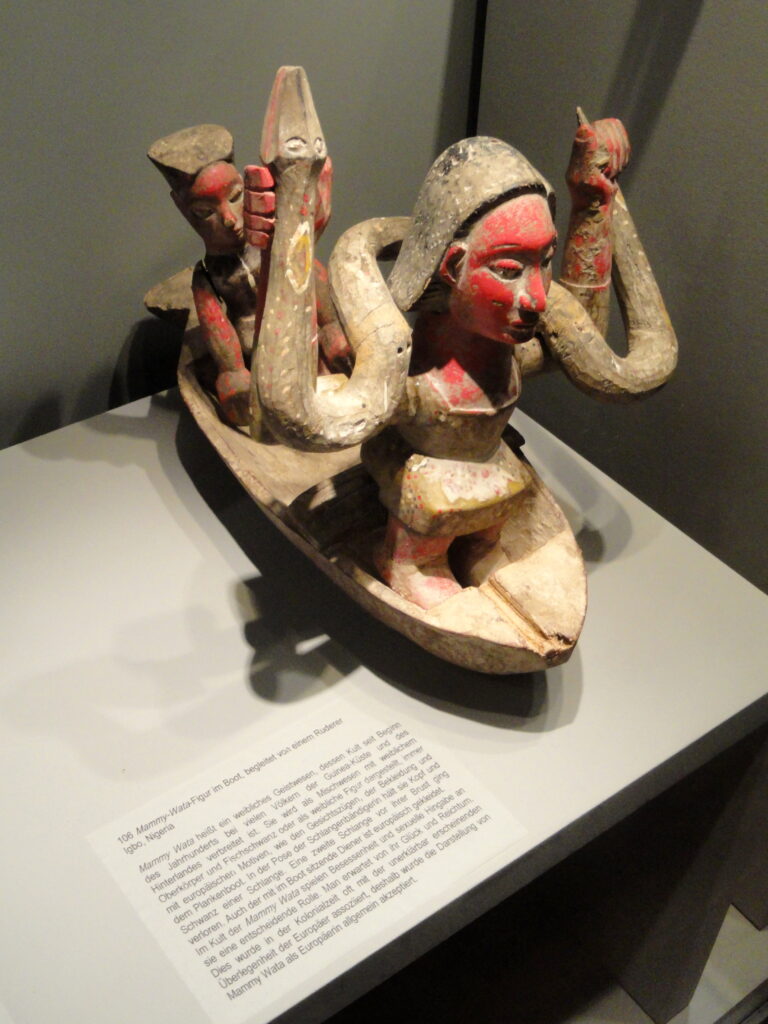
Mami Wata is a religious figure of the waters, honoured along the coasts of West and Central Africa and in the diasporas, often depicted as a woman of great beauty, sometimes as a mermaid, with a snake wrapped around her body. Her name comes from the English “Mammy Water”, the mother of the waters, and her image took shape at the end of the nineteenth century, on top of much older water traditions.
At the temple of Sakété, what I say about Mami Wata

Direct observationWêtê Agbonon, vodun priest and bokonon of the Fâ, at the temple of Sakété
Mami Wata is a subject about which many false things circulate. She is sometimes presented as if she were an exclusively Beninese divinity, very ancient and identical everywhere. I would not present her that way. Mami Wata is a religious figure linked to the waters, which spread widely along the African coasts and in the diasporas[1].
The water traditions of Benin are much older, and one must distinguish the ancient African traditions linked to the waters from the particular historical form under which the cult of Mami Wata developed and spread. That is why I would not say: “Mami Wata is a Beninese vodun thousands of years old.” That statement is too simple.
Key points
- Mami Wata is one figure of the waters among other water powers, each with its own tradition.
- Her image comes from a print made in Hamburg in the 1880s, later enriched by images from India.
- She is ambivalent: prosperity and beauty, but also danger, demand and secrecy.
Reducing her to a promise of wealth betrays the tradition[1].
An English name, African waters
“Mami Wata” comes from the pidgin of the African coasts, formed on the English “Mammy Water”. The name already tells her story: that of a coast where Africans, sailors and European merchants met. The art historian Henry Drewal, who devoted a major exhibition to her in 2008, describes her as a water figure honoured in many countries of Africa and in the diasporas of the Americas[2]. For Drewal, Mami Wata embodies the encounter with the “other” who came from the sea: her followers worship her by appropriating the objects, images and manners of foreigners, which they turn into sacred matter. This explains why she could take such different forms from place to place[3].
The image of a snake charmer
Her most widespread image has a precise origin. In the 1880s, the Adolph Friedlander printing house in Hamburg produced a chromolithograph of a snake charmer, a circus performer. The print circulated along the African coasts and became, in Africa as in the diaspora, the common image of Mami Wata: a woman of great beauty, a comb or a mirror in her hand, a snake around her body[4]. The mermaid became one of her best-known images, sometimes with a fish or snake tail; but this image is not enough to define her, and calling her “the African mermaid” reduces her[1].
The gods from India
From the 1950s, another wave of images arrived: chromolithographs of Hindu divinities, printed in India, England or Nigeria, spread through West Africa. They were absorbed into vodun art and served as models for temple murals[5]. Drewal recorded the account of a Yoruba follower of Mami Wata, a seller of these images, who said that people owned the prints during the colonial period without knowing their meaning, until they became spirits of Mami Wata[2]. The art historian Dana Rush, whose research centres on Ouidah, describes a Beninese coast where Hindu divinities and vodun coexist, and where Indian prints find their place in shrines[6]. The Ghanaian painter Joseph Kossivi Ahiator covered the walls of temples in Benin, Togo and Ghana with these images, mixing the spirits of Mami Wata with the rainbow serpent[7].
White and water
White is often associated with Mami Wata in certain images and cults. But I do not want to turn a colour into a universal rule: white can have different religious meanings in the traditions of Benin, such as purity, water, freshness, peace, light. Seeing someone dressed in white is not enough to say: “That is Mami Wata.”[1]
The link with water is far more fundamental: Mami Wata is a figure of the waters. But not every water divinity is Mami Wata. In Benin there are other traditions linked to the waters and to aquatic beings, and one must avoid lumping together Mami Wata, Dan, Tohossou and all the other powers associated with water. The traditions are not interchangeable. On the serpent vodun, see Dan (in French)[1].
Mami Wata and wealth
This is probably the greatest misunderstanding. People say: “Mami Wata automatically gives money.” She does not. The link between Mami Wata, beauty, luxury, seduction, success and material power does exist in many stories and images, and some traditions associate the encounter with Mami Wata with prosperity. But that does not mean: “Serve Mami Wata and you will become rich.” That would turn a complex religious tradition into an advertisement for money[1].
In the stories, Mami Wata is an ambivalent power: she can be associated with beauty, prosperity and abundance, but also with danger, desire, demand, secrecy, and the consequences of a misunderstood relationship. That is why I never advise reducing a vodun to what it can “give”.
What researchers say
Mami Wata has mainly been studied by art historians, attentive to the circulation of her images. The main works, in chronological order:
What we know, and how we know it
What comes from oral tradition
The stories of encounters with Mami Wata, and what they bring or cost, are passed on orally along the coast[1].
What comes from direct observation
The distinction between Mami Wata and the other water powers, and the warning against promises of wealth, come from my practice[1].
What is documented
The Hamburg print of the 1880s, the Indian images from the 1950s and their place in temples are established by art historians[4][5][2][6].
What is interpretation
Seeing Mami Wata as the embodiment of the encounter with the stranger from the sea is Henry Drewal’s reading[3].
What is still debated
The age of the water traditions on which Mami Wata grew, and their names, vary between regions and sources[2].
Common misconceptions about Mami Wata
- “Mami Wata is a Beninese vodun thousands of years old.” Her image took shape at the end of the nineteenth century, on older water traditions[4].
- “Mami Wata is the African mermaid.” The mermaid is one of her images, not her definition[1].
- “Indian images have nothing to do with vodun.” Since the 1950s they have been absorbed into shrines and temple paintings[5].
- “Every water divinity is Mami Wata.” Dan, Tohossou and the other water powers have their own traditions[1].
- “Mami Wata makes you rich.” She is ambivalent, and reducing a vodun to what it can give is a mistake[1].
Frequently asked questions
Who is Mami Wata?
A religious figure of the waters, honoured along the coasts of West and Central Africa and in the diasporas, often depicted as a beautiful woman with a snake around her body.
Where does the name Mami Wata come from?
From the pidgin of the African coasts, based on the English “Mammy Water”, the mother of the waters.
Why is Mami Wata shown with a snake?
Her best-known image comes from an 1880s Hamburg print of a snake charmer, which circulated along the African coasts.
Is Mami Wata a mermaid?
The mermaid is one of her images, but it is not enough to define her.
Does Mami Wata bring wealth?
She is associated with prosperity in many stories, but she is ambivalent; serving her is no promise of riches.
Is Mami Wata the same as Dan or Tohossou?
No: they are distinct water powers, each with its own tradition.
Glossary
- Chromolithograph: a colour print, the medium through which Mami Wata’s image spread.
- Mammy Water: the English expression behind the name Mami Wata.
- Pidgin: the contact language of the African coasts.
Notes and references
[1] Direct observation and oral transmission, Wêtê Agbonon, bokonon, temple of Sakété.
[2] DREWAL Henry John (ed.), Mami Wata: Arts for Water Spirits in Africa and Its Diasporas, Los Angeles, Fowler Museum at UCLA, 2008.
[3] DREWAL Henry John, « Performing the Other: Mami Wata Worship in Africa », TDR: The Drama Review, vol. 32, no. 2, 1988.
[4] Wikipedia, « Mami Wata », for the chromolithograph printed by Adolph Friedlander in Hamburg and its snake-charmer model. See
[5] Wikipedia, « Vodun art », for the spread of Indian chromolithographs in West Africa since the 1950s. See
[6] RUSH Dana, Vodun in Coastal Bénin: Unfinished, Open-ended, Global, Nashville, Vanderbilt University Press, 2013.
[7] Wikipedia, « Joseph Kossivi Ahiator », painter of vodun temples in Benin, Togo and Ghana, after the work of Dana Rush. See
Sources
- DREWAL Henry John (ed.), Mami Wata: Arts for Water Spirits in Africa and Its Diasporas, Fowler Museum, 2008.
- RUSH Dana, Vodun in Coastal Bénin, 2013.
- Direct observation and oral transmission, temple of Sakété, 1994–2026
Cite this entry
Wêtê Agbonon, « Mami Wata », dans Vodun Bénin, l’encyclopédie du vodun béninois, entry no. 013, updated on 28 October 2026. Online: https://vodunbenin.org/en/mami-wata/ (accessed on 1 November 2026). Licence CC BY 4.0.
- Last checked : 7 October 2026
- Reuse : free, with attribution, under the licence CC BY 4.0
- A mistake? Report it · Method and corrections