
The Temple of Pythons is the shrine of Dangbé, the vodun associated with the royal python in the tradition of Ouidah, in Benin. Standing in the heart of the town, opposite the Basilica of the Immaculate Conception, it is both a living place of worship, kept by the families in charge of it, and one of the most visited sites in Benin.
At the temple of Sakété, my view of the Temple of Pythons

Direct observationWêtê Agbonon, vodun priest and bokonon of the Fâ, at the temple of Sakété
When we speak of the Temple of Pythons in Ouidah, we must first understand one thing: it is a living place of worship, well before being a tourist site. Tourism grew around the temple, visitors became far more numerous, and pictures of the python draped on tourists’ shoulders have gone around the world. But behind this image there is an ancient tradition linked to Dangbé and to the families in charge of it[1].
I know the Temple of Pythons and the place of Dangbé in the religious history of Ouidah. But I make an important distinction: I am not the person responsible for the Temple of Pythons. My own transmission comes from my tradition and my path as a vodun priest and bokonon. So I can speak of Dangbé with the respect this divinity deserves, without claiming a role that belongs to the families and those responsible for this temple.
Key points
- The Temple of Pythons is a living shrine before being a tourist site.
- Dangbé is the vodun associated with the python in the tradition of Ouidah; not every snake is Dangbé.
- Visiting a vodun temple means being curious without intruding, looking without touching everything, photographing without profaning.
And accepting that a tradition may keep part of its mystery[1].
The shrine of Dangbé
The people of Ouidah established, venerated and handed down Dangbé as the town’s main divinity. According to the Beninese government’s official presentation of Ouidah, three great families venerate him in the Temple of Pythons today: the Agbo Atakpaloko, the Zossoungbo and the Adjovi. They can be recognised by the scarification on their faces, two series of five marks, the same as the python’s. Besides Dangbé, they also serve other vodun, such as Gou and Hèviosso. Locally, people speak of Xweda Dangbé, the benevolent python[2].
I would avoid a sentence like “the people of Ouidah worship snakes”. We are speaking of a particular religious relationship with Dangbé. Dangbé cannot be reduced to the animal the visitor sees, and not every snake is Dangbé: in the region there are different traditions linked to snakes, to Dan, to Dangbé and to other powers. On the vodun Dan, see Dan (in French)[1].
Three centuries of accounts
European travellers’ accounts attest a snake cult in the Ouidah region from the end of the seventeenth century. In the Voyage du chevalier Des Marchais, published in 1730, Father Labat describes the processions to the “house of the great Serpent”, which he presents as the country’s main divinity[3]. According to historians, the cult was first centred in Savi, the Hueda capital, before being established in Ouidah after the kingdom was conquered by Dahomey in 1727[4].
The temple guides tell another story, that of a king saved by pythons: “for having protected the king’s life and the ancestors’ field”, the python is said to have become a divinity in Ouidah. The versions of this story, the king’s name and the dates vary from one storyteller to another: it is an oral tradition, which this entry reports without dating it. In the nineteenth century, Father Laffitte still described the temple in 1873; the present temple has been rebuilt and modernised since 1992[5].
Facing the basilica
The temple and the Basilica of the Immaculate Conception, built in 1909, are separated only by a road barely ten metres wide. The Beninese government presents this face-to-face as a testimony of religious coexistence in Ouidah[2]. Above the basilica’s door, the Fon inscription “E ni kpa Mawu, e ni kpa Maria” uses the name Mawu for the Christian God. The temple’s manager, Modeste Zinsou, and a Catholic priest, Father Fulbert Amoussou, spoke of it in the same way in the daily La Nation in January 2025[6].
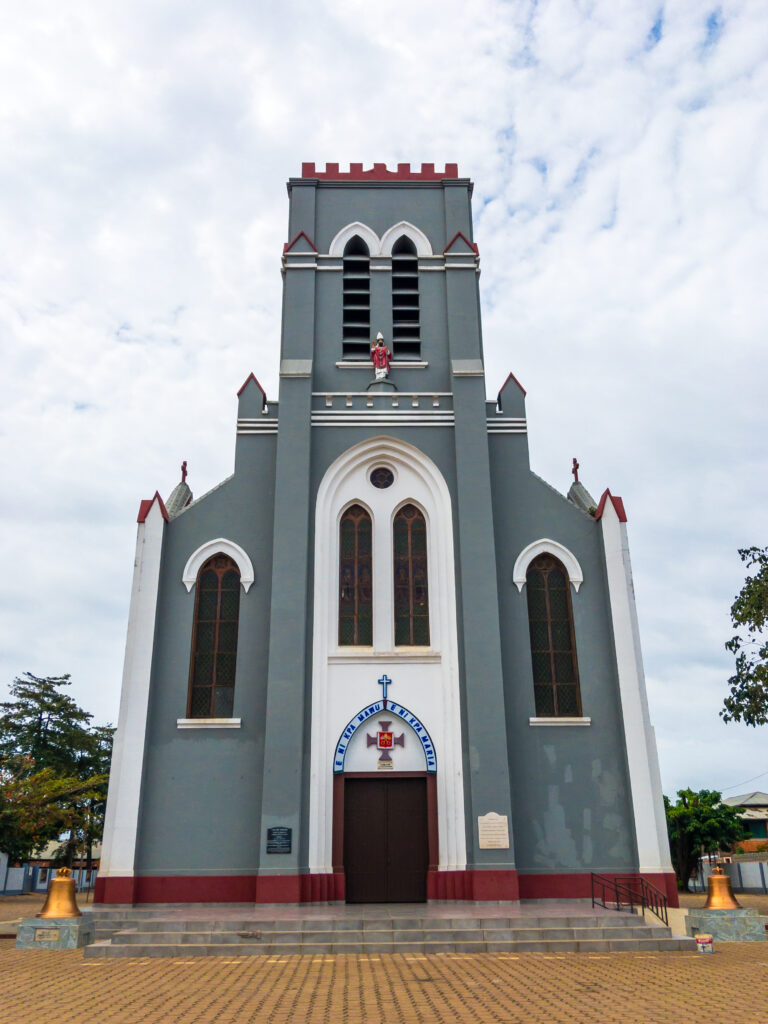
For me, this is one of the strongest images of Ouidah: two religious traditions facing each other in the same town. I do not necessarily see a provocation in it; I see part of Ouidah’s history. Beninese can know vodun and be Christian; a family can have several religious histories. I do not ask anyone to become a vodunsi to respect the Temple of Pythons; I simply ask them to understand that this place belongs to a religious tradition that deserves the same respect as other sacred places[1].
The python on the visitor’s shoulders
This is probably the best-known image of the temple. I have nothing against a visitor having this experience when it is offered within the temple, with the agreement of those responsible. But I ask visitors not to turn it into a circus act. The python is a living animal and, in this place, it also has a religious meaning. It must be handled calmly, without sudden movements, without squeezing or provoking it. A keeper placing a python on a visitor’s shoulders does not make Dangbé a photo prop[1].
A python in the house
When a python enters a house in Ouidah, one must not panic, and above all not kill it out of fear. First try to get it out without harming it and, if necessary, call people able to handle the animal. In a house attached to the tradition of Dangbé, the presence of a python may also have a particular meaning. And if someone kills a python by accident, I will not give on the Internet a recipe claiming to be valid for every family in Ouidah: do not hide what happened, do not invent a ritual yourself, but inform the competent people and ask what must be done. An accident and a deliberate act call for different answers[1].
Visiting the temple
Since the first Vodun Days in 2024, the square of the Temple of Pythons has been one of the venues of the celebrations; see the Benin voodoo festival. My advice is simple: come to understand, not only to photograph[1].
- Respect those responsible and the keepers.
- Listen to the instructions given on site.
- Do not touch objects or spaces that are not open to the public.
- Never force a photograph.
- Do not mistreat the pythons to get a good picture.
- Do not treat a rite as a show you are automatically entitled to.
- If something is forbidden to you, simply accept that limit.
What researchers say
The cult of Dangbé and its temple were described by travellers, then studied by historians. The main milestones, in chronological order:
- 1730Father Labat describes the processions to the “house of the great Serpent” in Ouidah[3].
- 1873Father Laffitte describes the temple in his memories of Dahomey[5].
- 1974Christian Merlo and Pierre Vidaud devote a thesis to Dangbé and the Hueda settlement[7].
- 2004Robin Law traces the social history of Ouidah and the transfer of the cult from Savi[4].
What we know, and how we know it
What comes from oral tradition
The story of the king saved by pythons, its dates and the king’s name come from oral tradition, passed on notably by the guides and the temple families[1].
What comes from direct observation
The view of the temple as a living shrine, the visiting advice and what to do when facing a python come from my practice[1].
What is documented
The families in charge of the cult, the temple facing the basilica, the travellers’ accounts and the transfer of the cult after 1727 are established by official sources, the press and historians[2][6][3][4].
What is interpretation
Seeing the temple facing the basilica as part of Ouidah’s history rather than a provocation is a reading I defend[1].
What is still debated
The temple’s founding date, the identity of the king saved by pythons and the number of pythons living there vary between sources[4].
Common misconceptions about the Temple of Pythons
- “It is a place to take a photo with a snake.” It is a living shrine, kept by the families in charge of the cult[2].
- “Dangbé is simply a python.” The python is linked to the manifestation of Dangbé, but Dangbé is not reduced to the animal the visitor sees[1].
- “The people of Ouidah worship snakes.” It is a particular religious relationship with Dangbé, and not every snake is Dangbé[1].
- “The temple dates from 1717.” This date comes from guides’ accounts; historians place the cult’s establishment in Ouidah after 1727[4].
Frequently asked questions
What is the Temple of Pythons in Ouidah?
The shrine of Dangbé, the vodun associated with the royal python in the tradition of Ouidah: a living place of worship that has become one of the most visited sites in Benin.
Who looks after the Temple of Pythons?
According to the Beninese government, three great families of Ouidah venerate Dangbé in the temple: the Agbo Atakpaloko, the Zossoungbo and the Adjovi.
Why does the temple face a basilica?
The temple and the Basilica of the Immaculate Conception, built in 1909, are separated only by a street; this face-to-face is presented as a sign of religious coexistence in Ouidah.
Can you touch the pythons?
The keeper may place a python on a visitor’s shoulders, with the agreement of those responsible. Handle it calmly, without squeezing or provoking it.
Are the temple’s pythons dangerous?
They are royal pythons, which are not venomous. The rules of calm and respect protect their well-being as much as the visitor’s safety.
What should you do if a python enters a house in Ouidah?
Do not panic and do not kill it. Try to get it out without harming it, if necessary with the help of competent people.
Glossary
- Dangbé: the vodun associated with the royal python in Ouidah.
- Hueda: the people and kingdom of the Ouidah region, conquered by Dahomey in 1727.
- Xweda Dangbé: the benevolent python, as it is called locally.
Notes and references
[1] Direct observation and oral transmission, Wêtê Agbonon, bokonon, temple of Sakété.
[2] Government of Benin, « Destination Bénin : Ouidah, la terre hxuéda, ville à vocation historique, culturelle, cultuelle et touristique », 2020. See
[3] LABAT Jean-Baptiste, Voyage du chevalier Des Marchais en Guinée, isles voisines et à Cayenne, Paris, 1730.
[4] LAW Robin, Ouidah: The Social History of a West African Slaving Port, 1727-1892, Athens (Ohio), Ohio University Press, 2004.
[5] LAFFITTE Jean, Le Dahomé : souvenirs de voyage et de mission, Tours, Mame, 1873.
[6] TOKPONOU Joël C., « Basilique et Temple des pythons à Ouidah : un symbole de cohabitation interreligieuse », La Nation, 21 January 2025. See
[7] MERLO Christian and VIDAUD Pierre, Dangbé et le peuplement houéda, thesis, 1974.
Sources
- Government of Benin, « Destination Bénin : Ouidah, la terre hxuéda », 2020.
- LABAT Jean-Baptiste, Voyage du chevalier Des Marchais, 1730.
- LAW Robin, Ouidah: The Social History of a West African Slaving Port, 2004.
- Direct observation and oral transmission, temple of Sakété, 1994–2026
Cite this entry
Wêtê Agbonon, « The Temple of Pythons », dans Vodun Bénin, l’encyclopédie du vodun béninois, entry no. 011, updated on 28 October 2026. Online: https://vodunbenin.org/en/temple-of-pythons-ouidah/ (accessed on 1 November 2026). Licence CC BY 4.0.
- Last checked : 7 October 2026
- Reuse : free, with attribution, under the licence CC BY 4.0
- A mistake? Report it · Method and corrections