Nana Buluku is a primordial figure of the Fon traditions and of West Africa, often presented as the primordial creative power, said to have given birth to Mawu and Lisa. Her place varies between traditions, and she remains little known to the general public. She is found in the Americas, as Nanã, in the Afro-Brazilian religions.
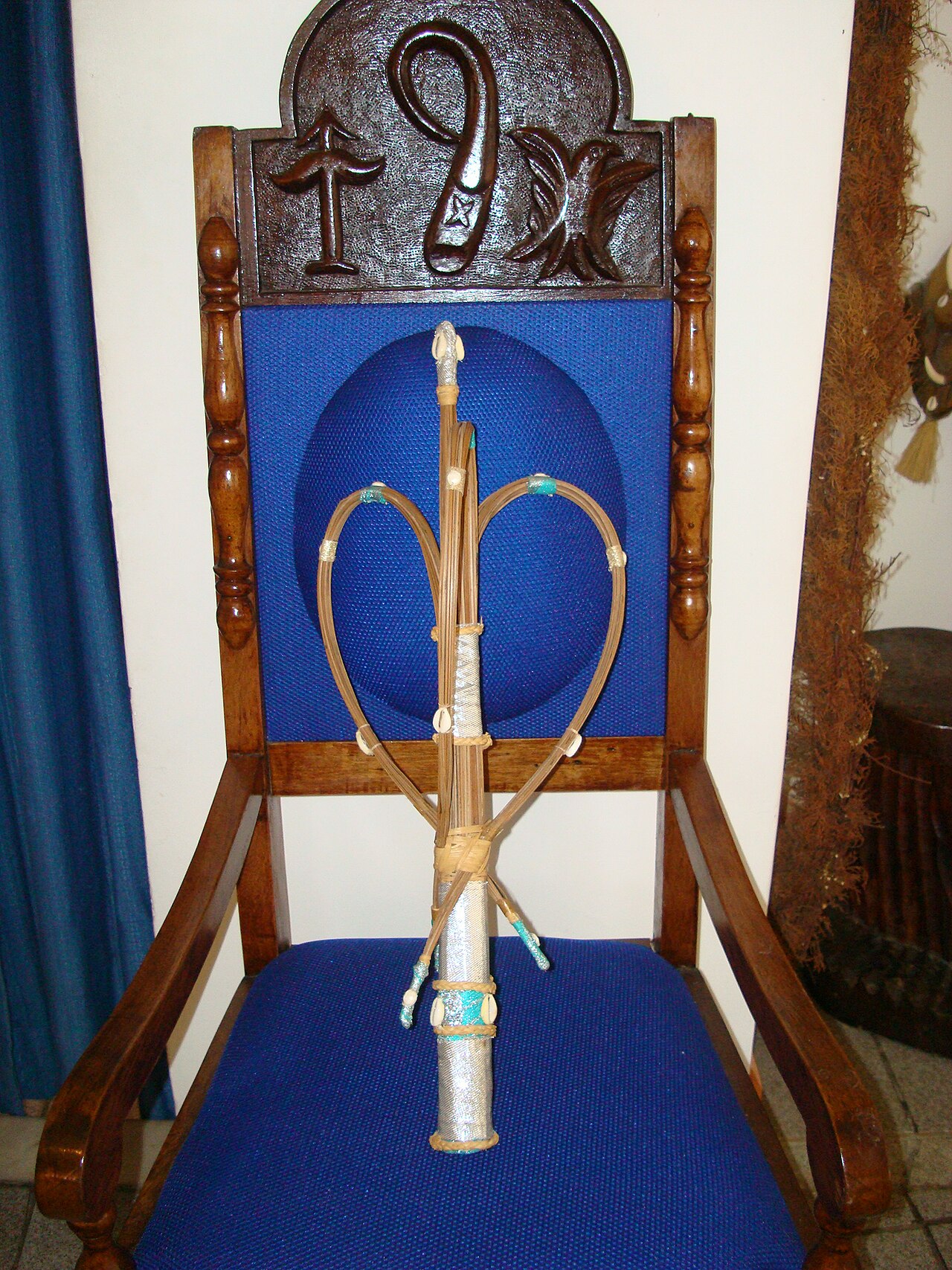
At the temple of Sakété, what I can say of Nana Buluku

Direct observationWêtê Agbonon, vodun priest and bokonon of the Fâ, at the temple of Sakété
Nana Buluku is an ancient and important figure of certain religious traditions of the Fon area, and more widely of West Africa. Yet I must immediately add a precision: her place varies between traditions, with different ideas of her role, her age and her relationship with the other divine powers. In some traditions, Nana Buluku is presented as a primordial creative power, associated with the origin of the world and the generation of Mawu and Lisa. In other traditions or presentations, the relationships between Nana Buluku, Mawu, Lisa or Mawu-Lisa are put differently. I prefer to respect this diversity, without inventing a single genealogy valid for all of Benin[1].
Key points
- Nana Buluku is a primordial figure, often presented as the mother of Mawu and Lisa.
- Her place varies between traditions: no single genealogy holds for all of Benin.
- She belongs to a very ancient layer of the religious ideas of the region.
A divinity can be important without being everywhere in the images made for tourists[1].
The mother of Mawu and Lisa
The anthropologist Melville Herskovits, who worked in Abomey in 1931, collected the tradition according to which Nana Buluku, the first creator, gave birth to the twins Mawu and Lisa, the feminine principle associated with the moon and the masculine principle associated with the sun, to whom she entrusted the ordering of the world[2]. Mawu and Lisa are then understood as two aspects, or two complementary powers, of the order of the world: see Mawu-Lisa.
I would never present this genealogy as a single doctrine of every vodun temple. African religious traditions were passed on orally for generations, and the stories vary between regions, families and lineages. What is certain for me is that Nana Buluku belongs to a very ancient layer of the religious ideas of this region, and must never be reduced to a mythological character added recently[1]. The history of the royal cult also helps: according to the historian Edna Bay, it was in the eighteenth century that the queen mother Hwanjile placed Mawu-Lisa at the top of the cults of the kingdom of Dahomey[3].
Nanã, across the Atlantic
With the slave trade, Nana Buluku crossed the ocean. In the Afro-Brazilian religions such as candomblé she became Nanã, or Nanã Buruku, a very ancient divinity, often associated with still waters and wet earth; she is also found in Cuba[4]. See Vodun in the Americas.
Why is she so little known?
Because the foreign public mostly knows a few figures who have become emblematic of vodun: Legba, Dan, Sakpata, Hèviosso, Mami Wata. Yet a religious tradition is never summed up by its highly publicised names. Nana Buluku is also less visible because her image lends itself poorly to the tourist object: she belongs to deep cosmological ideas, and some traditions concerning her are known more through transmission than through public spectacle. That is also why I refuse to invent a spectacular ceremony around her just to make the page more attractive. An encyclopedia must sometimes accept that a divinity can be important without being everywhere in the pictures[1].
What we know, and how we know it
What comes from oral tradition
Nana Buluku’s place in creation, and her relationship with Mawu and Lisa, are passed on orally, in versions that vary[1][2].
What comes from direct observation
The caution towards any single genealogy, and the antiquity of her figure, come from my practice[1].
What is documented
The tradition of Nana Buluku as mother of Mawu and Lisa, collected in Abomey, and her presence in Brazil and Cuba are established by researchers[2][4].
What is interpretation
Seeing Nana Buluku as a very ancient layer of the region’s religious ideas is a reading I defend[1].
What is still debated
Her exact place, before or beside Mawu-Lisa, varies between traditions and authors[2].
Common misconceptions about Nana Buluku
Frequently asked questions
Who is Nana Buluku?
A primordial figure of the Fon traditions, often presented as the primordial creative power, mother of Mawu and Lisa.
What is the link between Nana Buluku and Mawu-Lisa?
According to a tradition collected in Abomey, she gave birth to Mawu and Lisa and entrusted them with the ordering of the world; the stories vary.
Who is Nanã in Brazil?
Nanã, or Nanã Buruku, a very ancient divinity of candomblé, heir to Nana Buluku.
Why is Nana Buluku little known?
Because she belongs to deep cosmological ideas, passed on more than shown, and lends herself poorly to tourist images.
Glossary
- Candomblé: an Afro-Brazilian religion.
- Nanã: Nana Buluku’s name in Brazil.
Notes and references
[1] Direct observation and oral transmission, Wêtê Agbonon, bokonon, temple of Sakété.
[2] HERSKOVITS Melville J., Dahomey: An Ancient West African Kingdom, New York, J. J. Augustin, 1938, 2 vols.
[3] BAY Edna G., Wives of the Leopard: Gender, Politics, and Culture in the Kingdom of Dahomey, Charlottesville, University of Virginia Press, 1998.
[4] Wikipedia, « Nana Buluku », for her place in Fon traditions and her presence in Afro-Brazilian and Cuban religions. See
Sources
- HERSKOVITS Melville J., Dahomey, 1938.
- BAY Edna G., Wives of the Leopard, 1998.
- Direct observation and oral transmission, temple of Sakété, 1994–2026
Cite this entry
Wêtê Agbonon, « Nana Buluku », dans Vodun Bénin, l’encyclopédie du vaudou béninois, entry no. 039, updated on 25 November 2026. Online: https://vodunbenin.org/en/nana-buluku/ (accessed on 26 November 2026). Licence CC BY 4.0.
- Last checked : 7 October 2026
- Reuse : free, with attribution, under the licence CC BY 4.0
- A mistake? Report it · Method and corrections