
In Benin, voodoo and Christianity live side by side in the same towns, often in the same families. Many Beninese who call themselves Christian also practise vodun, others make a more exclusive choice, and tensions exist. The country offers one of the most striking examples of religious coexistence: in Ouidah, the Temple of Pythons faces a basilica.
At the temple of Sakété, what I see in families
Direct observationWêtê Agbonon, vodun priest and bokonon of the Fâ, at the temple of Sakété
Can one be Christian and practise vodun? The question really exists in Beninese families, and the answer is not a simple yes or no. In some families, people consider themselves Christian while keeping certain practices or obligations inherited from their family. In others, people make a more exclusive religious choice. In others still, the relationship with vodun is essentially family and cultural, without the person calling themselves a practitioner[1].
I know families in which several religions coexist: one member goes to church, another is engaged in a vodun house, another respects family traditions without considering himself a priest or follower. This may seem contradictory to someone who imagines one must belong to a single category; in real life, family histories are more complex.
Key points
- Many Beninese combine Christianity and vodun; others make an exclusive choice.
- Tensions exist between churches and vodun, without amounting to a permanent war.
- The real question is living together without despising the other’s religion.
I prefer to speak of coexistence, of dialogue, and sometimes of real tensions[1].
What the figures say
In the 2002 census, Benin counted 27% Catholics, 24% Muslims, 17% vodun practitioners, 5% followers of the Celestial Church of Christ, a church born in Benin, and other Protestant and evangelical churches[2]. The U.S. report on religious freedom still notes in 2023 that many people who call themselves Christian or Muslim also practise vodun or other traditional religions[3].
Ouidah, the basilica facing the temple
The strongest image of this coexistence is in Ouidah: the Basilica of the Immaculate Conception, built in 1909, faces the Temple of Pythons, separated from it by a road barely ten metres wide. The temple’s manager and a Catholic priest both spoke of it as a symbol of coexistence in the daily La Nation in January 2025[4]. See The Temple of Pythons.
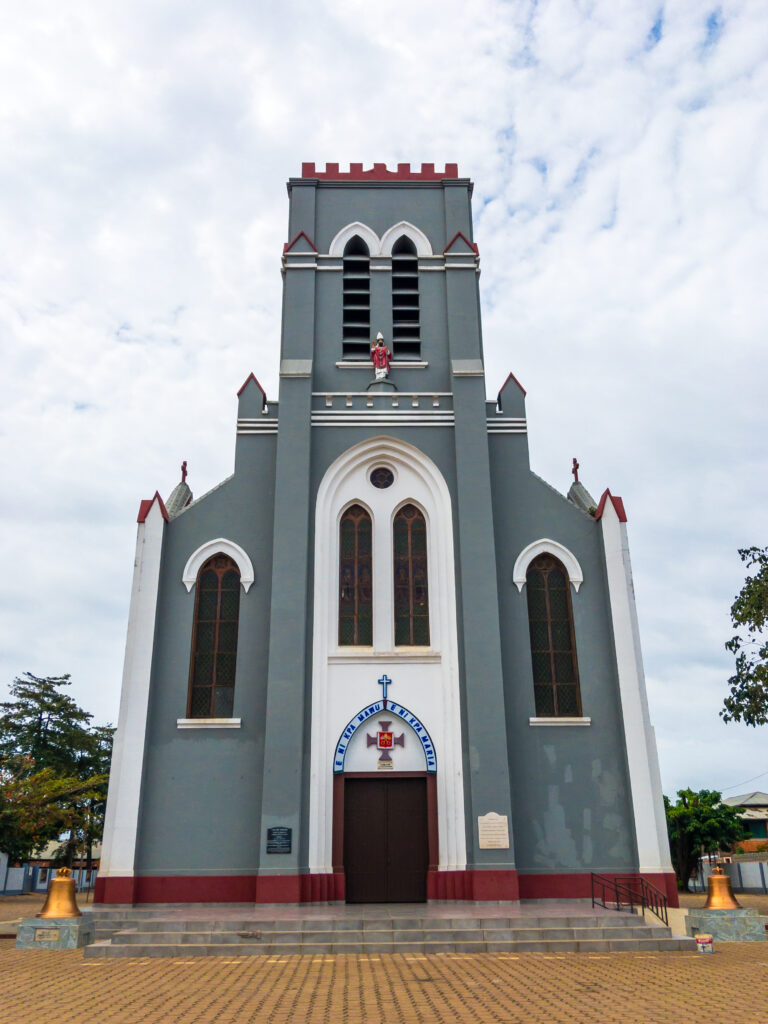
Above the basilica’s door, the Fon inscription “E ni kpa Mawu, e ni kpa Maria” uses the name Mawu for the Christian God: the missionaries took the word that named the creative power of vodun; see Mawu-Lisa. Religions meet even in words. Rites cross too: the anthropologist Joël Noret has studied the organisation of Catholic funerals in Abomey, where the obligations of the Church and those of families are negotiated[5]. See Funerals.
The tensions
Conflicts exist, and it would be false to claim there have never been tensions. Some Christian communities consider certain vodun practices incompatible with their faith; on their side, some people attached to vodun feel certain Christian preaching as a devaluation of their traditions. But I see no use in turning this into a permanent war between “Christians” and “vodunsi”. Benin is a religiously diverse society, and the important question is how different people can live together without despising each other’s religion. I can be deeply attached to vodun without needing to insult Christianity; and a Christian can be faithful to his faith without treating every vodun practitioner as someone to humiliate[1].
What we know, and how we know it
What comes from oral tradition
How each family combines its religions is passed down within it[1].
What comes from direct observation
Families where several religions coexist, and the call to live together without contempt, come from my practice[1].
What is documented
The census figures, the double practice noted in 2023, the basilica facing the temple and Catholic funerals in Abomey are established by official sources, the press and researchers[2][3][4][5].
What is interpretation
Speaking of coexistence and dialogue rather than war is a reading I defend[1].
What is still debated
The real share of Beninese who practise vodun alongside another religion is hard to measure[3].
Common misconceptions
Frequently asked questions
Can you be Christian and practise vodun in Benin?
Many Beninese do: they call themselves Christian and also keep vodun practices, while others make an exclusive choice.
What share of Beninese practise vodun?
17% declared themselves vodun practitioners in the 2002 census, but many Christians and Muslims also practise it.
Why does the Ouidah basilica face the Temple of Pythons?
The basilica was built in 1909 opposite the temple; the two are presented today as a symbol of coexistence.
Why do Christians in Benin call God Mawu?
Missionaries took the Fon word that named the creative power of vodun.
Glossary
- Celestial Church of Christ: a church born in Benin in 1947.
- Mawu: the creative power of vodun, and the Fon name of the Christian God.
Notes and references
[1] Direct observation and oral transmission, Wêtê Agbonon, bokonon, temple of Sakété.
[2] U.S. Department of State, 2007 Report on International Religious Freedom: Benin, based on the 2002 census. See
[3] U.S. Department of State, 2023 Report on International Religious Freedom: Benin. See
[4] TOKPONOU Joël C., « Basilique et Temple des pythons à Ouidah : un symbole de cohabitation interreligieuse », La Nation, 21 January 2025. See
[5] NORET Joël, « Sur le dos des morts ? Organiser des funérailles catholiques à Abomey (Bénin) », 2014.
Sources
- U.S. Department of State, Reports on International Religious Freedom: Benin, 2007 and 2023.
- TOKPONOU Joël C., « Basilique et Temple des pythons à Ouidah », La Nation, 2025.
- Direct observation and oral transmission, temple of Sakété, 1994–2026
Cite this entry
Wêtê Agbonon, « Voodoo and Christianity », dans Vodun Bénin, l’encyclopédie du vodun béninois, entry no. 034, updated on 31 October 2026. Online: https://vodunbenin.org/en/voodoo-and-christianity/ (accessed on 1 November 2026). Licence CC BY 4.0.
- Last checked : 7 October 2026
- Reuse : free, with attribution, under the licence CC BY 4.0
- A mistake? Report it · Method and corrections