
Dan is the serpent vodun. In the vodun of Benin, the “voodoo” of English dictionaries, he is recognised by the snake and sometimes by the rainbow, and he is associated with movement, life, continuity and the link between what is below and what is above. In Haiti, his heritage lives on in Damballa and Ayida-Weddo.
At the temple of Sakété, Dan in the house
Direct observationWêtê Agbonon, vodun priest and bokonon of the Fâ, at the temple of Sakété
In my tradition, Dan is no mere image shown to visitors. He is a vodun who is respected, and who has his place in the organisation of the house. For the precise days, the offerings and certain gestures of his service, I prefer not to put everything on the Internet. Some things can be explained publicly; others belong to the transmission of the house and to the people who have received that responsibility[1].
I hold firmly to this distinction. An encyclopedia can explain who Dan is, his symbolism, his history and the main lines of his cult; it must not turn practices reserved for initiates into a public manual. Snake-related practices are not the same everywhere in Benin, as a major survey carried out in 39 villages and districts of central and southern Benin has shown[2].
Key points
- Dan is the serpent vodun, associated with movement, life, continuity and prosperity.
- As the rainbow, Dan Ayidohwêdo links the earth and the sky.
- Dan, Dangbé of Ouidah and the water powers are distinct traditions.
No single story of Dan is told the same way by every vodun house[1].
Who is Dan?
In the languages of southern and central Benin, Fon, Mina, Adja, Maxi, Gun, Kotafon and Xwla, the word dan means snake. In Fon it has several meanings, noted by the Segurola and Rassinoux dictionary: the snake, but also the vodun represented by an iron rod imitating a snake, and the spirit dwelling in a tree or a mound who sometimes possesses someone to speak through them[3]. Dan links. Where Legba guards the passage between people and the vodun, Dan embodies circulation and continuity: what moves forward, what renews itself, what joins separate spaces. See Legba.
The snake, movement and life
For me, the snake matters because it is always in motion. It moves without limbs, it undulates, it sheds its skin and renews itself. That is why Dan is associated, in several traditions, with continuity and circulation[1]. Beninese researchers put it in similar terms: Dan represents movement and life, ensures the continuation of human beings, and is held to be the source of all prosperity; the Fon language keeps the trace of it, as “Dan do nu ni” is said of someone Dan has favoured with something good[2]. These associations, life, fertility, prosperity, are real; they do not form a definition valid for every lineage.
Dan and the name of Dahomey
The word dan appears even in the name of the kingdom. According to a tradition reported by the Segurola and Rassinoux dictionary, a landowner named Dan ruled the area when Houegbadja, founder of the Abomey dynasty, wanted to build there the house of his son Akaba. Dan was killed, and the palace was raised over his body: Danxomè, “in the belly of Dan”, also read as “in the house of Dan”[3]. Versions differ on who committed the killing, Akaba or Houegbadja; all place the event at the spot called Danxomèhondji. The name Dahomey, which became Benin in 1975, thus carries the memory of Dan.
Dan Ayidohwêdo, the rainbow serpent
The rainbow holds a special place in the stories of Dan Ayidohwêdo. It embodies the link between below and above, between earth and sky: the snake and the rainbow are two images of the same idea, connection and circulation[1]. For some communities, Dan is first the rainbow, Dan Ayidohwêdo, the force and movement of life: its red part represents his male side, the blue his female side, like the duality of creation. Placed in the sky, he holds up the earth and keeps it from collapsing; some stories give him the power to resurrect, and he watches over distant ancestors that families may have forgotten[2].
According to Fon creation stories collected in the twentieth century, notably by Melville Herskovits, the rainbow serpent was the creator’s companion: he carried Mawu on her journey through the newborn world, then coiled beneath the earth to support it[4]. The Zinsou Foundation also describes Ayidohwêdo as a double intertwined serpent, male and female[5]. Because the rainbow is many-coloured, the snakes painted on the walls of Dan’s convents and houses often are too, as researchers observed in Agbokou, Allada and Avrankou[2].
Dan and Dangbé, the python of Ouidah
One must avoid putting all sacred snakes in the same category. In Ouidah, the royal python, called Dangbé in Fon and Dagbé in Mina, holds a special place as the town’s tutelary vodun; that does not mean that everything called Dan is the python of Ouidah. The 2004 study reports that the cult of Dan came from Mahi country, and that the python Dangbé is mainly venerated by the Hueda and the Xwla; the name itself would mean “snake-life”, dan-gbè, the vodun who gives and protects the life of his followers[2].
According to tradition, Dangbé’s temple was first at Savi, the Hueda capital, and the cult was moved to Ouidah after King Agaja of Dahomey conquered the kingdom in 1727[6]. The cult of the snake in Ouidah is among the West African religious practices described earliest by Europeans: the Dutch merchant Willem Bosman reported it as early as 1704, and an engraving published in 1748 shows a procession to the “temple of the serpent”[7][8]. Today the temple stands in the heart of Ouidah, opposite the basilica; see The Temple of Pythons.
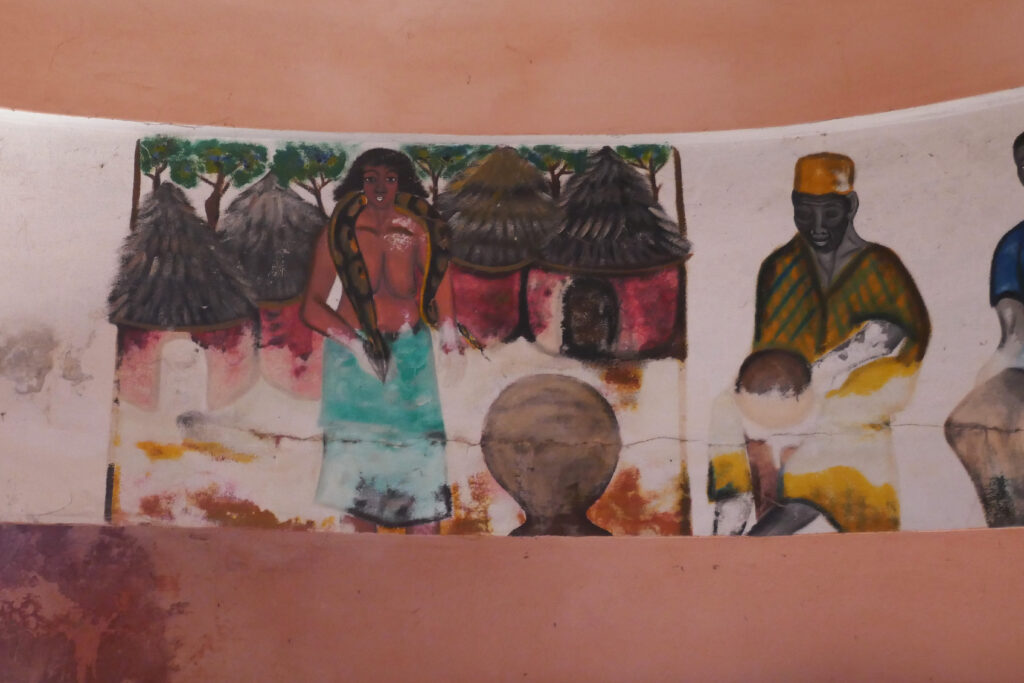
In the past, the snakes were protected, cared for and carefully buried; their life, researchers say, was worth a man’s[2]. The royal python, Python regius, is now threatened by trade: a 2022 study documented its trafficking in Benin, for meat, leather, traditional medicine and export as a pet[9]. The respect surrounding it in Ouidah helps protect it.
Dan, the water powers and Mami Wata
I do not automatically place Dan, Dangbé, the water vodun and Mami Wata in one category. There are symbolic connections, around water, the snake or spiritual power, but each tradition has its own history, families, cults and rules[1]. Links do exist: researchers note that the mamissi, followers of Mami Wata, and the thronssi, followers of Thron, are among the great venerators of Dan[2]. Honouring Dan does not make him Mami Wata; see Mami Wata.
Who becomes a servant of Dan?
One does not become a servant of Dan by deciding so one morning. In vodun there is the family, transmission, vocation, recognition by the house and apprenticeship; how it happens depends on the tradition[1]. The people devoted to the cult of Dan are called Mahinou and Dansi; according to the 2004 study, the royal courts of central and southern Benin are where the rites of Dan are applied most rigorously, as are families who counted priests among their ancestors[2]. In Ouidah, the cult of Dangbé is passed on by families who are responsible for it; but the organisation of Ouidah is not a rule for every house in Benin. With us, knowledge of the vodun is received, and it requires time, listening, respect and above all discipline[1].
What people come to seek from Dan
People who turn to Dan have very different concerns: protection, stability in their life, an opening, prosperity, or simply understanding what they are going through. But I never tell anyone: “Do this and you are certain to get that.” That is not how I work. When someone comes to see me, I first try to understand their situation; in my work as a bokonon and vodun priest, the Fâ has its place when the situation must be questioned and what must be done must be said. Vodun is not, for me, a trade in promises. It is a tradition that demands respect and responsibility, and one must accept that some answers are not the ones hoped for[1].
Dan beyond Benin
With those deported by the slave trade, the figure of the serpent crossed the Atlantic. In Haitian vodou, Damballa and Ayida-Weddo form a couple of celestial serpents, and their names carry the heritage of Dan and Ayidohwêdo; among the neighbouring Yoruba, Ayidohwêdo is often compared to Oshumare, the rainbow serpent. These figures keep the idea of the link between sky and earth, but they have their own history, songs and rites, distinct from the Dan of Beninese houses[1]. See Vodun in the Americas.
What we know, and how we know it
What comes from oral tradition
The stories of Dan Ayidohwêdo, of the killing of Dan and of the transfer of Dangbé’s cult are passed down in lineages and royal courts, in versions that differ[3][2].
What comes from direct observation
Dan’s place in the house, the limits of what can be published, and the refusal to promise results come from my practice[1].
What is documented
The meanings of the word dan, the early European descriptions of the snake cult, the transfer to Ouidah after 1727 and the python trade are established by dictionaries, travellers and researchers[3][7][6][9].
What is interpretation
Seeing the snake and the rainbow as two images of the same idea of connection is a reading I defend[1].
Common misconceptions about Dan
- “Dan is just a snake.” He is a vodun associated with movement, life, continuity and the link between earth and sky[2].
- “Dan and Dangbé are the same.” Dangbé is the python of Ouidah, with his own families and cult[2].
- “Every water power is Dan.” Dan, the water vodun and Mami Wata have their own traditions[1].
- “Serving Dan guarantees wealth.” Prosperity is one of his associations, never a promise[1].
Frequently asked questions
Who is Dan in voodoo?
The serpent vodun of Benin, associated with movement, life, continuity, prosperity, and, as the rainbow, the link between earth and sky.
What is Dan Ayidohwêdo?
Dan as the rainbow serpent: in Fon stories he carried the creator Mawu and coils beneath the earth to support it.
Is Dan the same as Damballa?
Haitian vodou’s Damballa and Ayida-Weddo carry the heritage of Dan and Ayidohwêdo, but they have their own history and rites.
What is the difference between Dan and Dangbé?
Dangbé is the royal python, tutelary vodun of Ouidah, with his own families and temple; Dan is a broader serpent vodun.
Why is Dahomey named after Dan?
According to tradition, the palace of Abomey was built over the body of a landowner named Dan: Danxomè, “in the belly of Dan”.
Is the royal python endangered?
It is threatened by trade: a 2022 study documented its trafficking in Benin for meat, leather, medicine and export.
Glossary
- Ayidohwêdo: the rainbow serpent, a form of Dan.
- Dangbé: the royal python, tutelary vodun of Ouidah.
- Dansi, Mahinou: people devoted to the cult of Dan.
- Danxomè: the kingdom of Dahomey, “in the belly of Dan”.
Notes and references
[1] Direct observation and oral transmission, Wêtê Agbonon, bokonon, temple of Sakété.
[2] TOUDONOU A. S. C., MENSAH G. A. and SINSIN B., « Les serpents dans l’univers culturel au Bénin », Bulletin de la Recherche Agronomique du Bénin, 2004, survey of 39 villages and districts of central and southern Benin.
[3] SEGUROLA Basilio and RASSINOUX Jean, Dictionnaire fon-français, Madrid, Société des Missions africaines, 2000, cited by Toudonou, Mensah and Sinsin.
[4] HERSKOVITS Melville J., Dahomey: An Ancient West African Kingdom, New York, J. J. Augustin, 1938, 2 vols.
[5] Fondation Zinsou, « Introduction au panthéon vodoun », 2018.
[6] LAW Robin, Ouidah: The Social History of a West African Slaving Port, 1727-1892, Athens (Ohio), Ohio University Press, 2004.
[7] BOSMAN Willem, Nauwkeurige beschryving van de Guinese Goud-, Tand- en Slavekust, Utrecht, 1704; English translation, A New and Accurate Description of the Coast of Guinea, London, 1705.
[8] « Procession au Temple du Serpent », engraving published in 1748 in the Dutch edition of the Histoire générale des voyages, The Hague, P. de Hondt.
[9] TOUDONOU Christian et al., « Seeking serpents: Ball python trade in Benin, West Africa », Nature Conservation, no. 50, 2022, p. 85-114.
Sources
- TOUDONOU A. S. C. et al., « Les serpents dans l’univers culturel au Bénin », 2004.
- HERSKOVITS Melville J., Dahomey, 1938.
- LAW Robin, Ouidah, 2004.
- Direct observation and oral transmission, temple of Sakété, 1994–2026
Cite this entry
Wêtê Agbonon, « Dan », dans Vodun Bénin, l’encyclopédie du vodun béninois, entry no. 002, updated on 28 October 2026. Online: https://vodunbenin.org/en/dan/ (accessed on 1 November 2026). Licence CC BY 4.0.
- Last checked : 7 October 2026
- Reuse : free, with attribution, under the licence CC BY 4.0
- A mistake? Report it · Method and corrections