
Sakpata is the vodun of the earth. In the vodun of Benin, the “voodoo” of English dictionaries, he is best known as the vodun of smallpox and eruptive diseases. That view is far too narrow: Sakpata is a great power of the earth, who gives and takes back, at once the most feared and one of the most loved of the vodun. In Brazil and Cuba, his heritage lives on in Omolu, Obaluaiê and Babalú Ayé.
At the temple of Sakété, the respect due to Sakpata

Direct observationWêtê Agbonon, vodun priest and bokonon of the Fâ, at the temple of Sakété
When we speak of Sakpata, we must begin by respecting what this vodun represents. Many people know him only through disease, especially smallpox; for me, that way of presenting him is too limited. In my house in Sakété, Sakpata has his place among the forces we serve and respect. I can speak publicly about what he represents and how we understand his presence; I do not give here the details of consecrated objects, ritual words, precise gestures or practices that must remain in the house[1].
An initiatory tradition always has a public part, and a part passed on differently. Researchers note it too: the initiatory songs of Sakpata, recorded near Porto-Novo by the ethnomusicologist Gilbert Rouget, are performed in the greatest secrecy[2].
Key points
- Sakpata is the vodun of the earth, king of the earth vodun, who gives fertility and wealth and can take them back.
- He is historically linked to smallpox, a disease eradicated in 1980; his cult has never been reduced to it.
- His relationship with the kings of Abomey was a long rivalry between two masters of the land.
A great power of the earth, far more than a “god of disease”[1].
Who is Sakpata?
For the Beninese professor Mahougnon Kakpo, a specialist of the Fâ, Sakpata is the eldest of the vodun, linked to the element Earth: he owns and distributes its riches, and his weapon is smallpox, with the other eruptive diseases. He is called the king of the Ayivodun, the earth vodun, as Hèviosso is the king of the Jivodun, the sky vodun[3]. A study published in 1974 in the Journal de la Société des Africanistes describes him the same way: a divinity linked to the earth, who manifests in a beneficial aspect, fertility, and a feared one, smallpox or drought[4].
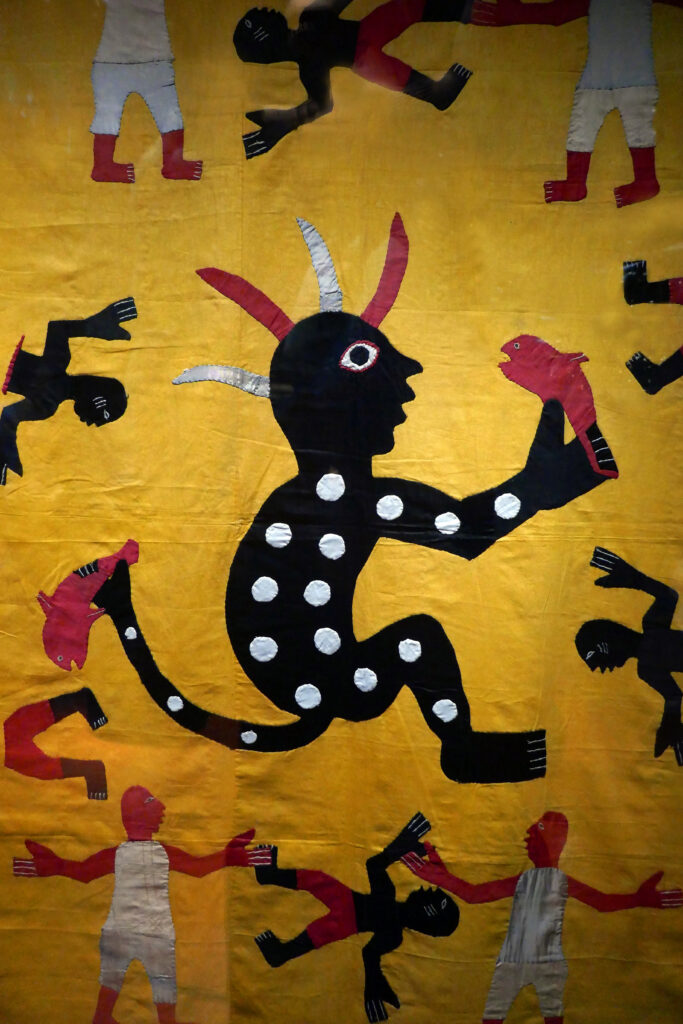
Sakpata is of Nago, that is Yoruba, origin. His Yoruba name, Shankpanan, rendered by the Fon as Sakpata, would mean “the Unavoidable, the Supreme”; his followers bear the generic name Anagonu, “those of Nago origin”. He is a lineage vodun and a whole organised pantheon on his own: Kakpo counts about twenty Sakpata, each with a domain, from Kuxɔsu Agbla, “king of death”, father of all the Sakpata, to Dada Langan, in charge of agriculture and hunting[3]. Herskovits, who worked in Abomey in 1931, already described under this name a whole pantheon of the earth[5].
Why is he called the king of the earth?
This expression matters. The earth is far more than the ground we walk on: it feeds us, receives the dead, lets plants grow, and carries everything we build. The expression does not make him a king in the political sense; it expresses his particular relationship with the land and everything that depends on it[1]. His titles say it in their own way: Ayinɔn, the owner or Master of the earth; Dɔkunnɔn, the one who owns and dispenses riches; and Jɛxɔsu, the King of pearls[3]. According to the anthropologist Christine Henry, who worked in Savalou, this link with the earth first appears in writing with the administrator Auguste Le Hérissé in 1911, and it is more complex than a simple image of fertility[6].
Sakpata in the Fâ
For a bokonon, Sakpata is understood first through the Fâ, which traces the destiny of all the vodun. Kakpo reports two stories. The first belongs to the sign Wlɛn-Mɛnji: when the earth existed only in principle, Dada Sɛgbo, the creator God, had six children, and all the earth went to Sakpata. But Sakpata, the eldest, had neither weapons nor the Word. She went to consult the Fâ, which had her build a dwelling guarded by Kiti, a guardian of the threshold; Sakpata then recovered the Word and all her attributes as Master of the earth. The second, from the sign Yɛku-Mɛnji, tells a pursuit: Sakpata spreads disease in every house where his victim takes refuge, until the victim finds shelter with the Fâ; before the Fâ, Sakpata turns back. Even the most feared of the vodun bows before the Fâ[3]. See What is the Fâ?.
Sakpata and Hèviosso
Hèviosso is associated with the sky, thunder, lightning and rain; Sakpata with the earth. Rain falling from the sky joins the earth and makes life possible: that is why these two powers are so often thought of together. I prefer to speak of complementarity, rather than separating the vodun as if each lived in its own world. See Hèviosso[1].
Melville and Frances Herskovits collected several versions of a story. Sakpata, the eldest, received the earth, and Sogbo, of the thunder family, received the sky. But Sakpata came down to earth without taking water or fire, and Sogbo held back the rain: drought set in. In one version, two messengers consult the Fâ and advise Sakpata to send the wututu bird to carry a message of peace to Sogbo; in another, it is Legba, the mediator, who has a great fire lit on earth whose smoke rises to the sky, and the rain falls to put it out. The two brothers are reconciled, and the wututu becomes a sacred bird whose cry announces rain[7]. Master of the earth, Sakpata can do nothing without the rain of the sky.
Sakpata and disease
This is probably the most delicate subject. In the tradition, certain diseases may be understood as having a spiritual dimension, and Sakpata is historically associated with eruptive diseases, above all smallpox[1]. The link is so strong that, according to Kakpo, in the languages of the region the word for smallpox is the same as the word for Sakpata; the family of Sakpata also covers eruptive fevers, dysentery, leprosy and wounds that do not heal[3].
But there is an important distinction to make. Spiritual tradition and modern medicine do not have to fight each other. When someone is ill, I do not advise them to leave a doctor to seek an answer only from a vodun. If a person has a fever, an infection, serious pain, a wound or any symptom that needs care, they must see a health professional. Having a traditional practice does not mean refusing medicine. The doctor seeks to understand and treat the medical problem; the person may also seek, in their tradition, the meaning they give to what they are going through. Above all, one must never promise a spiritual cure to someone who needs care[1].
In the past, the victims of smallpox were not buried like other dead: the tradition returned them to the earth, apart, in a sacred forest, which Kakpo also sees as a logic of prudence that limited contagion[3]. Smallpox itself no longer exists: the World Health Organization declared its worldwide eradication in 1980, after great vaccination campaigns[8]. The cult of Sakpata remains, because it was never reduced to that single disease.
Where does the cult come from?
According to Kakpo, the cult is older in Benin than the Fâ, which reached Abomey in 1715. It came with migrants from Ɛgba, in the region of Abeokuta in present-day Nigeria, who, after a long stay in Ketu, settled on the hills of Dassa-Zoumè; among the divinities they carried was Shankpanan, the future Sakpata. The first initiations began on those hills at least from the end of the seventeenth century[3].
Sakpata and the kings of Abomey
At the very beginning of the eighteenth century, followers of Sakpata were captured by King Akaba’s troops and brought to the palace. Ordered to prostrate themselves before the king, they refused: only the Master of the earth deserved that honour. Under threat they gave in, leaving the responsibility to the king. A few months later, a smallpox epidemic ravaged the court and carried off King Akaba himself, in 1708. His twin sister, Tasi Hangbè, then acted as regent from 1708 to 1711, and it was she who brought Sakpata into Abomey[3].
Cohabitation was not easy. The followers prostrated themselves before Sakpata as subjects did before the king, and the Master of the earth disputed the sovereign’s own attributes. As the art historian Didier Houénoudé writes, for the kings there could not be two masters for one kingdom[9]. Pierre Verger reports that Ghezo and Glele banned the public cult;[10] Kakpo adds nuance: Ghezo eventually allowed a convent of Sakpata in Abomey, provided its clergy respected the king’s prerogatives, and that convent is now among the most prestigious[3].
The names of Sakpata
Sakpata has several names depending on the region and tradition: Sakpata, Sapata and Sagbata, the form used by Herskovits. In some traditions people even avoid saying his name directly: the name of a powerful vodun is not always spoken like that of an ordinary person, and naming him otherwise shows respect and prudence[1]. Kakpo confirms it: out of fear and respect, people used a litotes, Ayikungban, “the Earth”; one did not say that a sick person had smallpox, but that they “had to deal with the Venerable One”[3]. Names and prohibitions vary from one house to another.
Sakpata and fertility
Sakpata is not only associated with disease. The earth also produces: it receives the seed, lets the plant be born, feeds people and animals. It therefore also stands for fertility and abundance. This double dimension is the key to Sakpata: the earth can give, but it can also take back[1]. Researchers debate it. For Mahougnon Kakpo, Sakpata is first a beneficial force, responsible for fertility in all its forms;[3] Christine Henry, by contrast, disputes the idea of Sakpata as a fertility god and stresses the complexity of his relationship with the earth[6]. This entry presents both readings.
What can be seen of Sakpata
His representation is a mound of earth topped with a canari, an earthenware pot pierced all over: each opening stands for a pustule of smallpox. Le Hérissé already described these mounds in 1911;[11] in Porto-Novo, the art historian Gérard Bassalé photographed such altars on the vodun squares, the mound often hidden under a white cloth[12]. Just as Legba guards the threshold of the other vodun, Sakpata has his own guardian, Kiti, who carries a stick and a broom; the broom, symbol of authority and of driving out evil, also stands for the happiness one must not sweep away, which is why Sakpata forbids sweeping at night[3].
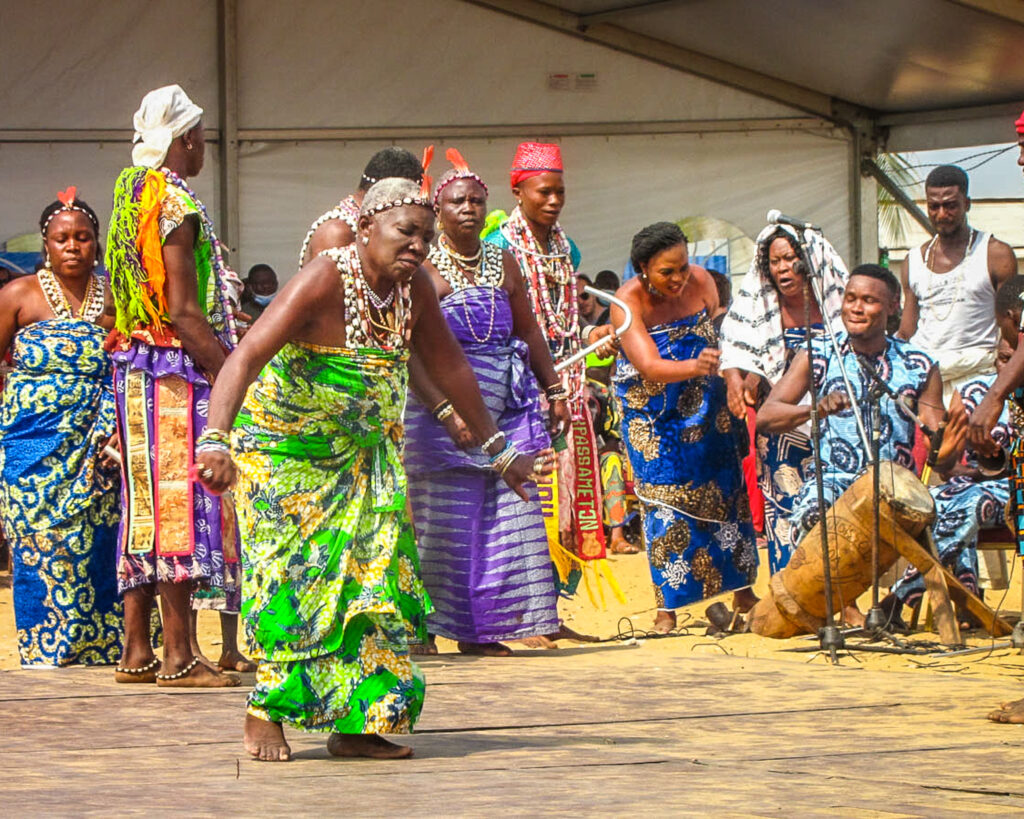
A paradox noted by Kakpo: this feared vodun is one of the most popular. His public appearances are real spectacles, with fine cloths, leaps and pirouettes, drums and songs full of wisdom[3].
What people come to seek from Sakpata
People who turn to Sakpata do not all come for the same reason: protection, a difficult period, family, professional or material problems, or the feeling that an illness or a series of misfortunes has a spiritual dimension. But when someone comes to see me, I do not automatically tell them that Sakpata is responsible for what is happening to them. I first try to understand; the Fâ can help question the situation when a direction must be sought. One must not attribute every misfortune to a vodun just because one knows its name. And I promise no one: “Do this and Sakpata will surely solve your problem.” That is not how I practise[1].
Sakpata beyond Benin
Among the Yoruba, the divinity of the earth and smallpox has been studied at length under the names Shopona or Obaluaye; even in Abeokuta, his home, the cult was banned in 1884 after a smallpox epidemic[13][3]. With the slave trade, this figure crossed the Atlantic: he is found in Brazil as Omolu, Obaluaiê or Xapanã, and in Cuba as Babalú Ayé. In São Luís, in Maranhão, the Casa das Minas, a house of Jeje tradition, honours the family of Dambirá, “the children of Acossi-Sakpatá”, led by three brothers represented by Saint Lazarus, Saint Roch and Saint Sebastian, saints invoked against smallpox and plague[14]. Each of these figures has its own history, songs and rites, distinct from the Sakpata of Beninese houses. See Vodun in the Americas.
What Sakpata teaches me
For me, Sakpata reminds us above all of our relationship with the earth. We come from the earth, we live thanks to it, and we return to it. He also reminds us that, in the old view of the world, life and disease are not thought of separately: the same earth that feeds can be feared when it shows a power that humans do not master. That is why I do not present Sakpata as a “god of disease”, but as a great power linked to the earth, to fertility, to earthly order and, in some traditions, to the diseases of which smallpox is the best-known historical example. And as with the other vodun, what I can explain publicly is only part of what is truly passed on in the house[1].
What researchers say
Administrators, anthropologists and Beninese researchers have studied Sakpata. The main ones, in chronological order:
- 1911Auguste Le Hérissé describes the altars of Sakpata and first notes his link with the earth[11].
- 1938Melville J. Herskovits publishes Dahomey, describing the earth pantheon[5].
- 1957Pierre Verger compares the cults of the orisha and vodun, and reports the ban on Sakpata’s public cult in Abomey[10].
- 1958Melville and Frances Herskovits publish Dahomean Narrative, with versions of the quarrel between Sakpata and Sogbo[7].
- 1974Roger Brand describes an initiation into a Sapata cult in the Ouémé valley[4].
- 1985Anthony Buckley studies the Yoruba god of smallpox[13].
- 2010Christine Henry, from fieldwork in Savalou, re-examines Sakpata’s link with the earth[6].
- 2013Mahougnon Kakpo traces the history of Sakpata and reads him in the sacred texts of the Fâ[3].
What we know, and how we know it
What comes from oral tradition
The stories of the Fâ about Sakpata, the quarrel with Sogbo and the history of the cult’s migration are passed down orally[3][7].
What comes from direct observation
Sakpata’s place in the house, the refusal to promise a cure, and the reading of Sakpata beyond disease come from my practice[1].
What is documented
His altars, the conflict with the kings of Abomey, the eradication of smallpox and his presence in Brazil and Cuba are established by researchers and official sources[12][3][8][14].
What is interpretation
Seeing Sakpata as a power that gives and takes back, rather than a god of disease, is a reading I defend[1].
Common misconceptions about Sakpata
- “Sakpata is the god of disease.” He is a great power of the earth, who gives and takes back[1].
- “Sakpata can replace a doctor.” Anyone who is ill must see a health professional; tradition and medicine need not fight[1].
- “Smallpox is still Sakpata’s weapon today.” Smallpox was eradicated worldwide in 1980; the cult has never been reduced to it[8].
- “Every misfortune comes from Sakpata.” One must not attribute every misfortune to a vodun just because one knows its name[1].
Frequently asked questions
Who is Sakpata in voodoo?
The vodun of the earth in Benin, king of the earth vodun, linked to fertility and wealth, and historically to smallpox and eruptive diseases.
Why is Sakpata linked to smallpox?
In the languages of the region, the word for smallpox is the same as the word for Sakpata; the disease was seen as his weapon.
Is Sakpata the same as Omolu or Babalú Ayé?
They carry his heritage in Brazil and Cuba, but each has its own history and rites.
What is the symbol of Sakpata?
A mound of earth topped with a pot pierced all over, each hole standing for a pustule.
Why did the kings of Abomey fear Sakpata?
Because his followers bowed to him as to a king: there could not be two masters for one kingdom.
Can Sakpata heal a disease?
Anyone who is ill must see a health professional; tradition can give meaning, never replace care.
Glossary
- Anagonu: the followers of Sakpata, “those of Nago origin”.
- Ayinɔn: the Master of the earth, a title of Sakpata.
- Ayivodun: the earth vodun, whose king is Sakpata.
- Kiti: the guardian of Sakpata, with his stick and broom.
Notes and references
[1] Direct observation and oral transmission, Wêtê Agbonon, bokonon, temple of Sakété.
[2] ROUGET Gilbert, Musica Reservata. Deux chants initiatiques pour le culte des vôdoun au Bénin, Paris, Palais de l’Institut, 2006.
[3] KAKPO Mahougnon, « Vodun Sakpata et épidémie de variole dans la littérature orale sacrée du golfe du Bénin », Ponti/Ponts, no. 13, 2013, p. 13-34.
[4] BRAND Roger, « Initiation et consécration de deux vodúnɔ̃ dans les cultes vodú », Journal de la Société des Africanistes, vol. 44, no. 1, 1974.
[5] HERSKOVITS Melville J., Dahomey: An Ancient West African Kingdom, New York, J. J. Augustin, 1938, 2 vols.
[6] HENRY Christine, « La terre de Sakpata », Journal des africanistes, vol. 80, no. 1-2, 2010, p. 253-265, fieldwork in Savalou.
[7] HERSKOVITS Melville J. and HERSKOVITS Frances S., Dahomean Narrative: A Cross-Cultural Analysis, Evanston, Northwestern University Press, 1958.
[8] World Health Organization, official declaration of the eradication of smallpox, World Health Assembly, 8 May 1980.
[9] HOUÉNOUDÉ Didier, Musique traditionnelle à Abomey, Abomey, 2009, p. 34, cited by Kakpo 2013.
[10] VERGER Pierre, Notes sur le culte des Orisa et Vodun à Bahia, la Baie de tous les Saints, au Brésil et à l’ancienne Côte des Esclaves en Afrique, Dakar, IFAN, 1957.
[11] LE HÉRISSÉ Auguste, L’ancien royaume du Dahomey, Paris, Larose, 1911, p. 128, cited by Bassalé 2015.
[12] BASSALÉ Gérard Ogouyèmi, Enjeux des places vodùn dans l’évolution architecturale de la ville de Porto-Novo, master’s thesis in art history, University of Abomey-Calavi, 2015.
[13] BUCKLEY Anthony D., « The God of Smallpox: Aspects of Yoruba Religious Knowledge », Africa, vol. 55, no. 2, 1985, p. 187-200.
[14] FERRETTI Sergio F., « Estórias da Casa Grande das Minas Jeje », Federal University of Maranhão, São Luís.
Sources
- KAKPO Mahougnon, « Vodun Sakpata et épidémie de variole... », 2013.
- HENRY Christine, « La terre de Sakpata », 2010.
- HERSKOVITS Melville J., Dahomey, 1938.
- Direct observation and oral transmission, temple of Sakété, 1994–2026
Cite this entry
Wêtê Agbonon, « Sakpata », dans Vodun Bénin, l’encyclopédie du vodun béninois, entry no. 004, updated on 28 October 2026. Online: https://vodunbenin.org/en/sakpata/ (accessed on 1 November 2026). Licence CC BY 4.0.
- Last checked : 7 October 2026
- Reuse : free, with attribution, under the licence CC BY 4.0
- A mistake? Report it · Method and corrections