Traditional medicine in Benin rests first on plants: leaves, barks and roots, whose knowledge is passed on between generations. It belongs to a heritage wider than voodoo alone, and the bokonon, priest of the Fâ, holds a different place from the plant healer. No recipe or dosage is published here.
At the temple of Sakété, what plants represent
Direct observationWêtê Agbonon, vodun priest and bokonon of the Fâ, at the temple of Sakété
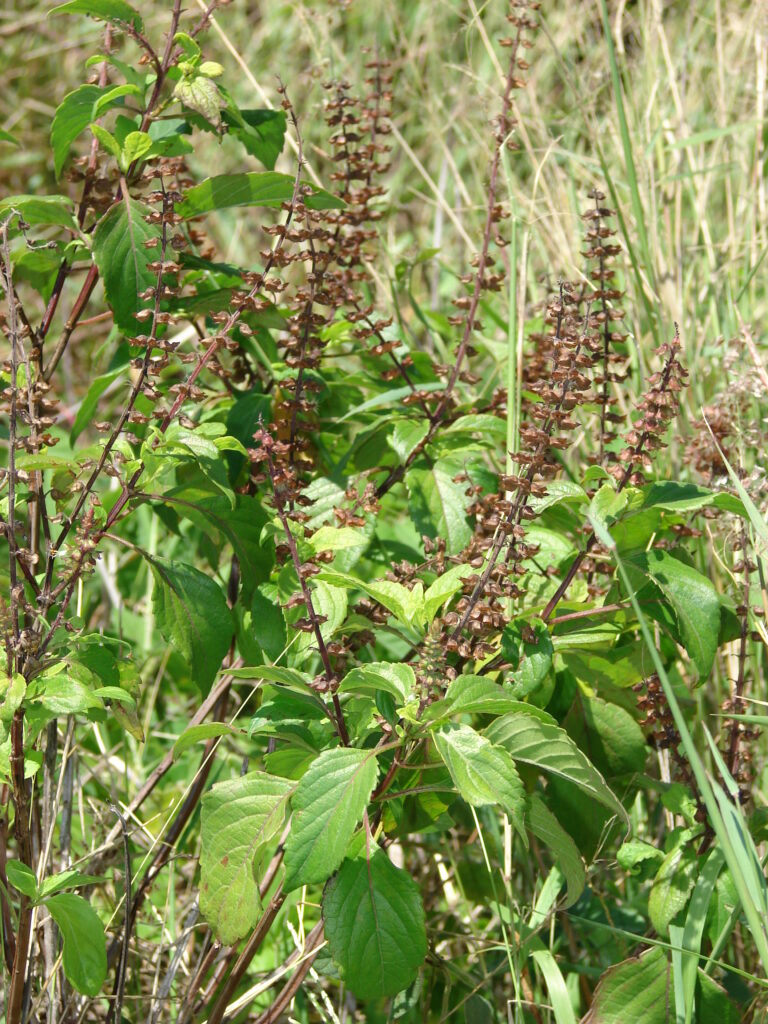
Plants hold an important place in the traditional knowledge of Benin. They belong to a heritage far wider than vodun alone: knowledge of leaves, barks, roots and other elements of nature has been passed on between generations[1]. The World Health Organization recognises traditional medicine as a body of knowledge, skills and practices from different cultures, in which herbal preparations are an important component[2].
But one must beware of a very common confusion: the bokonon and the plant healer are two different figures. The bokonon works mainly with the Fâ and with interpreting what the consultation reveals; his role is to understand the situation, identify the guidance that can be given and determine, according to tradition, what should be undertaken. He replaces neither the doctor, nor the pharmacist, nor the nurse, nor the plant specialist. The plant healer has another kind of knowledge: the properties traditionally attributed to plants, their preparation and their use. The two fields can meet; they do not merge. See The bokonon[1].
Key points
- Plants are a heritage of Benin, wider than vodun alone.
- The bokonon and the plant healer have two different kinds of knowledge.
- A natural plant can be dangerous: no recipe or dosage is published here.
A traditional practitioner’s responsibility begins with knowing the limits of his own field[1].
Knowledge shared by a whole country
Plant medicine is first an everyday knowledge. A study of 57 sellers of medicinal plants, in 23 markets of southern Benin, listed the plants sold to treat children[3]. Another, carried out among 801 traditional practitioners, listed the plants they use against hypertension[4]. In the streets of Cotonou, sellers of herbal teas have become a real street pharmacy, studied by researchers from the University of Abomey-Calavi[5].
The Beninese state has recognised this heritage: a National Programme of Traditional Pharmacopoeia and Medicine, attached to the Ministry of Health, has surveyed it[6]. And this knowledge crossed the Atlantic: researchers have compared the plants used for the same childhood ailments in Suriname and among the peoples of Ghana, Benin and Gabon from whom Afro-Surinamese people descend[7].
Why no recipe is published here
I am in favour of speaking about plants in the encyclopedia: their cultural importance, the transmission of knowledge, and people’s relationship with nature. But I would not publish a list of recipes presented as treatments, with dosages, precise mixtures, durations, or indications allowing someone to treat themselves alone[1].
First, for safety. A plant is not harmless because it is natural: the quantity, the part of the plant, the preparation, the person’s age, their other treatments and their state of health all matter. The WHO stresses precisely the quality, safety and efficacy of traditional herbal medicines[2]. There is also a traditional reason: some knowledge goes beyond a mere recipe; it belongs to a transmission, an experience and a responsibility[1].
And the hospital?
I am not against the hospital. On the contrary, we must stop presenting traditional and modern medicine as two enemies bound to fight. When a person is ill, they must be able to receive the care they need, and a traditional consultation must never lead someone to abandon a necessary medical treatment. I can respect tradition without asking anyone to give up modern medicine. See also Sakpata, whose tradition has long been linked to disease[1].
What we know, and how we know it
What comes from oral tradition
Knowledge of plants, their preparation and use is passed on between generations and in healers’ families[1].
What comes from direct observation
The distinction between bokonon and healer, the refusal to publish recipes, and the position on hospitals come from my practice[1].
What is documented
The plants sold in markets, the surveys of practitioners, the national programme and the WHO strategy are established by researchers and institutions[3][4][6][2].
What is interpretation
Refusing to set traditional and modern medicine against each other is a position I defend[1].
What is still debated
The efficacy of many plants remains to be assessed by scientific studies, as the WHO recalls[2].
Common misconceptions about traditional medicine
- “A bokonon is a plant healer.” He works with the Fâ; the healer has another kind of knowledge[1].
- “A natural plant is harmless.” Dose, preparation and the person’s condition matter[2].
- “Tradition opposes the hospital.” A traditional consultation must never lead anyone to abandon necessary treatment[1].
Frequently asked questions
What is traditional medicine in Benin?
A body of knowledge about plants, leaves, barks and roots, passed on between generations, wider than vodun alone.
Does a bokonon heal with plants?
The bokonon works with the Fâ; the plant healer has another kind of knowledge, and the two are distinct.
Why not publish the recipes?
For safety, because a plant can be dangerous depending on the dose and the person, and because some knowledge belongs to a transmission.
Must one choose between tradition and hospital?
No: a sick person must receive the care they need, and tradition must never lead anyone to abandon necessary treatment.
Glossary
- Pharmacopoeia: the body of remedies of a tradition.
- Traditional practitioner: a practitioner of traditional medicine.
Notes and references
[1] Direct observation and oral transmission, Wêtê Agbonon, bokonon, temple of Sakété.
[2] World Health Organization, WHO Traditional Medicine Strategy 2014-2023, Geneva, 2013.
[3] KOUCHADÉ A. S., ADOMOU A. et al., « Étude ethnobotanique des plantes médicinales utilisées dans le traitement des maladies infantiles et vendues sur les marchés au sud du Bénin », Journal of Animal & Plant Sciences, vol. 28, no. 2, 2016. See (in French)
[4] « Contribution à la connaissance des principales plantes antihypertensives utilisées en médecine traditionnelle au Bénin », survey of 801 practitioners, University of Abomey-Calavi. See (in French)
[5] Study of herbal teas sold along the main roads of Cotonou, Journal de la Société de Biologie Clinique du Bénin, no. 025, 2016. See (in French)
[6] Ministry of Health of Benin, National Programme of Traditional Pharmacopoeia and Medicine, La pharmacopée et la médecine traditionnelle au Bénin : état des lieux et perspectives, 2009.
[7] VOSSEN Tessa et al., « Consequences of the Trans-Atlantic Slave Trade on Medicinal Plant Selection », PLOS ONE, 2014. See
Sources
- World Health Organization, Traditional Medicine Strategy 2014-2023, 2013.
- KOUCHADÉ A. S. et al., medicinal plants in markets of southern Benin, 2016.
- Direct observation and oral transmission, temple of Sakété, 1994–2026
Cite this entry
Wêtê Agbonon, « Traditional medicine and plants », dans Vodun Bénin, l’encyclopédie du vodun béninois, entry no. 042, updated on 8 November 2026. Online: https://vodunbenin.org/en/traditional-medicine/ (accessed on 16 November 2026). Licence CC BY 4.0.
- Last checked : 7 October 2026
- Reuse : free, with attribution, under the licence CC BY 4.0
- A mistake? Report it · Method and corrections