Vodun is a tradition of speech: the core of its knowledge is passed on by word of mouth, from an elder to a younger person, from a master to the one he trains, within a relationship. A given word binds, an oath binds even more, and the proverb, lɔ̀ in Fon, says a great deal in few words.
At the temple of Sakété, a tradition of speech

Direct observationWêtê Agbonon, vodun priest and bokonon of the Fâ, at the temple of Sakété
Vodun is a tradition of speech. That does not mean the elders could not write: it means that the core of traditional knowledge was not originally conceived as a text to be read by anyone. It is passed on within a relationship: an elder to a younger person, a master to the one he trains, a family to its descendants, a priest to the one authorised to receive. This transmission takes account of the person receiving: the same teaching can be explained differently to a child, an adult, a visitor, a follower or someone engaged in an initiation. That is one reason I am careful when speaking of putting vodun into writing. Writing is very useful for safeguarding memory; but writing does not mean that everything must become public[1].
Key points
- Vodun knowledge is passed on within a relationship, by word of mouth.
- A given word binds, and an oath binds even more.
- The proverb teaches a great deal in few words, without humiliating.
One must learn to speak, but also when to speak, before whom, and what must not be said[1].
A living heritage
UNESCO itself speaks of living heritage: its 2003 convention protects oral traditions and expressions, including language as a vehicle of heritage, and their formal and informal transmission from one generation to the next[2]. That is exactly the case of vodun, whose knowledge lives in those who carry it.
When the language was first written
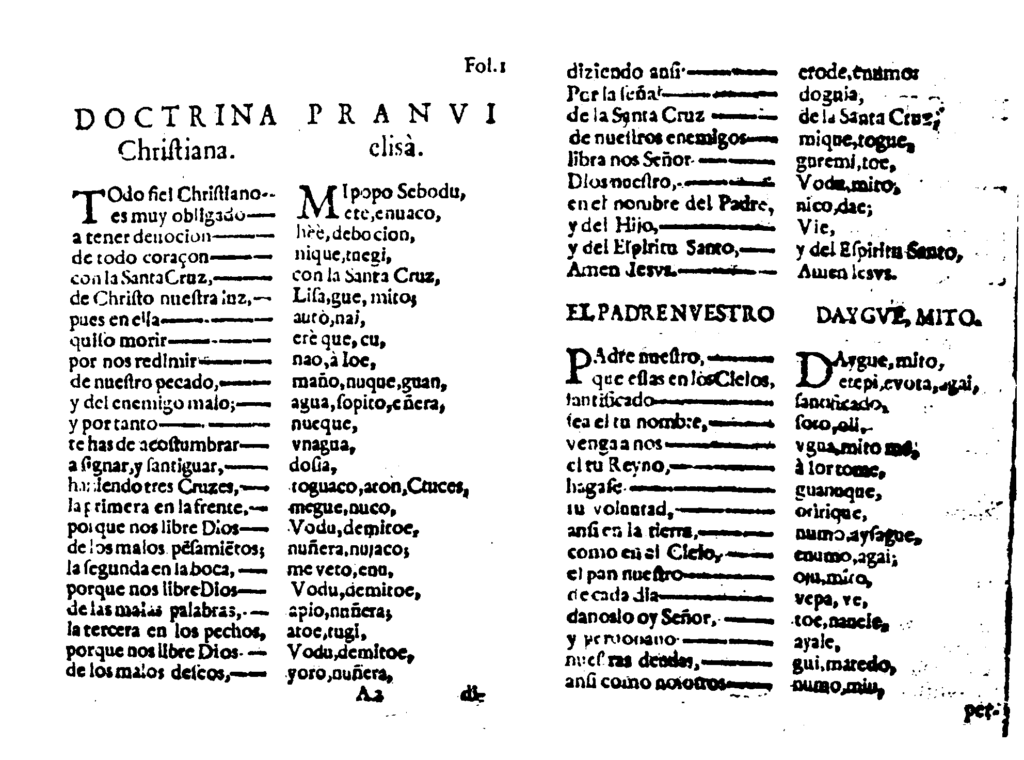
The Gbe languages long lived without writing. One of the oldest known texts in one of them is a catechism: in 1658, the Spanish priest José de Nájera translated a Doctrina Christiana into the language then spoken in Allada[3]. The ethnologists Henri Labouret and Paul Rivet studied it in 1929[4]. Writing thus came from outside, in the service of another religion; the speech of vodun went on being passed by word of mouth. See Mawu-Lisa.
The given word
In our culture, a word outlives the moment it is spoken: a given word binds, an oath binds even more. That is why speech holds an important place in family, social and religious relationships, and in matters that concern the community. One must learn to speak, but also when to speak, before whom, and what must not be said[1]. The Fâ itself is speech: its signs open onto stories, songs and formulas; see What is the Fâ?.
The proverb
The proverb, the lɔ̀, is a particularly important form of this intelligence of speech. It says a great deal in few words: it can advise, warn, correct or make one think, without directly humiliating the person addressed[1].
| Fon proverb | Meaning |
|---|---|
| Lo nyi ahan nu dodo, bo nyi nu do nu kpodo. | The proverb feeds the mouth and teaches the ear: a short word can hold a teaching greater than itself. |
| Xoxo tɔn vo, din tɔn vo. | Other times, other ways: times change, and behaviour changes with them. |
I prefer that the encyclopedia never present as a “traditional Fon proverb” a sentence made up in French or English. We will therefore publish a small corpus of proverbs whose Fon form, translation and context have been reviewed together, rather than multiplying quotations found on the Internet[1].
What we know, and how we know it
What comes from oral tradition
Proverbs, their form and meaning are passed on by word of mouth[1].
What comes from direct observation
Transmission adapted to the receiver, the weight of the given word and caution towards writing come from my practice[1].
What is documented
The UNESCO convention and the 1658 catechism are established by texts and researchers[2][4].
What is interpretation
Holding that writing does not mean making everything public is a position I defend[1].
What is still debated
The exact form of many proverbs varies between regions and families[1].
Common misconceptions about orality
- “An oral tradition is a poor tradition.” Spoken transmission adapts to the receiver and keeps what must be kept[1].
- “Everything written must be public.” Writing safeguards memory without making everything public[1].
- “Any African saying is a Fon proverb.” A proverb is checked, in its Fon form and meaning[1].
Frequently asked questions
Why is vodun passed on orally?
Because its knowledge lives within a relationship, from an elder to a younger person, and adapts to the one who receives it.
What is the Fon word for proverb?
Lɔ̀.
What is the oldest text written in a Gbe language?
One of the oldest known is the 1658 Doctrina Christiana, a catechism translated into the language of Allada.
What does “Xoxo tɔn vo, din tɔn vo” mean?
Other times, other ways: times change, and behaviour changes with them.
Glossary
- Gbe: the family of languages of southern Benin and Togo, including Fon.
- Lɔ̀: the proverb, in Fon.
Notes and references
[1] Direct observation and oral transmission, Wêtê Agbonon, bokonon, temple of Sakété.
[2] UNESCO, Convention for the Safeguarding of the Intangible Cultural Heritage, 2003. See (in French)
[3] Ideophone, « The mysteries of Christian doctrine, or, How an African language was mistaken for an Amazonian one », on the Doctrina Christiana of 1658.
[4] LABOURET Henri and RIVET Paul, Le royaume d’Arda et son évangélisation au XVIIe siècle, Paris, Institut d’ethnologie, 1929.
Sources
- UNESCO, Convention for the Safeguarding of the Intangible Cultural Heritage, 2003.
- LABOURET Henri and RIVET Paul, Le royaume d’Arda et son évangélisation au XVIIe siècle, 1929.
- Direct observation and oral transmission, temple of Sakété, 1994–2026
Cite this entry
Wêtê Agbonon, « Speech and orality », dans Vodun Bénin, l’encyclopédie du vodun béninois, entry no. 043, updated on 9 November 2026. Online: https://vodunbenin.org/en/speech-and-orality/ (accessed on 16 November 2026). Licence CC BY 4.0.
- Last checked : 7 October 2026
- Reuse : free, with attribution, under the licence CC BY 4.0
- A mistake? Report it · Method and corrections