The appliqué hangings of Abomey are cloths decorated by appliqué: motifs cut from coloured fabrics are sewn onto a background[2][3]. Since the eighteenth century this art has been tied to the kingdom of Danxomè and to the royal court of Abomey[2][4][5]. Its animals, objects and figures evoke the kings, their strong names and their victories[3][6][7]. Families of craftsmen worked for the king, foremost among them the Yèmadjè family[2][4]. Workshops in Abomey still make them, and several museums in Europe and the United States hold examples[2][4][6][7].
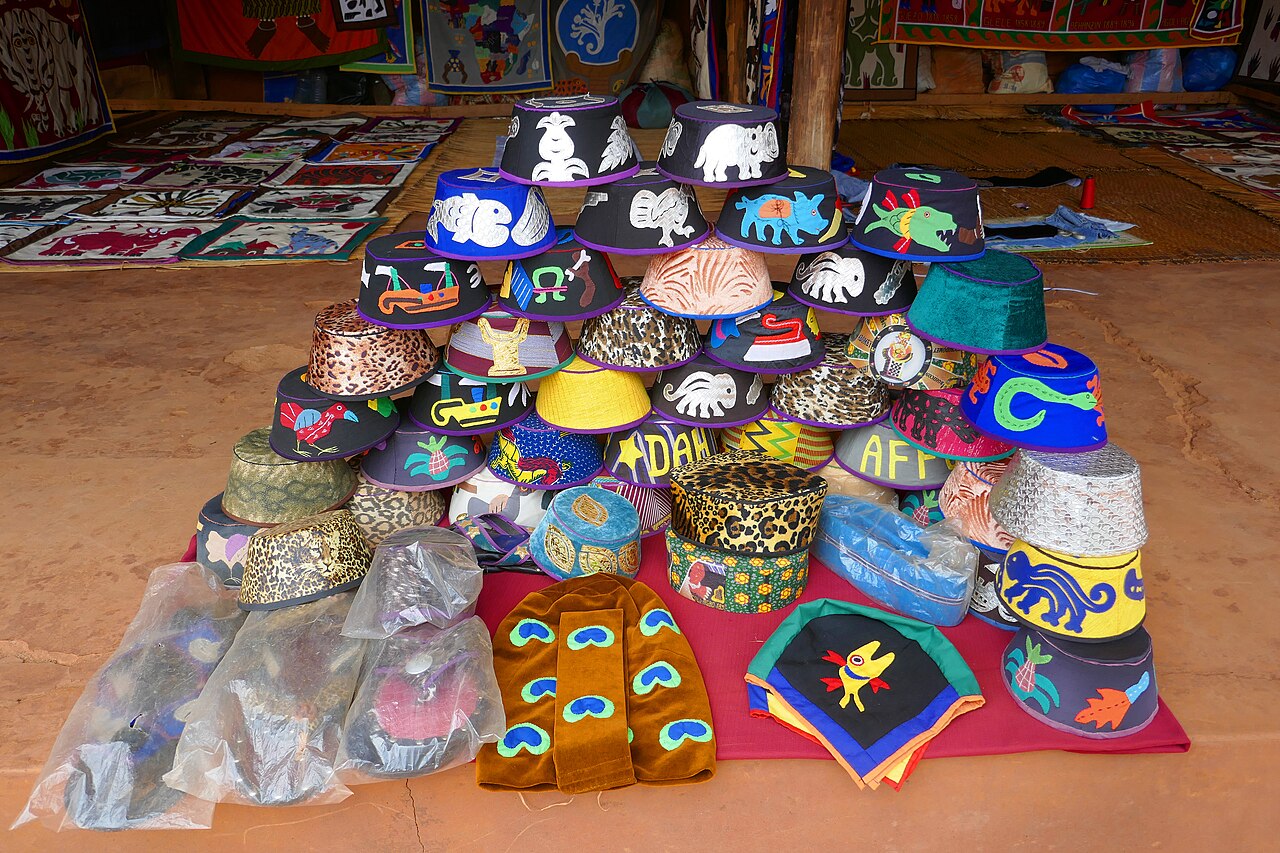
At the temple of Sakété, what the hangings tell

Direct observationWêtê Agbonon, vodun priest and bokonon of the Fâ, at the temple of Sakété
At the temple, we look at the Abomey hangings as a sewn memory: each king keeps his animal and his motto there, and the signs of the deities of vodun appear on them. This language of images speaks first to those who know the stories of Danxomè[1]. See Abomey.
Key points
- The Abomey hangings are appliquéd cloths: motifs cut from coloured fabrics are sewn onto a background[2][3].
- According to historians at the University of Abomey-Calavi, the technique is attributed to King Agaja, and the Yèmadjè family entered the service of King Agonglo[2].
- Their images take up the emblems of the kings, such as Agaja’s ship, Ghézo’s buffalo, Glèlè’s lion or Béhanzin’s shark[7].
- Workshops in Abomey still produce them, and wall hangings in this style are widely sold in the city[2][6].
The hangings tell in pictures the story of the kings of Danxomè, each recognisable by his emblems[6][7][8].
A technique from the court of Agaja
According to Didier Marcel Houenoude and Hyppolite Togo, of the University of Abomey-Calavi, the technique of the hangings is attributed to King Agaja, who is said to have drawn inspiration from vodun followers dancing in multicoloured costumes in a foreign region[2]. Agaja, who took the throne in 1718 according to French Wikipédia, later brought to his kingdom, after a conquest at Agbozounmey, the hanging makers and weavers Hantan and Zinflou, the first specialists of the craft in Danxomè[2][9]. The two authors take up the definition given by Paul Mercier: the decoration of fabrics by applying motifs cut from fabrics of another colour[2]. See The colours of vodun.
The Yèmadjè, craftsmen of the king
The art of the hangings spread under King Agonglo, who is said to have “endowed and married” Yèmadjè to secure his services; the Yèmadjè family eventually supplanted the Zinflou and the Hantan[2]. Its head had to carry every appliquéd garment before the king, and he was called the king’s “mirror”[2]. According to French Wikipédia, the artists of Danxomè were supported by the king and his family, and the role of the royal family in the arts was central[9].
The British Museum holds a replica banner made around 1912 by the Yémadjé family, in the royal palace of Abomey, for presentation or sale[4]. A photograph taken in Abomey in 1971 by Eliot Elisofon, kept at the Smithsonian, shows an appliqué banner on display; its record states that the appliqué workers are Fon men and boys of the city[3].
The emblems of the kings
According to French Wikipédia, the kings of Danxomè are often depicted in animal forms, each resembling a particular animal[9]. A cotton hanging with brightly coloured appliquéd motifs on a black ground, brought back in 1973 by the C. Savary mission to the Musée d’ethnographie de Genève, thus gathers the strong names of twelve kings, each in the form of an emblem: fish and fish trap for Houégbadja, ship for Agaja, pineapple for Agonglo, buffalo and two birds on a tree for Ghézo, lion for Glèlè, shark and egg for Béhanzin[7]. The museum register notes that the piece is unfinished and compares it with a similar hanging shown in 1975 in the exhibition “Dahomey, traditions du peuple fon”[7].
Béhanzin’s motto, in the Fondation Zinsou’s translation, reads “the angry shark comes to disturb the helm”; in 2006 the foundation devoted an exhibition to him in which fifteen canvases by Cyprien Tokoudagba presented his emblems[8]. The Brooklyn Museum holds a royal or noble costume from Abomey, from the late nineteenth century, whose trousers bear appliquéd sharks[10].
The king among the deities: Glèlè’s banner
The British Museum banner shows the victory of the warriors of Danxomè, under King Glèlè, over their Yoruba enemies[4]. At the centre, Glèlè appears in the guise of several vodun: he bears the sun and moon associated with Mawu-Lisa, and the récade, a royal axe, which stands for Hèviosso[4]. See Récades.
Around the king, the warriors of Danxomè, armed with iron-bladed sabres, fight Yoruba armed with wooden clubs[4]. According to the museum, life-size wooden statues of the central figure were carried into battle or stood near the king, and the banner may have played a similar role[4]. See Hèviosso.
Images close to the bas-reliefs
The motifs of animals, objects and figures are cut from brightly coloured plain-weave cotton[3]. Their figures recall the bas-reliefs that adorn palace walls and the doorways of the homes of important men[3]. The Fondation Zinsou recalls that regalia and applied arts glorified power with imagery that symbolised each sovereign[8].
Hangings for visitors
Twentieth-century wall hangings, inspired by the royal appliquéd textiles of the precolonial period, are widely sold in Abomey[6]. The Saint Louis Art Museum, which holds one from the 1980s, sees in it animals, figures and weapons linked to Kings Agaja, Glèlè and Béhanzin; it notes that their imagery is less graphic than that of older pieces, while still displaying the wealth and power of the courts of Danxomè[6]. Abomey today has workshops for hangings and other court arts, and members of the court craft families work at the craft centre of the Abomey historical museum[2].
What we know, and how we know it
What comes from oral tradition
The meaning of the emblems, tied to the strong names of the kings, comes from the oral traditions of Danxomè about power, conquest and authority; at the temple, these images are still read as a memory of vodun and of the kings[1][6].
What comes from written sources
The work of the University of Abomey-Calavi, the records of the British Museum, the Saint Louis Art Museum, the Brooklyn Museum and the Musée d’ethnographie de Genève, and Eliot Elisofon’s photographic archives at the Smithsonian document these hangings[2][3][4][6][7][10].
What remains debated
The attribution of the technique to Agaja and the place of each family of craftsmen rest on accounts that the authors report without precise dates. The role of the large banners also remains uncertain: the British Museum only suggests that its banner may have accompanied the fighters, like the king’s wooden statues[2][4].
Common mistakes about the Abomey hangings
- “The Abomey hangings are painted cloths.” Their motifs are cut from coloured fabrics and then sewn onto a background, using the appliqué technique[2][3].
- “The hangings are mere tourist souvenirs.” This art was born at the royal court of Danxomè, and the pieces sold today follow a style inspired by the royal textiles of the precolonial period[2][6].
- “The animals on the hangings are decorative.” Each animal refers to a king and his strong name, such as Glèlè’s lion or Béhanzin’s shark[7][8].
Frequently asked questions
What is an Abomey hanging?
A cloth decorated by appliqué, whose motifs tell the story of the kings of Danxomè.
Who makes the Abomey hangings?
Families of craftsmen in Abomey, foremost among them the Yèmadjè family.
Since when have hangings been made in Abomey?
Since the eighteenth century; tradition attributes the technique to King Agaja.
What do the animals on the hangings represent?
The emblems of the kings: Agaja’s ship, Ghézo’s buffalo, Glèlè’s lion, Béhanzin’s shark.
Where can you see Abomey hangings?
In Abomey, in the workshops and at the craft centre of the historical museum, and in museums such as the British Museum or the Musée d’ethnographie de Genève.
Glossary
- Appliqué: a technique of sewing onto a background motifs cut from fabrics of another colour.
- Danxomè: the former Fon kingdom of Abomey, called Dahomey by Europeans.
- Strong name: the reign name of a king of Danxomè, which the hangings render as an emblem.
- Récade: a royal sceptre of Danxomè.
- Tenturier: the French word for a maker of hangings.
Notes and references
[1] Direct observation and oral transmission, Wêtê Agbonon, bokonon, temple of Sakété.
[2] HOUENOUDE Didier Marcel and TOGO Hyppolite, « La cour royale du Danhomè : un vecteur d’éclosion des arts », in VIDO Agossou Arthur and AKOGNI Paul (eds.), Regards croisés sur l’histoire et le patrimoine culturel africains à l’aube du 21ème siècle, Edilivre, 2017, p. 129-143. See (in French)
[3] Smithsonian, Eliot Elisofon Photographic Archives, ELISOFON Eliot, « Fon appliqué banner, on display, Abomey, Benin », 1971, record citing GRAHAM R., 1992. See
[4] British Museum, appliqué banner from Abomey, around 1912, museum number Af1982,23.1. See
[5] Wikipedia, « Appliqué », consulted on 13 November 2026. See
[6] Saint Louis Art Museum, « Cloth », Fon artist, 1980s, object number 232:1992. See
[7] Musée d’ethnographie de Genève, inventory register, hanging no. 38026, C. Savary mission, October 1973. See (in French)
[8] Fondation Zinsou, « Behanzin, roi d’Abomey », exhibition, 2006. See
[9] Wikipédia (in French), « Royaume du Dahomey », consulted on 13 November 2026. See (in French)
[10] Brooklyn Museum, « Robe (Kansawu) and Trousers, from 3 Piece Royal or Noble Costume », late 19th century, accession number 22.1500a-b. See
Sources
- University of Abomey-Calavi (Houenoude and Togo, 2017); British Museum; Saint Louis Art Museum; Smithsonian; Musée d’ethnographie de Genève; Fondation Zinsou; Brooklyn Museum; Wikipedia.
- Direct observation and oral transmission, temple of Sakété, from 1994 to 2026
Cite this entry
Wêtê Agbonon, « The appliqué hangings of Abomey », dans Vodun Bénin, l’encyclopédie du vaudou béninois, entry no. 178, updated on 21 November 2026. Online: https://vodunbenin.org/en/abomey-applique-hangings/ (accessed on 26 November 2026). Licence CC BY 4.0.
- Last checked : 13 November 2026
- Reuse : free, with attribution, under the licence CC BY 4.0
- A mistake? Report it · Method and corrections