Ogou, also written Ogoun, is the lwa of iron and war in Haitian vodou[2][3][4]. He comes from the Yoruba orisha Ogun, whom Dahomey, present-day Benin, honoured under the name Gou[2][5]. The Figge Art Museum presents him as the principal male deity of Haitian vodou[3]. His name covers a family of warrior spirits, from Ogou Feray to Ogou Badagri[2][6]. Ogou Feray is associated with Saint James the Greater, and Ogou is celebrated on 25 July, Saint James’s Day[2][7].
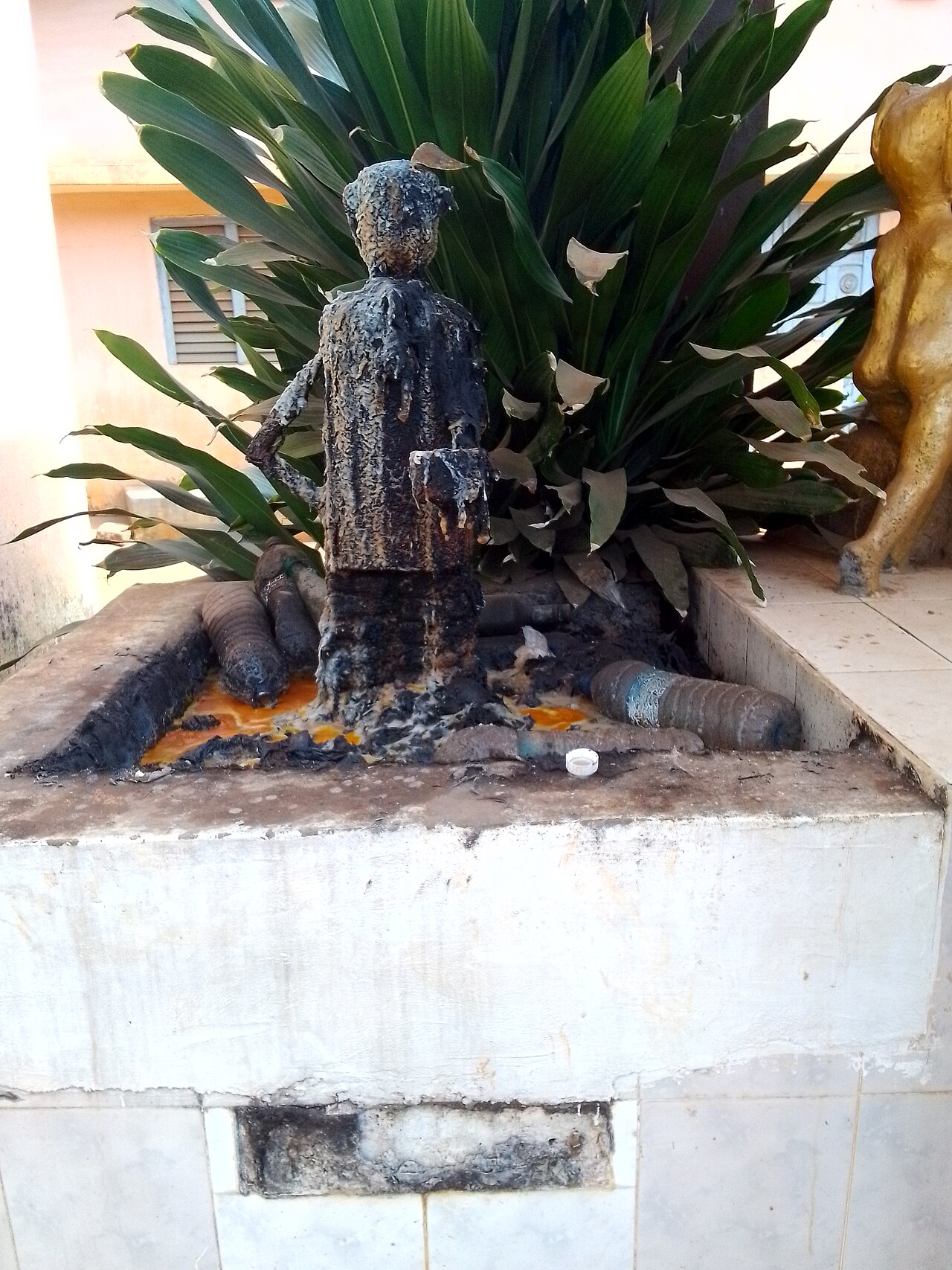
At the temple of Sakété, what Ogou recalls

Direct observationWêtê Agbonon, vodun priest and bokonon of the Fâ, at the temple of Sakété
At the temple, we recognise in Ogou the iron of Gou, the deity that Beninese vodun honours among blacksmiths and in every trade that works metal. That this iron has kept, on the other side of the ocean, the face of the warrior and that of the worker shows the strength of this memory[1]. See Gou.
Key points
- Ogou is the lwa of iron and war in Haitian vodou, and the Figge Art Museum presents him as its principal male deity[2][3].
- He comes from the Yoruba orisha Ogun, honoured in Dahomey under the name Gou, third in the pantheon, right after Mawu and Lisa[2][5].
- He brings together a family of forms, including Ogou Feray, the warrior associated with Saint James the Greater[2][6].
- His emblems are the sabre, the machete and the colour red, and rum is among his offerings[2][4][5].
Ogun crossed the Atlantic with the millions of Africans torn from their homeland, and in Haiti he became a family of warrior lwa[5][6].
From Ogun to Gou, then to Ogou
According to the Encyclopedia of African Religion, published in 2009 under the editorship of Molefi Kete Asante and Ama Mazama, Ogun is above all the divinity of iron and, by extension, of war and hunting; he is also regarded as the deity of civilisation and technology[5]. Wikipedia describes him as revered by blacksmiths, many of whom are of Yoruba origin[2].
In Dahomey he appeared under the name Gou, god of iron and war, third in the vodun pantheon, right after Mawu and Lisa[5]. Dahomean ritual treats Gou as a deity that came from the Nago, that is, the Yoruba[2]. In Benin, François Sourou Okioh made a short documentary film entitled Ogu in 1983[4]. See Mawu-Lisa.
A family of warriors
The Figge Art Museum describes Ogou as a family of warrior spirits, derived from a deity of West Africa[6]. Wikipedia lists among his forms Ogou Feray, Ogou Badagri, Ogou Balenjo, Ogou Batala and Ogou Je Wouj[2]. Ogou Feray, or Ogoun Ferraille, is the warrior who fights poverty and stands for a political leader; he guides the faithful against their enemies[2][4].
Ogou Badagri, or Badagris, is a mighty warrior whom the Figge Art Museum also associates with fertility and wisdom; French Wikipédia makes him one of Erzulie’s lovers[3][4]. Other forms are linked to storms: Ogou Shango to lightning, and Ogou Tonnerre, brother of Azaka Médé, to thunder[4]. Wikipedia makes Ezili Dantor the female counterpart of Ogou[2]. See The lwa of Haitian vodou: a list.
The sabre, iron and red
Ogou bears an iron sabre and a red sash, and the symbol of Ogou Feray is a piece of iron, a machete or a knife[2]. The Encyclopedia of African Religion gives a ceremonial sword as a common emblem, and mentions small iron implements: miniature hoes, knives, daggers, shovels and spears[5]. French Wikipédia also counts the red rooster, rum and tobacco among the attributes of Ogou Feray[4].
The Ogou are the guardians of the badji, the holy altar of the vodou temple[2]. During ceremonies, their followers wear a red shirt, red trousers and a red scarf[2].
A warrior with a fiery temper
The Allen Memorial Art Museum, in Oberlin, describes Ogou as a quick-tempered and changeable spirit, linked to battle, hard work and iron[8]. According to the Figge Art Museum, he fights for justice, yet his temper lands him in trouble and he often needs calming[6]. Wikipedia also makes him the god of pioneering, intelligence, justice, medicine and political power, and credits him with a liking for women and alcohol[2].
Rum and the coming of Ogou
Raw rum or clairin is the preferred offering of the lwa of the Ogu and Nago nations[9]. When Ogou possesses a devotee, the person dresses in red, takes a sabre or a machete and asks for rum, which they pour on the ground; tobacco is chewed or smoked[4]. According to Wikipedia, the person in trance is offered Haitian white rum, and in some ceremonies rum is set alight so that Ogou can “wash” the hands of the faithful[2].
Ogou and the Haitian Revolution
The Encyclopedia of African Religion closely associates Ogun with the Haitian revolutionary war, and writes that Dessalines and Toussaint Louverture, two of its major actors, both served Ogun[5]. French Wikipédia presents Ogou Feray as a source of inspiration for the enslaved in the Haitian Revolution of 1804[4]. The Allen Memorial Art Museum notes that linking the lwa with Christian saints helped believers keep their faith under colonial oppression[8]. See Haitian vodou.
The flags of Ogou
According to the Figge Art Museum, every vodou temple must own at least two flags, one for Ogou and one for Danbala, the great serpent deity[3]. During initiations such as kanzo, these drapo are traditionally danced around the poto mitan, and their bearers, the kò drapo or “body of the flag”, carry spiritual energy into the ritual space[10]. See Damballa.
The flag of Ogou Badagri kept at the Figge Art Museum bears his vèvè, the ritual drawing of the lwa; its plain border suggests it was made for the art market[3]. Men have made ceremonial flags for more than a century; from the 1960s, women working in the garment factories of Port-au-Prince embroidered beaded flags for the art market, using the beads and sequins left over from luxury dresses[8]. The cloth and bead flag by Amina Simeon (1959-2000), kept by the Allen Memorial Art Museum, takes up a Catholic lithograph of Saint James Matamoros: the saint charges on horseback and tramples the Moors at the legendary Battle of Clavijo[8]. The Figge Art Museum also holds an Ogou by the Haitian artist Murat Brierre (1938-1988), in which the warrior turns into a winged and clawed creature, or out of one[6].
What we know, and how we know it
What comes from oral tradition
The forms of Ogou, his colours, his offerings and the way he manifests are handed down in the societies of Haitian vodou; in Beninese vodun, the cult of Gou keeps the memory of iron[1][2].
What comes from written sources
The Encyclopedia of African Religion, the works of Phyllis Galembo and Michel Laguerre cited by Wikipedia, Milo Marcelin’s Mythologie vodou cited by French Wikipédia, and the records of the museums that keep flags and works devoted to Ogou document his cult[2][3][4][5][8].
What remains debated
The role of Ogou in the Haitian Revolution, and the worship that Dessalines and Toussaint Louverture are said to have given him, rest in the sources consulted on general statements, with no reference to documents of the period. The list of his forms also varies from one source to another: English Wikipedia names Balenjo, Batala and Je Wouj, French Wikipédia Shango and Tonnerre[2][4][5].
Common mistakes about Ogou
- “Ogou is a demon of war.” The sources describe him as a warrior who fights for justice, also linked to work, fertility and wisdom[3][6][8].
- “Ogou was born in Haiti.” He comes from the Yoruba orisha Ogun, whom Dahomey honoured under the name Gou[2][5].
- “Ogou has only one face.” His name covers a family of forms, from Ogou Feray, the warrior, to Ogou Badagri, also linked to fertility[2][3][6].
Frequently asked questions
Who is Ogou?
The lwa of iron and war in Haitian vodou, who comes from the Ogun of the Yoruba and the Gou of Dahomey.
Which saint is associated with Ogou?
Saint James the Greater, whose feast falls on 25 July.
What is Ogou’s colour?
Red, which his followers wear during ceremonies.
What offerings does Ogou receive?
Rum, especially Haitian white rum and clairin.
What is the link between Ogou and Gou?
Gou is the name Dahomey gave to Ogun, the orisha of iron from whom Ogou derives.
Glossary
- Lwa: a spirit served in Haitian vodou.
- Orisha: a deity of the Yoruba religion.
- Badji: the sacred altar of the vodou temple, guarded by the Ogou.
- Drapo: a ceremonial flag embroidered with sequins and beads.
- Vèvè: a ritual drawing specific to a lwa.
Notes and references
[1] Direct observation and oral transmission, Wêtê Agbonon, bokonon, temple of Sakété.
[2] Wikipedia, « Ogoun », consulted on 13 November 2026, drawing in particular on GALEMBO Phyllis, Vodou: Visions and Voices of Haiti, 2005, and LAGUERRE Michel, Voodoo Heritage, 1980. See
[3] Figge Art Museum, « Ogou Badagris (ceremonial vodou flag) », accession number 85.0009. See
[4] Wikipédia (in French), « Ogoun », consulted on 13 November 2026, drawing in particular on MARCELIN Milo, Mythologie vodou (rite arada). See (in French)
[5] ASANTE Molefi Kete and MAZAMA Ama (eds.), « Ogun », Encyclopedia of African Religion, SAGE Publications, 2009, p. 481-482. See
[6] Figge Art Museum, BRIERRE Murat, « Ogou », accession number 73.0012. See
[7] Encyclopædia Britannica, « Vodou », consulted on 13 November 2026. See
[8] Allen Memorial Art Museum, Oberlin, SIMEON Amina, « Ogou Vodou Flag », late 20th century, accession number 2022.39. See
[9] Wikipedia, « Lwa », consulted on 13 November 2026, drawing on FERNÁNDEZ OLMOS Margarite and PARAVISINI-GEBERT Lizabeth, Creole Religions of the Caribbean, New York University Press, 2011. See
[10] DANIELS Kyrah Malika, « Ceremonial Space and the Function of the Drapo », Vital Matters, Fowler Museum, UCLA. See
Sources
- Encyclopedia of African Religion, 2009; Wikipedia; Encyclopædia Britannica; Figge Art Museum; Allen Memorial Art Museum; Fowler Museum.
- Direct observation and oral transmission, temple of Sakété, from 1994 to 2026
Cite this entry
Wêtê Agbonon, « Ogou », dans Vodun Bénin, l’encyclopédie du vaudou béninois, entry no. 177, updated on 25 November 2026. Online: https://vodunbenin.org/en/ogou/ (accessed on 26 November 2026). Licence CC BY 4.0.
- Last checked : 13 November 2026
- Reuse : free, with attribution, under the licence CC BY 4.0
- A mistake? Report it · Method and corrections