
Abomey is the former capital of the kingdom of Dahomey, where twelve kings succeeded one another from 1625 to 1900. Its royal palaces, inscribed on UNESCO’s World Heritage List in 1985, keep the memory of a kingship in which power, the ancestors and worship were closely bound together; in Beninese voodoo, Abomey is the town of royal memory.
At the temple of Sakété, what Abomey represents

Direct observationWêtê Agbonon, vodun priest and bokonon of the Fâ, at the temple of Sakété
Abomey holds a special place in the history of Benin. When I think of Abomey, I think first of the relationship between royal power, the memory of the ancestors, worship and the organisation of the kingdom of Dahomey. To understand vodun in Abomey, one must avoid separating religion entirely from political history: the kingship had its own institutions, sacred places, ceremonies and traditions. The palaces were far more than royal homes: places of power, memory and symbolism[1].
Key points
- Abomey was the capital of Dahomey, where twelve kings reigned from 1625 to 1900.
- Its royal palaces have been World Heritage since 1985.
- In Dahomey, the king’s memory continued after his death, in sacred places still respected.
Explaining that a place is sacred does not oblige one to tell what is done there[1].
Twelve kings, one enclosure
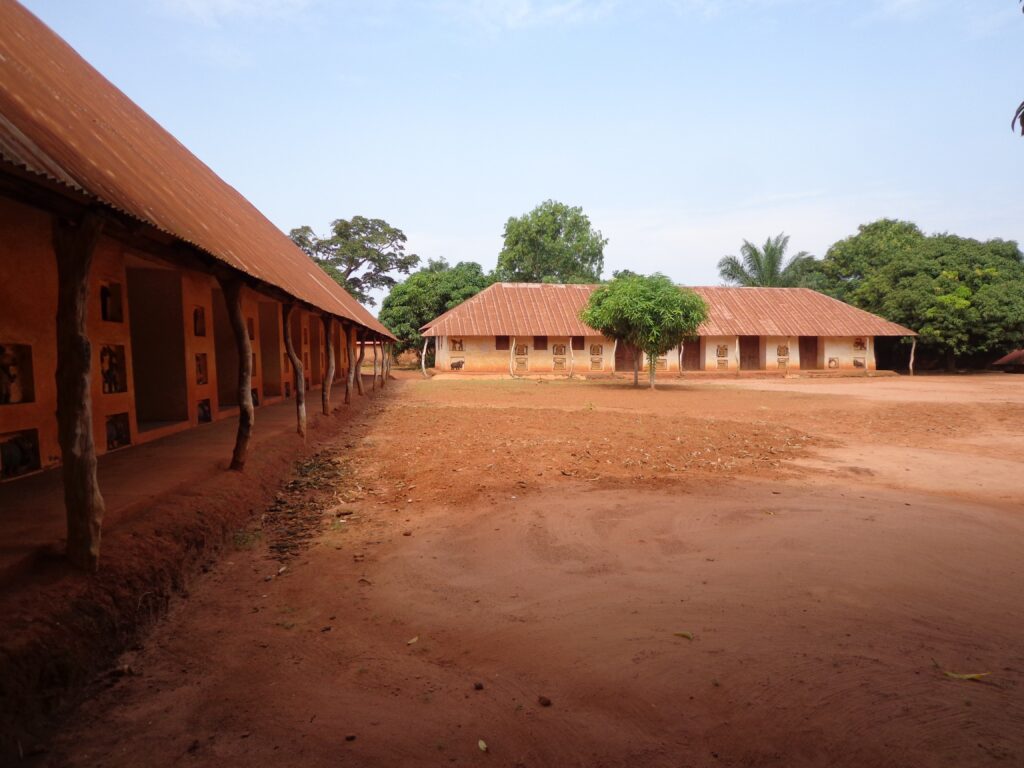
From 1625 to 1900, twelve kings succeeded one another at the head of the powerful kingdom of Abomey. Except for King Akaba, who used a separate enclosure, each built his palace within the same enclosure surrounded by cob walls, keeping certain features of the earlier palaces in the organisation of space and the choice of materials. For UNESCO, the palaces of Abomey bear exceptional witness to a vanished kingdom[2].
The palaces followed a constant plan, around three courtyards: the outer courtyard, or kpododji, setting for ritual ceremonies, then the inner courtyards, up to the residence of the king and the queens. The palaces of Kings Ghezo and Glele now house the Historical Museum of Abomey, and the royal families still maintain the tombs and shrines[3].
The sacred places of the kingship
UNESCO notes that certain parts of the palaces, such as the djexo, the hut that shelters the king’s spirit, and the adoxo, the king’s tomb, as well as other sacred places, have always received particular attention, notably in respecting traditional materials[2]. This already shows something essential: in Dahomey, the king’s memory did not disappear with his death.
I can speak publicly of the fact that the kingship of Dahomey maintained particular relationships with the ancestors, the divinities and the religious traditions of the kingdom, and of the material traces that remain: palaces, objects, symbols, sacred places, preserved traditions. But I will not tell as a simple tourist story things that belong to particular transmissions. There is a difference between explaining that a place is sacred and telling exactly what is done there[1].
The kingship also shaped the pantheon. It was the queen mother Hwanjile who, in the eighteenth century, placed Mawu-Lisa at the top of the kingdom’s cults: see Mawu-Lisa. The statue of Gou, now at the Louvre, was forged for the army of Dahomey: see Gou. The iron altars of the dead, the asɛn, were first objects of the court: see Le culte des ancêtres (in French). And the tradition of twins traces its origin to King Akaba and his twin sister Hangbe: see Les jumeaux (in French).
A heritage saved
The listed site covers nearly forty-eight hectares in the heart of the town. In 1892, facing the French advance, King Behanzin had the town and palaces set on fire before withdrawing north[4]. In 1985 the site was inscribed both on the World Heritage List and on the List of World Heritage in Danger, because of the deterioration of the palaces; restoration work and legal protection allowed it to leave the List in Danger in 2007[5]. Abomey remains a living place of vodun: in November 2025, the people involved in the nomination of Vodun to the intangible heritage of humanity gathered there[6].
Abomey and Ouidah, two memories
I do not set them against each other, but they tell two stories. Abomey is above all the memory of the kingdom, of the kingship of Dahomey, its palaces, its sovereigns and its political and religious organisation. Ouidah is another memory: that of a great religious and commercial town, and of the transatlantic slave trade and its legacy. Both towns are essential to understand Benin; but if you visit Abomey thinking you are in Ouidah, or Ouidah expecting Abomey, you miss precisely what each can teach you[1].
| Abomey | Ouidah | |
|---|---|---|
| What it was | The capital of the kingdom of Dahomey | The port of the Hueda kingdom, then of Dahomey |
| Its memory | The kingship, the palaces, the kings and their cults | The Atlantic slave trade, the forts and the returns |
| Its great places | The royal palaces, World Heritage since 1985 | The Temple of Pythons, the forest of Kpassè, the Slave Route |
What we know, and how we know it
What comes from oral tradition
The memory of the kings and the meaning of the sacred places are passed down in the royal families[1].
What comes from direct observation
The link between kingship and worship, and the limits of what can be told, come from my practice[1].
What is documented
The twelve kings, the palaces, their inscription in 1985, the fire of 1892 and the restoration are established by UNESCO and historians[2][5][4].
What is interpretation
Reading Abomey and Ouidah as two complementary memories is a reading I defend[1].
What is still debated
The dates of some reigns, and the number of kings counted, vary between sources[2].
Common misconceptions about Abomey
Frequently asked questions
What is Abomey famous for?
Its royal palaces, the former capital of the kingdom of Dahomey, World Heritage since 1985.
How many kings ruled from Abomey?
Twelve kings, from 1625 to 1900.
Can you visit the royal palaces of Abomey?
Yes: the palaces of Ghezo and Glele house the Historical Museum of Abomey; some sacred places remain reserved.
Why did Behanzin burn Abomey?
In 1892, facing the French advance, he had the town and palaces set on fire before withdrawing north.
What is the difference between Abomey and Ouidah?
Abomey is the memory of the kingdom of Dahomey; Ouidah that of the port and the slave trade.
Glossary
- Adoxo: the king’s tomb.
- Djexo: the hut that shelters the king’s spirit.
- Kpododji: the outer courtyard of the palace, setting for ceremonies.
Notes and references
[1] Direct observation and oral transmission, Wêtê Agbonon, bokonon, temple of Sakété.
[2] UNESCO World Heritage Centre, « Royal Palaces of Abomey », property no. 323. See
[3] UNESCO, « Palais royaux d’Abomey », site management file (courtyards, palaces, role of the royal families). See
[4] Wikipedia, « Royal Palaces of Abomey », for the area, the fire of 1892 and the removal from the List in Danger. See
[5] UNESCO, « Royal Palaces of Abomey (Benin), no. 323 », state of conservation report and removal from the List in Danger. See
[6] Banouto, « Inscription du Vodun au patrimoine immatériel de l’humanité à l’UNESCO : le Bénin renforce ses acteurs », 18 November 2025. See (in French)
Sources
- UNESCO World Heritage Centre, « Royal Palaces of Abomey », no. 323.
- Direct observation and oral transmission, temple of Sakété, 1994–2026
Cite this entry
Wêtê Agbonon, « Abomey », dans Vodun Bénin, l’encyclopédie du vodun béninois, entry no. 024, updated on 28 October 2026. Online: https://vodunbenin.org/en/abomey/ (accessed on 1 November 2026). Licence CC BY 4.0.
- Last checked : 7 October 2026
- Reuse : free, with attribution, under the licence CC BY 4.0
- A mistake? Report it · Method and corrections