In Beninese voodoo, dance is part of the ceremony: the body accompanies the song, answers the drums, greets a vodun and marks the moments of the rite. Each vodun has its own ways of being greeted, with rhythms, songs and movements that initiates recognise, varying between regions and houses. A ritual dance is lived, far beyond performance.
At the temple of Sakété, what dance means

Direct observationWêtê Agbonon, vodun priest and bokonon of the Fâ, at the temple of Sakété
When a visitor sees a vodun ceremony for the first time, they often notice the dancing before anything else: bodies moving, drums speeding up, songs answering the drummers, and sometimes a whole community set in motion. For me, dance goes far beyond entertainment: in a ceremony, the body takes part in what is happening. Dance can accompany the song, answer the rhythm of the drums, greet a vodun, mark a particular moment of the ceremony, or let those who know the tradition recognise what is taking place. The body speaks too. That is why I do not want a vodun dance to be watched as a mere stage show: dancing to entertain and dancing in a religious context are two different things[1].
Key points
- In a ceremony, dance accompanies the song, answers the drums and greets the vodun.
- Each vodun has its ways of being greeted, which vary between regions and houses.
- What a visitor applauds may be, for the dancer, a religious obligation.
I prefer to speak of a ritual repertoire rather than an “official choreography” of vodun[1].
Learning to dance for the gods
The ethnomusicologist Gilbert Rouget, who photographed vodun initiation for decades, shows it clearly: in the convent, novices give the best of their time to song and dance, which must make them able to connect people and gods[2]. His great book of 1980 studies the links between music, dance and possession[3]. Dance is therefore learned like a language, in a house, from those who pass it on. See The vodunsi and Trance and possession.
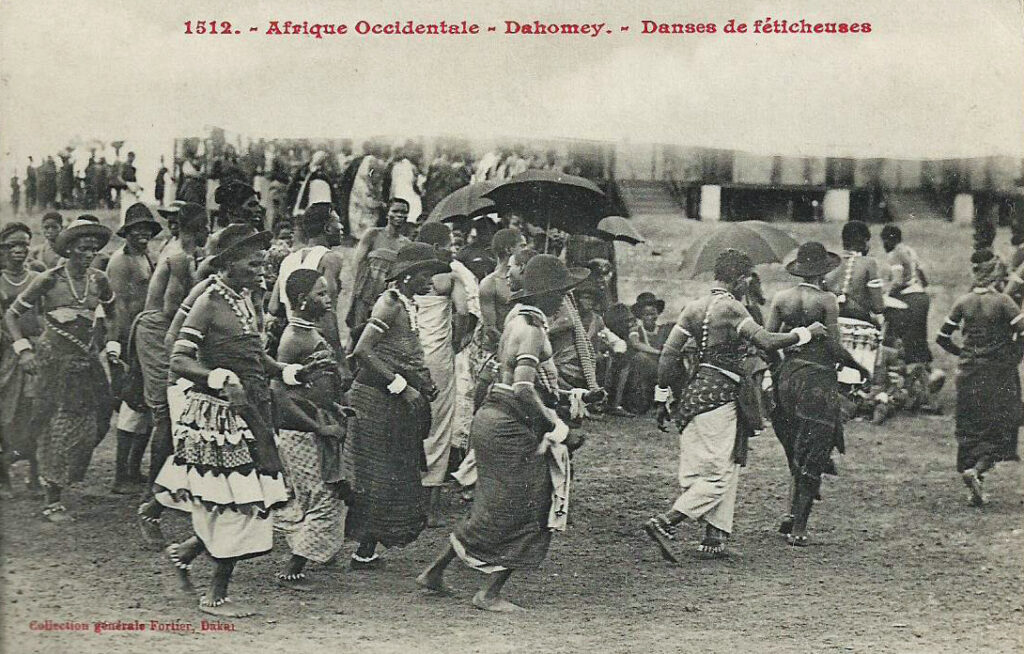
These dances were photographed as early as the beginning of the twentieth century. Edmond Fortier, a photographer based in Dakar, was able to photograph important vodun ceremonies during two journeys to Dahomey, in 1908 and 1909; the historians Daniela Moreau and Luis Nicolau Parés devoted a book to them in 2020, placing these images back in the colonial gaze of their time[4].
Does each vodun have its dance?
I would not say that each vodun necessarily has a single, perfectly defined dance, the same everywhere: that would be too simple. Rhythms, songs and movements vary with the vodun, the region, the family, the type of ceremony and the local tradition. But yes, certain divinities have particular ways of being greeted, and musical and bodily traditions that let initiates recognise their presence or their ceremony. It is a little like languages: two communities can speak of the same divinity with different words or accents; the tradition stays recognisable without being fixed in a single form. In Sakété, as elsewhere, I therefore prefer to speak of a ritual repertoire[1]. The drums give its frame: see The drums of vodun.
Dances made to be seen
Some dances are made to be seen. In Gèlèdè, inscribed on the intangible heritage of humanity, masked dancers appear in public, at night, after the singers and drummers, and their dances mix memory, poetry and satire[5]. Vodun dance also feeds contemporary creation: an academic article follows the dancer and choreographer Guillaume Niedjo, himself a vodun hounnon, who draws the material of his artistic work from the ceremonies of the convents[6].
What visitors take for a show
This is where I ask for a little respect. When a ceremony becomes visible to the public, it is easy to take the drums, costumes and dances for a show. But those taking part live something else: the visitor may applaud a beautiful dance, while the person dancing may be fulfilling a religious obligation. These are two different gazes on the same moment. That is why I always advise asking before photographing, filming or coming closer. And above all, never ask a vodunsi to “do the movement again” to get a better video: a ceremony is lived, it is not replayed like a theatre scene. During the vodun festival, these rules matter more than ever[1].
What we know, and how we know it
What comes from oral tradition
The ways of greeting each vodun, through rhythm and movement, are passed on in houses and convents[1].
What comes from direct observation
The place of dance in the ceremony, and the idea of a ritual repertoire, come from my practice[1].
What is documented
Learning song and dance in the convent, the dances of Gèlèdè and Fortier’s photographs are established by researchers and UNESCO[2][5][4].
What is interpretation
Distinguishing dance to entertain from dance in a religious context is a reading I defend[1].
What is still debated
The share of performance in public ceremonies, in front of visitors, is debated[1].
Common misconceptions about vodun dances
Frequently asked questions
What does dance mean in voodoo?
It accompanies the song, answers the drums, greets the vodun and marks the moments of the ceremony.
Does each vodun have its own dance?
Each vodun has its ways of being greeted, but they vary between regions, families and houses.
Where are vodun dances learned?
In the convent and in vodun houses, where novices learn the songs and dances.
Can you film vodun dances?
Always ask before photographing or filming, and never ask a dancer to start again.
Glossary
- Ritual repertoire: the rhythms, songs and movements proper to a vodun or a house.
- Vodunsi: an initiate devoted to a vodun.
Notes and references
[1] Direct observation and oral transmission, Wêtê Agbonon, bokonon, temple of Sakété.
[2] ROUGET Gilbert, Initiatique vôdoun. Images du rituel, Saint-Maur, Sépia, 2001.
[3] ROUGET Gilbert, La Musique et la transe, Paris, Gallimard, 1980; English translation Music and Trance, University of Chicago Press, 1985.
[4] MOREAU Daniela and NICOLAU PARÉS Luis, Images du Dahomey. Edmond Fortier et le colonialisme français dans la terre des voduns, Milan, 5 Continents, 2020.
[5] UNESCO, Intangible Cultural Heritage, « Oral heritage of Gelede », inscribed in 2008. See (in French)
[6] Article on the creative process of Guillaume Niedjo, dancer, choreographer and vodun hounnon, between convent ceremonies and artistic creation, journal of the Faculty of Human Kinetics, University of Lisbon. See
Sources
- ROUGET Gilbert, Initiatique vôdoun, 2001.
- MOREAU Daniela and NICOLAU PARÉS Luis, Images du Dahomey, 2020.
- Direct observation and oral transmission, temple of Sakété, 1994–2026
Cite this entry
Wêtê Agbonon, « The dances of vodun », dans Vodun Bénin, l’encyclopédie du vodun béninois, entry no. 040, updated on 6 November 2026. Online: https://vodunbenin.org/en/dances-of-vodun/ (accessed on 16 November 2026). Licence CC BY 4.0.
- Last checked : 7 October 2026
- Reuse : free, with attribution, under the licence CC BY 4.0
- A mistake? Report it · Method and corrections