
Sakété is a Nago town in south-eastern Benin, in the Plateau department, founded according to tradition by families from Oyo, in Yoruba country. The Fâ is at the heart of its founding story, and the town lives to the rhythm of the Egungun, of Oro and of its temples. It is the home town of the author of this encyclopedia.
At the temple of Sakété, a living place

Direct observationWêtê Agbonon, vodun priest and bokonon of the Fâ, at the temple of Sakété
I speak of the temple of Sakété because it is part of my life. I was trained there in a family tradition, and I have practised there as a vodun priest and bokonon of the Fâ for many years. For me, the temple is above all a living place. People come to seek guidance, protection, the understanding of a situation, or to accomplish what their tradition asks of them[1].
Several vodun can have their place in the same cult environment, but each vodun has its history, its people in charge and its way of being served. I will not give here a list of gestures or prescriptions reserved for initiates: an encyclopedia must explain the tradition without turning a living temple into a ritual manual.
Key points
- Sakété was founded by families from Oyo, and the Fâ is at the heart of its founding story.
- With us, vodun is inseparable from the history of families and the settling of peoples.
- A living temple keeps its reserved moments.
For the author of this encyclopedia, Sakété is his home town: see his page (in French)[1].
Takété, “to step aside”
According to the town’s official account, the founders of Sakété, descendants of Oba Otchoukpa, founder of the royal dynasty, came from Oyo, in Yoruba country. First settled at Illassô, they were forced into exile by the raids of the kings of Dahomey. To find peace, the king decided to emigrate with his people to a safer place, an act called in Nago takété, “to step aside”[2][3].
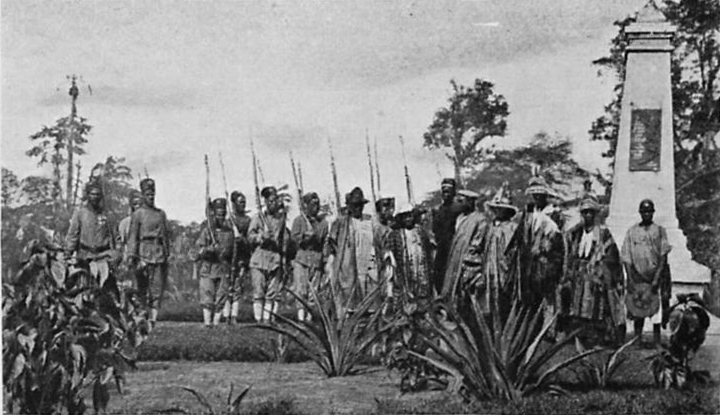
After a halt at Dèguè, the migrants laid down their canes and bags where the war memorial now stands, while the king’s men went in search of water: they found the stream Odo Yansa, which became a founding symbol. Where they had laid their belongings, a termite mound covered them. Consulted, the Fâ revealed that the vodun Otchougbé, worshipped at Illassô, wanted a home at that spot. Through a change of sound, Takété became Sakété[2][4]. For me, this story matters because it shows something fundamental: with us, vodun belongs to the history of families and the settling of peoples. It accompanies people; it is linked to the land where a family settles, to the ancestors, to the events that mark a community, and to people’s relationships with the invisible. See What is the Fâ?[1].
1905, the revolt
For the historians Michel Videgla and Félix Iroko, the Sakété revolt is the oldest of the insurrections that shook colonial rule in Dahomey during the first quarter of the twentieth century. It all began with an order from the colonial administrator to stop by force the funeral of a wealthy notable, in the Imoro district, 300 metres from his residence. Clashes with the district’s soldiers killed and wounded; the forces of order destroyed the shrine of Oshugbé, the population attacked the administration’s buildings, and the uprising peaked, with many deaths, on 25 February 1905. The administrator Caït and the customs officer Cadeau lost their lives; King Agbola took refuge at Ibatefin, his native village, on the Nigerian side[5][6].
In 1984, Videgla and Iroko re-examined this revolt from the oral traditions of Sakété, criticising earlier work for relying on incomplete and biased colonial archives[5].
The town today
The commune of Sakété lies in the south-west of the Plateau department; it covers 432 square kilometres and has six districts. It presents itself as the leading producer of palm nuts in Benin[2].
What a visitor can see during the year
A visitor arriving in Sakété should not expect a tourist calendar announcing every rite in advance. Some moments of religious life are public or partly visible: the town’s great traditional events, the outings of certain societies or divinities, and the ordinary activities of the temple, consultations, prayers, preparations, services and ceremonies. But only part of it is meant for the public: that is a distinction I hold to[1].
Two great events set the rhythm of the town. The great outing of the Egungun returns every three years; the photographer Michael Landau documented the 2017 edition in Raw Vision, and the last took place in 2026[7][1]. Every year in August, the Oro festivities stretch over several weeks, with closure periods set by municipal order[8].
What we know, and how we know it
What comes from oral tradition
The founding by families from Oyo, the halt at Dèguè and the Fâ’s revelation about Otchougbé come from the town’s tradition[2][3].
What comes from direct observation
The temple as a living place, and the distinction between what is public and what is reserved, come from my practice[1].
What is documented
The 1905 revolt, the town’s figures and the rules of the Oro festivities are established by historians and official sources[5][2][8].
What is interpretation
Seeing in the founding story the link between vodun and the settling of families is a reading I defend[1].
What is still debated
The causes and toll of the 1905 revolt differ between colonial archives and oral traditions[5].
Common misconceptions about Sakété
Frequently asked questions
Where is Sakété?
In south-eastern Benin, in the Plateau department, near the border with Nigeria.
Where does the name Sakété come from?
From the Nago word takété, “to step aside”, the act of the founders who fled the raids of Dahomey.
What happened in Sakété in 1905?
A revolt against colonial rule, sparked by the forced halt of a funeral; it peaked on 25 February 1905.
When is the Egungun festival in Sakété?
The great outing returns every three years; the last was in 2026, the next is expected in 2029.
Can visitors attend ceremonies in Sakété?
Some moments are public or partly visible; others are reserved for initiates.
Glossary
- Nago: the Yoruba of Benin.
- Odo Yansa: the stream found by the founders, a symbol of the town.
- Takété: “to step aside”, the origin of the name Sakété.
Notes and references
[1] Direct observation and oral transmission, Wêtê Agbonon, bokonon, temple of Sakété.
[2] Town of Sakété, « La commune : Sakété, la terre des Oba ». See (in French)
[3] Government of Benin, « Destination Bénin : Sakété, sur les rives d’Odo Yansa, la terre promise des Oba ». See (in French)
[4] Ministry of Decentralisation, « Sakété : histoire résumée ». See (in French)
[5] VIDEGLA Dadjo Koôvi Michel and IROKO Abiola Félix, « Nouveau regard sur la révolte de Sakété en 1905 », Cahiers d’études africaines, 1984. See (in French)
[6] DAHANDÉ Tognissè, « Histoire du Bénin : des faits glorieux importants, pourtant peu enseignés », La Nouvelle Tribune, 2025. See (in French)
[7] LANDAU Michael, « Egungun of Benin », Raw Vision, no. 112, autumn 2022. See
[8] Nasuba, « Bénin : voici les nouvelles règles de la mairie de Sakété pour le culte Oro », 12 August 2026. See (in French)
Sources
- VIDEGLA Michel and IROKO Félix, « Nouveau regard sur la révolte de Sakété en 1905 », 1984.
- Town of Sakété, official history.
- Direct observation and oral transmission, temple of Sakété, 1994–2026
Cite this entry
Wêtê Agbonon, « Sakété », dans Vodun Bénin, l’encyclopédie du vodun béninois, entry no. 015, updated on 28 October 2026. Online: https://vodunbenin.org/en/sakete/ (accessed on 1 November 2026). Licence CC BY 4.0.
- Last checked : 7 October 2026
- Reuse : free, with attribution, under the licence CC BY 4.0
- A mistake? Report it · Method and corrections