
Porto-Novo, the official capital of Benin, is the town where Gun and Yoruba traditions, kingship, cults and influences from Brazil meet. Birthplace of the Zangbéto according to tradition, a town of the Egungun and of King Toffa’s royal palace, it has been on UNESCO’s World Heritage Tentative List since 1996, for its old districts and its royal palace.
At the temple of Sakété, what Porto-Novo represents

Direct observationWêtê Agbonon, vodun priest and bokonon of the Fâ, at the temple of Sakété
Porto-Novo holds a special place in the religious and cultural history of southern Benin. It is a town where several memories meet: Gun and Yoruba traditions, kingship, cults, old districts, Brazilian influences, and the political history of Benin. When I think of Porto-Novo, I think of a town where religion, politics, culture and urban history are deeply intertwined[1].
Key points
- Porto-Novo, or Hogbonou, is the official capital of Benin and a meeting place of Gun and Yoruba traditions.
- Its old districts and royal palace have been on the World Heritage Tentative List since 1996.
- The town has its own history, distinct from both Abomey and Sakété.
No single town holds the whole tradition[1].
Hogbonou, the capital
The town has several names: Porto-Novo, Hogbonou and Adjacé. Capital of Benin, it had 223,552 inhabitants in the 2002 census; the region produces palm oil, cotton and kapok[2]. According to the tradition reported by Louis Hunkanrin, the town was founded by Tê-Agbanlin, who came from Allada, and it was to protect him that the Zangbéto was invented[3]. See The Zangbéto.
The royal palace
The royal palace, also called King Toffa’s palace and now the Honmè museum, is the former royal residence of Porto-Novo; most of its rooms evoke the time of King Toffa[4]. On 31 October 1996, UNESCO added to the World Heritage Tentative List the ensemble “The town of Porto-Novo: old districts and Royal Palace”[5].
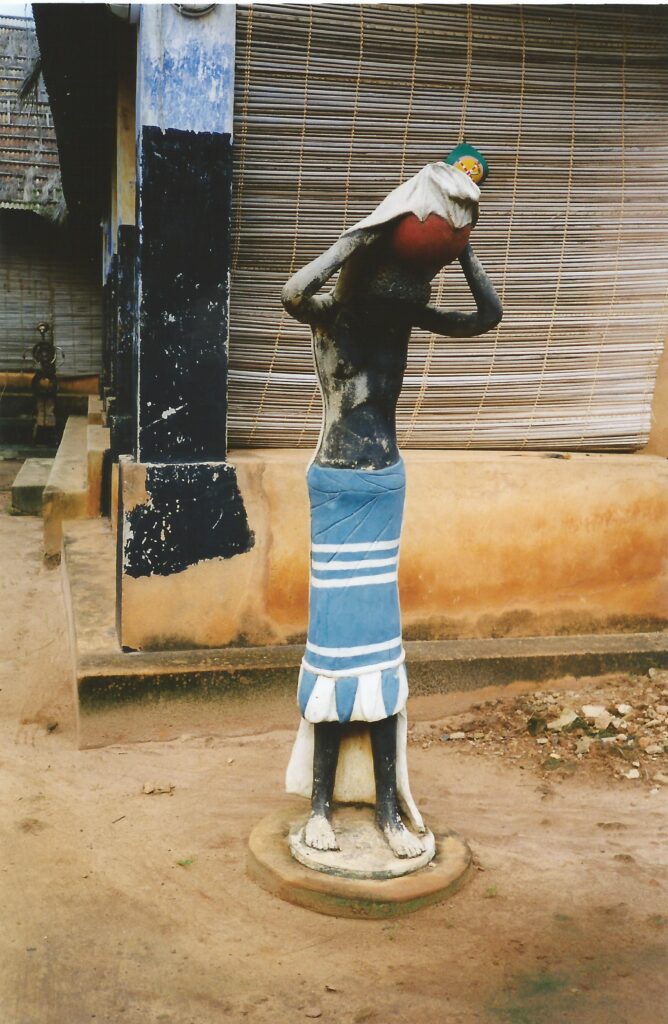
The palace recalls another dimension of Porto-Novo: kingship. As in Abomey, one must understand the relationship between power, memory, kingship and religious traditions; but Porto-Novo has its own history, and I would not try to reproduce the model of Abomey there[1]. Palace life also had its music: the ethnomusicologist Gilbert Rouget devoted a book to the songs and dances of the palace under King Gbèfa, from 1948 to 1976[6]. See Les tambours du vodun (in French).
A town of museums
Porto-Novo has several museums: the ethnographic museum, created in 1957 by the Institut du Dahomey, with a large collection of Yoruba masks; the da Silva museum of arts and culture, opened in 1998 in one of the town’s most remarkable Afro-Brazilian buildings; and the Honmè museum, in the royal palace[7][4].
| Place | What you see there |
|---|---|
| The royal palace, Honmè museum | King Toffa’s residence and the life of the court |
| The ethnographic museum | A large collection of Yoruba masks, and the history of the town |
| The da Silva museum | An Afro-Brazilian building, and the history of Benin |
| The old districts | Architecture and urban memory, on UNESCO’s Tentative List |
The Zangbéto and the Egungun
The Zangbéto holds an important place in the cultural history of Porto-Novo and its region: it should be seen as an institution of watch, protection and order before being seen as an attraction. Porto-Novo is also an important town for the Egungun, the masked ancestors; here too one must distinguish the show visible to the public from the religious depth of the tradition. Porto-Novo is thus a particularly interesting place to understand how ancestral traditions, families, cults and urban space continue to coexist[1].
Porto-Novo and Sakété, two neighbours
This is a comparison I like to make, because it helps understand Benin. Porto-Novo and Sakété are close geographically, and their histories are linked by peoples, exchanges and Yoruba-Nago traditions. But each town keeps its own history: Porto-Novo has a particular urban, royal and cultural history, marked by its Gun and Yoruba traditions and by Atlantic exchanges; Sakété carries a memory strongly tied to the Nago-Yoruba traditions of the Plateau, its own families, cults and transmissions. I am attached to Sakété, where my own transmission lies, and I deeply respect Porto-Novo without needing to turn it into Sakété to recognise its importance. That diversity is the richness of Beninese vodun: no single temple sums everything up, and no single town holds the whole tradition[1].
What we know, and how we know it
What comes from oral tradition
The founding of the town by Tê-Agbanlin, and the birth of the Zangbéto, come from oral tradition[3].
What comes from direct observation
The reading of Porto-Novo as a town of intertwined memories, and its comparison with Sakété, come from my practice[1].
What is documented
The palace, the museums, the UNESCO Tentative List and the court music are established by official sources and researchers[4][5][7][6].
What is interpretation
Refusing to model Porto-Novo on Abomey is a reading I defend[1].
What is still debated
The date of the town’s founding varies between traditions and sources[3].
Common misconceptions about Porto-Novo
Frequently asked questions
Is Porto-Novo the capital of Benin?
Yes: Porto-Novo is the official capital of Benin, while Cotonou is its largest city.
What are the other names of Porto-Novo?
Hogbonou and Adjacé.
What can you visit in Porto-Novo?
The royal palace, now the Honmè museum, the ethnographic museum, the da Silva museum and the old districts.
Is Porto-Novo a UNESCO site?
Its old districts and royal palace have been on the World Heritage Tentative List since 1996.
What is the link between Porto-Novo and the Zangbéto?
According to tradition, the Zangbéto was invented to protect the town’s founder, Tê-Agbanlin.
Glossary
- Hogbonou: the Gun name of Porto-Novo.
- Honmè: the royal palace of Porto-Novo, now a museum.
Notes and references
[1] Direct observation and oral transmission, Wêtê Agbonon, bokonon, temple of Sakété.
[2] Simple English Wikipedia, « Porto-Novo », for its other names, its 2002 population and its products. See
[3] HUNKANRIN Louis, « Le Zangbéto », study dated May 1937, reproduced by Babilown. See (in French)
[4] Wikipedia, « Royal Palace, Porto-Novo », for King Toffa’s palace, now the Honmè museum. See
[5] UNESCO World Heritage Centre, Tentative List: « La ville de Porto-Novo : quartiers anciens et Palais Royal », 1996. See
[6] ROUGET Gilbert, Un roi africain et sa musique de cour. Chants et danses du palais à Porto-Novo sous le règne de Gbèfa (1948-1976), Paris, CNRS Éditions, 1996.
[7] Africa.com, « Museums of Benin », for the ethnographic museum of Porto-Novo (1957) and the da Silva museum (1998). See
Sources
- UNESCO, Tentative List: « La ville de Porto-Novo : quartiers anciens et Palais Royal », 1996.
- ROUGET Gilbert, Un roi africain et sa musique de cour, 1996.
- Direct observation and oral transmission, temple of Sakété, 1994–2026
Cite this entry
Wêtê Agbonon, « Porto-Novo », dans Vodun Bénin, l’encyclopédie du vodun béninois, entry no. 031, updated on 28 October 2026. Online: https://vodunbenin.org/en/porto-novo/ (accessed on 1 November 2026). Licence CC BY 4.0.
- Last checked : 7 October 2026
- Reuse : free, with attribution, under the licence CC BY 4.0
- A mistake? Report it · Method and corrections