In Beninese vodun, songs tell the story of a divinity, greet, call, accompany dance, give thanks and pass on teaching: they are at once memory, prayer and ritual action. They are learned by ear, in the family, then in the convent. Some belong to the public; others remain reserved.
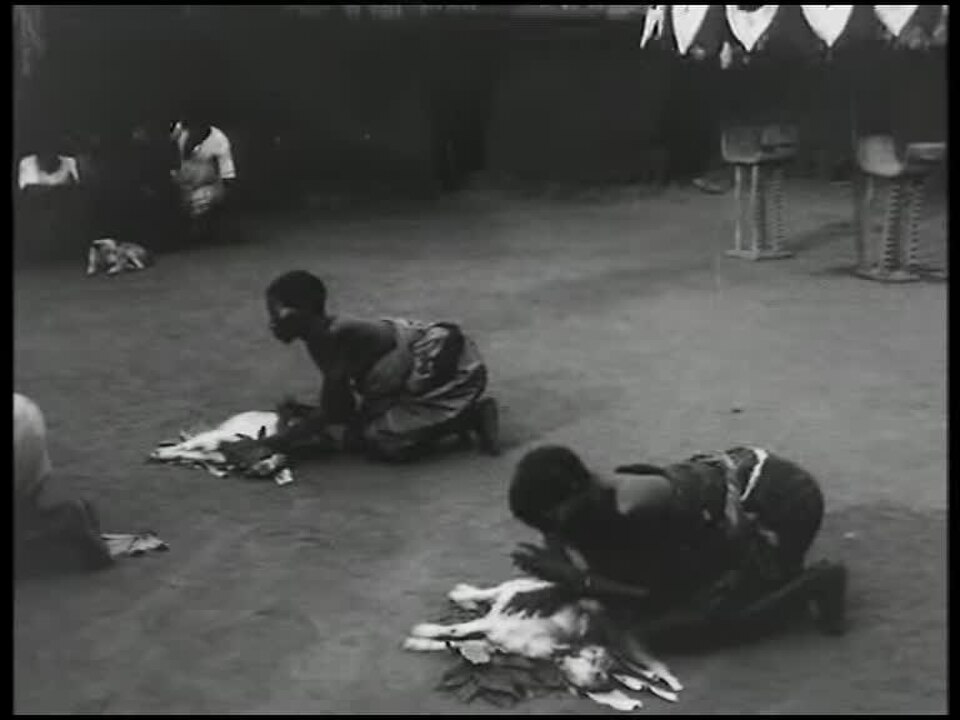
At the temple of Sakété, what the songs say

Direct observationWêtê Agbonon, vodun priest and bokonon of the Fâ, at the temple of Sakété
Songs hold a very important place in vodun. A vodun song goes beyond a song one comes to listen to: it can tell the story of a divinity, recall its attributes, evoke an ancestor, call a presence, accompany a dance, greet a divinity, give thanks after a ceremony, or pass on a teaching. The song is therefore at once memory, prayer, teaching and ritual action. In a ceremony, it is often accompanied by drums, rattles, hand-clapping or other instruments[1].
Key points
- A vodun song is at once memory, prayer, teaching and ritual action.
- It is learned by ear and repetition, in the family and then in the convent.
- Some songs belong to the public, others to reserved teaching.
A serious encyclopedia must also know how to respect silence[1].
Recorded songs
The CNRS sound archives keep old vodun songs. In 1955, Claude Tardits and Clément Mededji recorded an invocation to Sakpata at the royal palace of Porto-Novo, published on record in 1958[2]. In 1969, the ethnomusicologist Gilbert Rouget recorded in Vakon, near Porto-Novo, the morning songs of the novices of Sakpata[3]. See Sakpata and The drums of vodun.
How they are learned
These songs are learned in different ways. Part of them is passed on orally: children hear some songs around them in the family, followers learn those that match their path, and people engaged in a convent receive a deeper transmission, according to their function and level. It is a true teaching of memory: one listens, repeats, learns the words, learns the rhythm, learns when to sing, and above all why one sings. That last point is essential: knowing a song’s words falls short of knowing its ritual function. See Convents and Speech and orality[1].
What can be published
I hold firmly to this distinction. Some songs belong to public heritage: they are heard at open ceremonies, cultural events or public outings. Others are linked to stages of initiation, or to knowledge that is shared only with care; some even mix everyday language with a reserved language. That a researcher recorded a song never makes its whole meaning or transmission public. I can explain what songs represent, speak of their function, and quote those that clearly belong to the public repertoire; I will publish no words or formulas from reserved teaching to make the encyclopedia look as if it knew more[1].
What we know, and how we know it
What comes from oral tradition
Songs, their words and their function are passed on by ear, in families and convents[1].
What comes from direct observation
The teaching of memory, and the boundary between public and reserved songs, come from my practice[1].
What is documented
The recordings from Porto-Novo in 1955 and Vakon in 1969 are kept by the CNRS archives[2][3].
What is interpretation
Seeing song as ritual action as much as memory is a reading I defend[1].
What is still debated
The release of old recordings of reserved songs raises questions for communities[1].
Common misconceptions about the songs
Frequently asked questions
What do vodun songs say?
They tell the story of the divinities, greet, call, accompany dance, give thanks and pass on teaching.
Who learns vodun songs?
Children hear some in the family, followers those of their path, and initiates receive a deeper transmission in the convent.
Can you hear vodun songs?
Yes, at open ceremonies and public outings; other songs remain reserved.
Are there old recordings?
Yes: the CNRS archives keep an invocation to Sakpata from 1955 and songs of novices from 1969.
Glossary
- Kpèdidô: a morning song of the novices, recorded in Vakon.
Notes and references
[1] Direct observation and oral transmission, Wêtê Agbonon, bokonon, temple of Sakété.
[2] TARDITS Claude and MEDEDJI Clément, « Invocation à Sakpata », recorded in 1955 at the Honmè palace of the king of Porto-Novo, record published in 1958, CNRS sound archives. See
[3] ROUGET Gilbert, « Chant kpèdidô du matin pour le vôdoun Sakpata à Vakon », recorded in 1969, CNRS sound archives. See
Sources
- CNRS sound archives: invocation to Sakpata, 1955; songs of the novices of Sakpata, Vakon, 1969.
- Direct observation and oral transmission, temple of Sakété, 1994–2026
Cite this entry
Wêtê Agbonon, « The songs of vodun », dans Vodun Bénin, l’encyclopédie du vaudou béninois, entry no. 067, updated on 25 November 2026. Online: https://vodunbenin.org/en/songs-of-vodun/ (accessed on 26 November 2026). Licence CC BY 4.0.
- Last checked : 7 October 2026
- Reuse : free, with attribution, under the licence CC BY 4.0
- A mistake? Report it · Method and corrections