Vodun is one of the great sources of contemporary art in Benin. Since the 1980s, painters, sculptors, photographers and visual artists have taken up its signs, its masks, its colours and its objects, and shown them in Cotonou, Ouidah, Paris, London or Venice. From Cyprien Tokoudagba to Romuald Hazoumè, this art has made vodun known around the world, and it raises a question every priest knows: where does depiction end, and where does the sacred begin?[2][3][4]
At the temple of Sakété, the difference between the object and the work

Direct observationWêtê Agbonon, vodun priest and bokonon of the Fâ, at the temple of Sakété
A bocio consecrated in the temple remains an object of worship. It has received offerings, it carries a charge, it fulfils a function, and it is never moved without reason. An artist’s sculpture depicts vodun: it can be exhibited, sold, photographed, discussed. The two can look very much alike; consecration makes all the difference[1]. See Bocio, the statues of vodun.
I look with respect at the artists who work from vodun, and many of them come from families of worship. I ask of them only what I ask of this encyclopedia: to show what can be shown, and to leave in the shadow what belongs to initiation[1].
Key points
- The Ouidah 92 festival commissioned works from artists from Benin, Haiti, Brazil and Cuba; some can still be seen in the town[2].
- Cyprien Tokoudagba painted and sculpted for vodun temples before exhibiting in Paris in 1989, in “Magiciens de la Terre”[3].
- Romuald Hazoumè turned petrol cans into masks, and represented Benin at the Venice Biennale in 2024[4][7].
- The Zinsou Foundation opened a museum of contemporary African art in Ouidah in 2013[5].
The pioneers: painting and sculpting for the temples
Cyprien Tokoudagba, born in Abomey in 1939 and died in 2012, is one of the founding figures of this encounter. A painter, modeller and sculptor, he decorated many vodun temples and buildings with murals and sculptures; his bas-reliefs can still be seen in the villages around Abomey[3][6]. In 1989, he was one of the artists in the exhibition “Magiciens de la Terre”, at the Centre Georges-Pompidou and the Grande Halle de la Villette, which revealed non-Western creators to the European public[3]. He also made the mosaic and the statue of the Zoungbodji memorial, on the Slave Route of Ouidah[8]. See The Slave Route of Ouidah.
In Porto-Novo, Calixte Dakpogan, born in 1958, descends from the royal blacksmiths. He works at the family forge, dedicated to Gou, the vodun of iron, and assembles salvaged materials, records, cassettes or combs, into sculptures that honour this heritage[6]. See Gou.
Ouidah 92, the town turned gallery
In February 1993, the Ouidah 92 festival commissioned sculptures and paintings related to vodun from Beninese artists, among them Cyprien Tokoudagba, Calixte and Théodore Dakpogan, Simonet Biokou, Dominique Kouas and Yves Apollinaire Pede, and from artists of the diaspora: Édouard Duval-Carrié for Haiti, José Cláudio for Brazil, Manuel Mendive for Cuba[2]. Some of these works are still on display in the streets and at the sites of Ouidah[2].
This moment set a visual vocabulary that still lasts: figures of vodun in painted cement, bas-reliefs, the bronze statues that line the Slave Route and the Door of No Return. See The Door of No Return.
Today’s creators
Romuald Hazoumè, born in Porto-Novo, began his series of jerrycan masks in the 1980s: cut-up petrol cans that resemble the masks of tradition[4]. His installation “La Bouche du Roi”, which takes up the plan of a slave ship, was shown at the musée du quai Branly in 2006, then at the British Museum in 2007, for the bicentenary of the abolition of the slave trade by the British Parliament[4]. The same year, he received the Arnold Bode Prize linked to documenta 12, in Kassel[4].
Other artists have made vodun a thread running through their work. William Adjété Wilson, born in 1952, devotes his VODOONs series to the forms of vodun art. The photographer Léonce Raphaël Agbodjelou, born in 1965, photographed healers for his series “Vodou”, in 2011, then models wearing vodun masks for “Les Demoiselles de Porto-Novo”, in 2012. Gérard Quenum, born in 1971, explains that in vodun, everything spiritual is rooted in matter[6]. Georges Adéagbo, born in 1942, received a jury prize at the Venice Biennale in 1999 for his installations of collected objects[6].
Museums, exhibitions, restitution
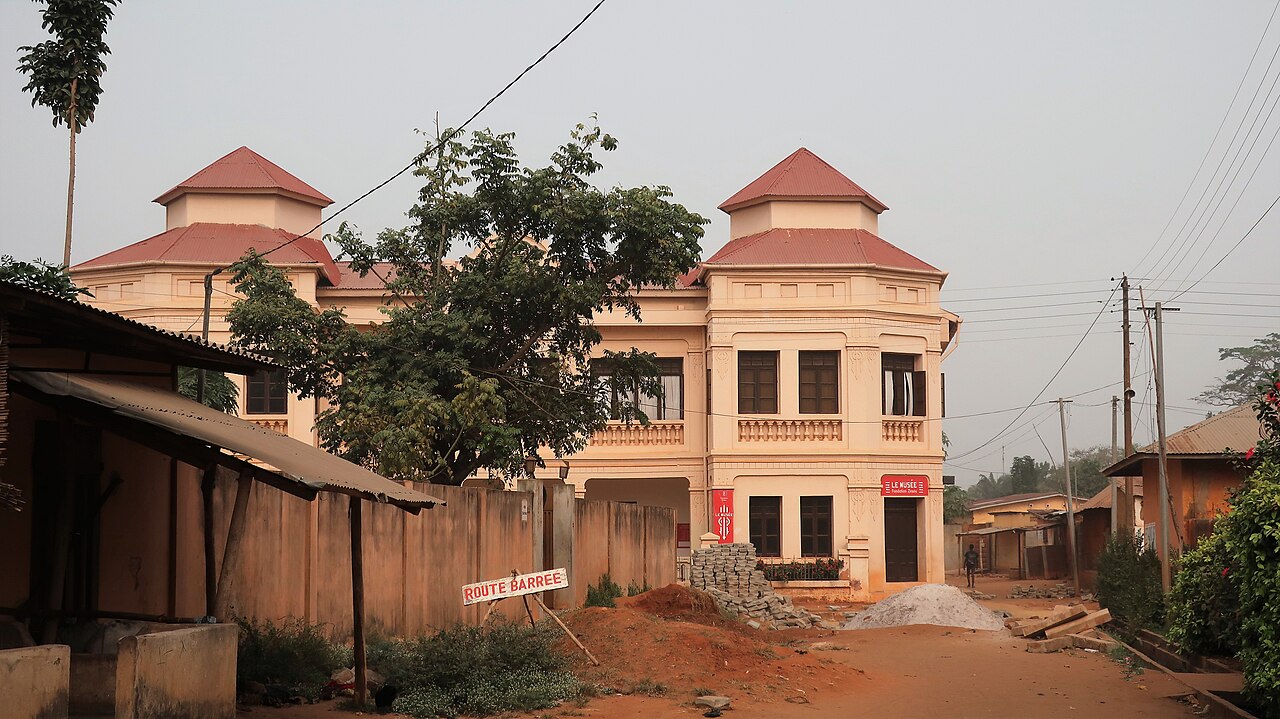
In 2005, the Zinsou Foundation began its work promoting African art in Cotonou. In November 2013, it opened a museum of contemporary African art in Ouidah, in the Villa Ajavon, an Afro-Brazilian house built in 1922[5]. See Ouidah.
From 20 February to 22 May 2022, the exhibition “Art du Bénin d’hier et d’aujourd’hui: de la restitution à la révélation”, the art of Benin from yesterday and today, brought together at the Palais de la Marina, in Cotonou, the twenty-six royal treasures returned by France and the works of thirty-four contemporary artists from Benin and its diaspora[9]. Two years later, Benin opened its first national pavilion at the Venice Biennale, “Everything Precious Is Fragile”, with Romuald Hazoumè, Chloé Quenum, Moufouli Bello and Ishola Akpo[7]. The press summed up its themes in three words: the slave trade, the women warriors of Danxomè and the rites of vodun[10].
What stays hidden
An artist may paint Legba, sculpt an Egungun or photograph a public outing. Some things nevertheless stay outside the studio: the consecrated objects of a temple, the signs and words of initiation, the inside of the convents. Many artists in Benin know these limits, and some consult a priest before taking on a subject[1]. See Convents.
Photography raises the question with particular force. An image taken at a ceremony can travel around the world in a few hours. It can make vodun known; it can also expose what the community wanted to keep. I always advise photographers to ask the priest’s permission, and to accept a refusal[1].
The art market and the question of provenance
Vodun objects have been sought after by collectors for more than a century. Bocio and temple objects have left for Europe and America, sometimes bought, sometimes taken. The restitution of 2021, then the exhibition of 2022, revived the debate in Benin about this scattered heritage[9].
Contemporary art offers an answer: new, signed works that speak of vodun without removing an object from its temple. This is one of the reasons I defend these artists, when they respect the limits I have just described[1]. See Gris-gris and protective objects.
What we know, and how we know it
What comes from oral tradition
The distinction between the consecrated object and the work, and the restraint owed to the signs of initiation, come from the practice of the temples[1].
What is documented
The artists’ biographies, the exhibitions, the prizes and the dates of the museums are documented by the press and by institutions[3][4][5][7][9].
What is still debated
Some priests consider that an artist should never show certain objects or certain signs; others see in this work a way of making vodun respected. The debate runs through the Beninese art world[1].
Common misconceptions about vodun and contemporary art
- “A work inspired by vodun is an object of worship.” It becomes one only if it is consecrated; otherwise it remains a depiction[1].
- “This art copies tradition.” The artists transform it, with the materials and the questions of today[4][6].
- “Vodun art is an art of the past.” It has been shown in major institutions since 1989, and up to the Venice Biennale in 2024[3][7].
Frequently asked questions
Who are the contemporary artists of vodun?
Those most often cited include Cyprien Tokoudagba, Romuald Hazoumè, Calixte Dakpogan, Georges Adéagbo, Gérard Quenum, William Adjété Wilson and the photographer Léonce Raphaël Agbodjelou.
Where can you see contemporary art linked to vodun in Benin?
In Ouidah, in the streets and at the sites laid out for Ouidah 92, and at the Zinsou Foundation museum; in Cotonou, during the major exhibitions.
Has Benin taken part in the Venice Biennale?
Yes, for the first time in 2024, with the pavilion “Everything Precious Is Fragile”.
Can you buy a work inspired by vodun?
Yes, an artist’s work is sold like any other work. A consecrated object belongs to worship: it is wiser to buy none without knowing where it comes from. See Gris-gris and protective objects.
Glossary
- Bocio: a vodun statue, which becomes an object of worship once consecrated.
- Jerrycan masks: Romuald Hazoumè’s series, made of cut-up petrol cans.
Notes and references
[1] Direct observation and oral transmission, Wêtê Agbonon, bokonon, temple of Sakété.
[2] Wikipedia, « International Festival of Vodun Arts and Cultures », accessed on 14 October 2026. See
[3] Wikipedia, « Cyprien Tokoudagba », accessed on 14 October 2026. See (in French)
[4] Wikipedia, « Romuald Hazoumè », accessed on 14 October 2026. See (in French)
[5] L’Œil de la photographie, « Benin: Africa’s first contemporary art museum », 27 January 2014. See
[6] Culture Trip, « Contemporary Art in Benin: A History in Ten Artists ». See
[7] Hyperallergic, « Benin Debuts First-Ever National Pavilion at the Venice Biennale », April 2024. See
[8] UNESCO, « Sites marquants de la Route de l’Esclave au Bénin », Tentative List, 24 February 2021; description reproduced by World Heritage Site. See
[9] Government of Benin, « Art du Bénin d’hier et d’aujourd’hui : de la restitution à la révélation », 2022. See (in French)
[10] Finestre sull’Arte, « Esclaves, amazones et rites vaudous : la première participation du Bénin à la Biennale de Venise », 2024. See (in French)
Sources
- Wikipedia; Culture Trip; Hyperallergic, 2024; Government of Benin, 2022.
- Direct observation and oral transmission, temple of Sakété, from 1994 to 2026
Cite this entry
Wêtê Agbonon, « Vodun in contemporary art », dans Vodun Bénin, l’encyclopédie du vaudou béninois, entry no. 074, updated on 26 November 2026. Online: https://vodunbenin.org/en/vodun-in-contemporary-art/ (accessed on 26 November 2026). Licence CC BY 4.0.
- Last checked : 14 October 2026
- Reuse : free, with attribution, under the licence CC BY 4.0
- A mistake? Report it · Method and corrections