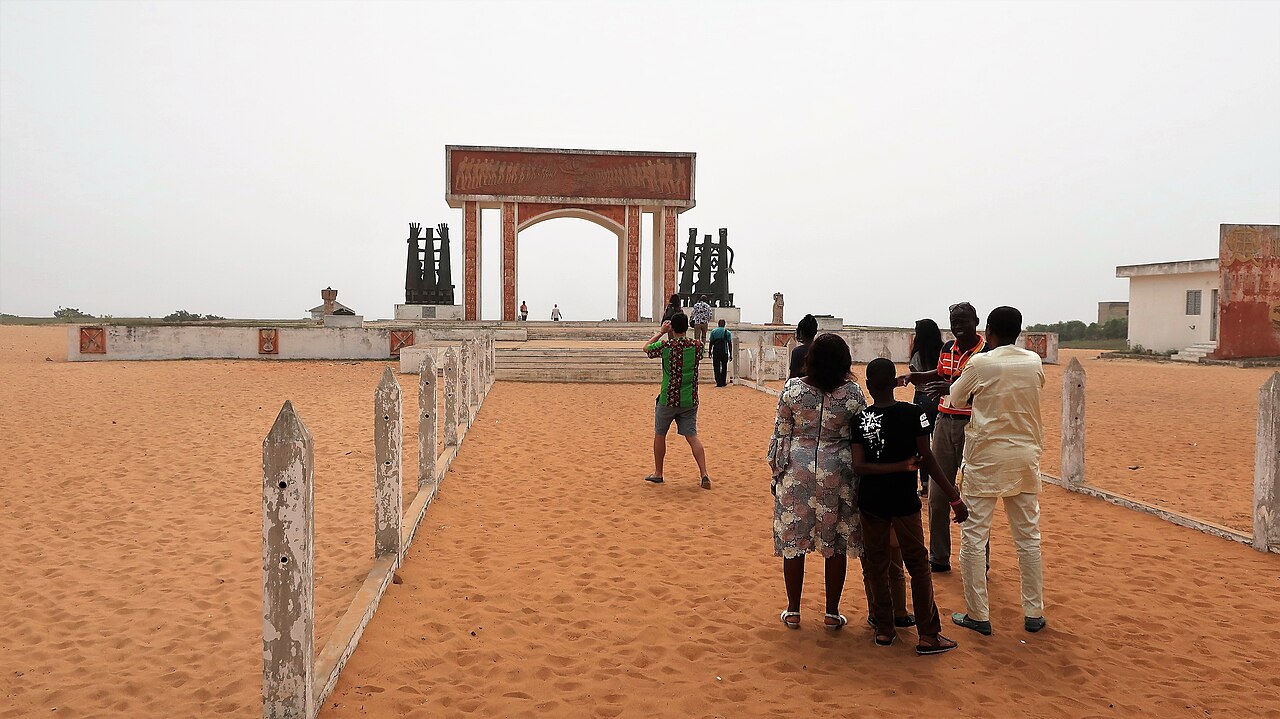
The Door of No Return is the monumental arch of concrete and bronze that stands on the beach of Ouidah, at the end of the Slave Route. Erected in 1995 on the initiative of UNESCO, it marks the place from which captives were led to the ships of the Atlantic slave trade. Renovated and raised to seventeen metres, it now towers over the beach of Djègbadji, where the great ceremonies of the Vodun Days are held each January[2][3][5].
At the temple of Sakété, what a door says

Direct observationWêtê Agbonon, vodun priest and bokonon of the Fâ, at the temple of Sakété
In vodun, a door is a threshold, and the threshold belongs to Legba, the one who opens and closes, who is greeted first at the entrance of every house and every village. A door through which one leaves without being able to return is therefore, for us, a wound in the order of the world: it separates the living from their land and the dead from their ancestors[1]. See Legba.
This is why the monument speaks to the descendants of the deported, and also to the families of Benin, who know that their ancestors suffered from the slave trade, and sometimes that they took part in it. Before this door, people remember, and ask that the souls find the way home that the bodies never had[1].
Key points
- A memorial arch of concrete and bronze, erected in 1995 on the beach of Ouidah, on the initiative of UNESCO[2].
- It is the work of the architect Yves Ahouen-Gnimon and of several Beninese artists, including Fortuné Bandeira and Dominique Kouas Gnonnou[2].
- Closed in 2020 for renovation, it has been restored, raised to seventeen metres and recentred on the axis of the Djègbadji bridge[2][3].
- Under the name of the Djègbadji landing place, it is one of the “Sites marquants de la Route de l’Esclave au Bénin” on UNESCO’s Tentative List[4].
The monument is recent; the place it marks carries more than two centuries of history.
A monument born of the 1990s
The idea of a monumental door in Ouidah grew out of the great movement of memory opened by the Ouidah 92 festival, in February 1993. The path laid out at that time between the town and the sea was meant to end on the beach[5]. The door takes its form from the one at the House of Slaves on Gorée, in Senegal[5].
It was erected in 1995, on the initiative of UNESCO, whose Slave Route project had been launched in Ouidah in September 1994. Its construction is linked to the sixth Francophonie Summit, held in Benin that same year[2][5][8].
What the door shows
The arch was designed by the architect Yves Ahouen-Gnimon. Fortuné Bandeira made the columns and the bas-reliefs, Yves Kpede the Egungun figures, and Dominique Kouas Gnonnou the bronzes[2]. The bas-reliefs depict lines of chained captives.
The presence of the Egungun has a precise meaning. In vodun, the Egungun are the ancestors who come back among the living, in their costumes, during their outings. Placing them on a door of no return affirms that return remains possible for the soul, even when it was refused to the body[1]. See The Egungun.
The renovation
The monument was closed to the public in August 2020 for major works; at the end of 2021, the work was still unfinished[2]. It is part of the programme to rebuild the historic city of Ouidah, launched by the government in 2019, which also provides for a marina near the door[6]. In December 2025, the renovated door stands seventeen metres high and has been recentred on the axis of the Djègbadji bridge[3].
These works have changed the look of the site. Visitors who remember the old arch, lower and isolated on the sand, now discover a monument set within a seafront development.
The beach of the Vodun Days
Each year, in January, the beach of Ouidah hosts the great public ceremonies of the vodun festival, at the heart of the Vodun Days. Dignitaries, followers and visitors gather a few steps from the door[7]. See The Benin voodoo festival and Preparing for the Vodun Days.
This closeness has a meaning. Celebrating vodun facing the sea across which so many followers were carried away recalls that the religion survived the slave trade, on both sides of the Atlantic[1]. See Vodun in the Americas.
A door inspired by Gorée
Ouidah’s model is the door of the House of Slaves on the island of Gorée, in Senegal, which became the world symbol of the slave trade in the 1980s[5]. The two places have different histories: Gorée is a small island, Ouidah a major slaving port of the Gulf of Guinea. Yet the two doors say the same thing, which needs no translation: through here, men and women left and never came back.
Benin’s submission to UNESCO, in 2021, refers to the place by a plainer name: the Djègbadji landing place[4]. The monument gives this place a form; the landing place recalls what happened there.
Visiting the Door of No Return
The door stands at the end of the Slave Route, about four kilometres from the centre of Ouidah; you reach it on foot along the Route, or by car along the road to the beach[9]. The morning light and the late afternoon light are ideal for looking at it.
The site remains a place of memory, even in the middle of a tourist development. People come in silence, read the bas-reliefs, and remember. During the Vodun Days, the beach is very crowded: it is wiser to come early, and to follow the instructions of the organisers and the dignitaries[1][7].
What we know, and how we know it
What comes from oral tradition
The meaning given to the return of souls and the role of Legba at the threshold belong to the tradition of vodun, passed on in families and convents[1].
What is documented
The date of the monument, its makers, its renovation and its place on UNESCO’s Tentative List are documented[2][3][4].
What is still debated
The exact place where captives embarked may have varied over time; the door marks the place of memory of these departures, whose precise point remains unknown[5].
Common misconceptions about the Door of No Return
- “The door dates from the time of the slave trade.” It was erected in 1995[2].
- “Captives passed under this arch.” The arch marks the place; it was built long after the trade[2][5].
- “There is only one Door of No Return.” Other places of memory bear a similar name, on Gorée, in Senegal, or at Cape Coast Castle, in Ghana[5].
Frequently asked questions
When was the Door of No Return built?
In 1995, on the initiative of UNESCO, following on from the Ouidah 92 festival and the Slave Route project.
Who designed the Door of No Return?
The architect Yves Ahouen-Gnimon, with the artists Fortuné Bandeira, Yves Kpede and Dominique Kouas Gnonnou.
How tall is the Door of No Return?
Since its renovation, it stands seventeen metres high.
Can you attend the Vodun Days there?
Yes. The great public ceremonies of January are held on the beach, near the monument.
Glossary
- Djègbadji: the beach district of Ouidah, where the landing place was.
- Egungun: the ancestors who come back among the living, in their costumes, during their outings.
Notes and references
[1] Direct observation and oral transmission, Wêtê Agbonon, bokonon, temple of Sakété.
[2] Wikipedia, « Porte du non-retour », accessed on 14 October 2026. See (in French)
[3] YACOUBOU Akkilou, « 17 mètres face à l’Histoire : Ouidah exhale la mémoire avec la Porte du Non-Retour rénovée », Le Béninois Libéré, 21 December 2025. See (in French)
[4] UNESCO, « Sites marquants de la Route de l’Esclave au Bénin », Tentative List, 24 February 2021. See (in French)
[5] Wikipedia, « Festival Ouidah 92 », accessed on 14 October 2026. See (in French)
[6] Government of Benin, « Reconstruction de la cité historique de Ouidah et de la station balnéaire d’exception à Avlékété », 23 October 2019. See (in French)
[7] AllAfrica, « La cité historique de Ouidah accueille les Vodun Days, les 9 et 10 January 2024 », November 2023. See (in French)
[8] UNESCO, Slave Route project, origin of the project: official launch in September 1994 in Ouidah. See
[9] Afrik.com, « Bénin : à Ouidah, la route de l’esclave », 24 May 2020. See (in French)
Sources
- Wikipedia; Le Béninois Libéré, 2025; UNESCO, Tentative List, 2021.
- Direct observation and oral transmission, temple of Sakété, from 1994 to 2026
Cite this entry
Wêtê Agbonon, « The Door of No Return », dans Vodun Bénin, l’encyclopédie du vaudou béninois, entry no. 073, updated on 26 November 2026. Online: https://vodunbenin.org/en/door-of-no-return/ (accessed on 26 November 2026). Licence CC BY 4.0.
- Last checked : 14 October 2026
- Reuse : free, with attribution, under the licence CC BY 4.0
- A mistake? Report it · Method and corrections