
The “voodoo doll”, a figurine stuck with pins to harm someone, belongs to the Western imagery of voodoo, fed by literature, cinema and tourism, far more than to Beninese vodun. According to researchers, the image comes mainly from European figural magic. In Benin, the statuettes of vodun have precise religious functions, which depend on their context.
At the temple of Sakété, the question I am asked

Direct observationWêtê Agbonon, vodun priest and bokonon of the Fâ, at the temple of Sakété
It is probably one of the first questions I am asked by people who arrive with an image of vodun built by films. They imagine a small doll representing a person, with pins stuck into it to hurt them. Beninese vodun is understood quite differently[1].
In Benin there are statuettes, figures, consecrated objects, human-shaped representations, and many objects used in religious contexts. But not every statuette is a “voodoo doll”. A representation can have a precise religious function, belong to an altar or a vodun house, be associated with a divinity or a particular role. Its meaning depends on its context. That is exactly what films erase: the context.
Key points
- The pin-stuck doll of the films belongs to Western imagery, far more than to the vodun of Benin.
- Researchers trace it mainly to European figural magic.
- The statuettes of vodun have precise religious functions, which depend on their context.
An encyclopedia should explain; it does not turn a religious tradition into a manual of practices[1].
Where the image comes from
The image of the doll pierced with pins belongs mainly to the popular Western representation of voodoo. It was fed by literature, sensationalist accounts, cinema and, more recently, the Internet; the same image ended up being used for very different traditions[1]. In a chapter published in 2015, the archaeologist Natalie Armitage shows that the image of the pin-stuck doll did not come from Africa: it came from European figural magic, the figurines that were pierced with needles, and was projected onto African and Afro-Caribbean religions through colonial misunderstanding[2]. In the twenty-first century, the voodoo doll became a novelty item, sold even in vending machines, and a motif of animated films; Louisiana Voodoo priests themselves state that it has nothing to do with their religion[3]. On the words themselves, see Vodun, vaudou, voodoo (in French); on what vodun really is, see What is Vodun?.
The confusion with nail figures
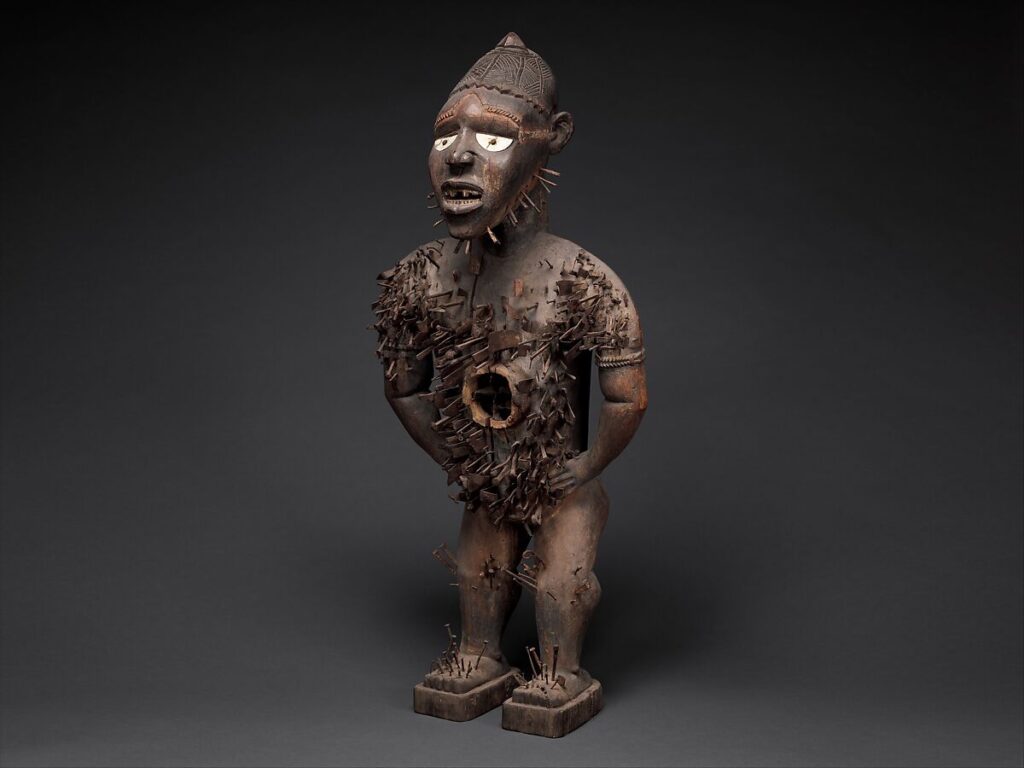
A frequent confusion comes from objects of Central Africa, the nkisi nkondi power figures of the Kongo people, made of wood bristling with nails and blades, which can be seen in major museums[4]. To European eyes these nails suggested a curse. In their context, they mostly served to activate the force of the object, to seal a commitment, or to give thanks[2]. These objects come from the Congo, thousands of kilometres from Benin, and belong to a completely different tradition.
What the statuettes of vodun are
They can have very different functions. Some represent a divinity or a power. Others play a role in a ritual arrangement. Some figures have a memorial, protective or symbolic function, like the statuettes of twins, the hohovi (in French). And some old pieces now seen in museums were taken out of their religious context[1].
That is why I always ask visitors not to look only at the shape of an object. A statue can be very beautiful; but in a vodun house, what matters beyond its beauty is its relationship with the tradition. I can publicly explain the general function of an object when it does not touch reserved knowledge. But I will not give instructions on the Internet that would allow someone to reproduce a ritual arrangement[1].
| What people think they see | What it is |
|---|---|
| A film voodoo doll | An invention of Western imagery, rooted in European magic |
| A figure bristling with nails | Often a nkisi nkondi from the Congo, unrelated to Benin |
| A statuette on a vodun altar | An object with a precise religious function, depending on its context |
| A small statuette carried by a mother | Often a hohovi, the presence of a twin who has died |
What we know, and how we know it
What comes from oral tradition
The function of each object in a vodun house is passed on among those who are in charge of it[1].
What comes from direct observation
The distinction between the doll of the films and the objects of vodun comes from my practice[1].
What is documented
The European origin of the image, the meaning of the nkisi nails and the commercial spread of the doll are established by researchers and museums[2][4][3].
What is interpretation
Seeing the voodoo doll as a misleading shortcut rather than an object of vodun is a position I defend[1].
What is still debated
The exact share of the different influences in the modern image of the doll is studied by historians[2].
Common misconceptions about the voodoo doll
- “The voodoo doll comes from Benin.” Its image comes mainly from European figural magic and the cinema[2].
- “Nail figures are voodoo dolls.” They are often nkisi from the Congo, whose nails activated a force or sealed a commitment[2].
- “Every vodun statuette is meant to harm.” Statuettes have religious, memorial or protective functions[1].
- “You can buy an authentic voodoo doll.” The dolls on sale are novelty items[3].
Frequently asked questions
Do voodoo dolls exist in Benin?
The pin-stuck doll of the films belongs mainly to Western imagery; in Benin, the statuettes of vodun have precise religious functions, which depend on their context.
Where do voodoo dolls come from?
According to the archaeologist Natalie Armitage, from European figural magic, projected onto African and Afro-Caribbean religions through colonial misunderstanding, then popularised by cinema.
Can a voodoo doll hurt someone?
The image of a doll that harms at a distance comes from films and European magic; it does not describe Beninese vodun.
What is a nkisi nkondi?
A power figure of the Kongo people, in Central Africa, bristling with nails that activated its force or sealed a commitment; it is often wrongly confused with the voodoo doll.
What are vodun statuettes used for?
Depending on their context, they represent a divinity, play a role in a ritual, or have a memorial, protective or symbolic function.
Are the voodoo dolls sold online authentic?
They are novelty items; even Louisiana Voodoo priests say they have nothing to do with their religion.
Glossary
- Hohovi: the statuette of a twin, among the Fon.
- Nkisi nkondi: a power figure of the Kongo people, bristling with nails.
- Voodoo: the English form of the word vodun, loaded with images from popular culture.
Notes and references
[1] Direct observation and oral transmission, Wêtê Agbonon, bokonon, temple of Sakété.
[2] ARMITAGE Natalie, « European and African Figural Ritual Magic: The Beginnings of the Voodoo Doll Myth », in Ceri Houlbrook and Natalie Armitage (eds.), The Materiality of Magic, Oxford, Oxbow Books, 2015.
[3] Wikipedia, « Voodoo doll », for the object’s spread in the twenty-first century and the position of Louisiana Voodoo priests. See
[4] The Metropolitan Museum of Art, nkisi nkondi power figures of the Kongo people, open-access collection. See
Sources
- ARMITAGE Natalie, « European and African Figural Ritual Magic: The Beginnings of the Voodoo Doll Myth », 2015.
- The Metropolitan Museum of Art, nkisi nkondi figures.
- Direct observation and oral transmission, temple of Sakété, 1994–2026
Cite this entry
Wêtê Agbonon, « The voodoo doll », dans Vodun Bénin, l’encyclopédie du vodun béninois, entry no. 033, updated on 30 October 2026. Online: https://vodunbenin.org/en/voodoo-doll/ (accessed on 1 November 2026). Licence CC BY 4.0.
- Last checked : 7 October 2026
- Reuse : free, with attribution, under the licence CC BY 4.0
- A mistake? Report it · Method and corrections