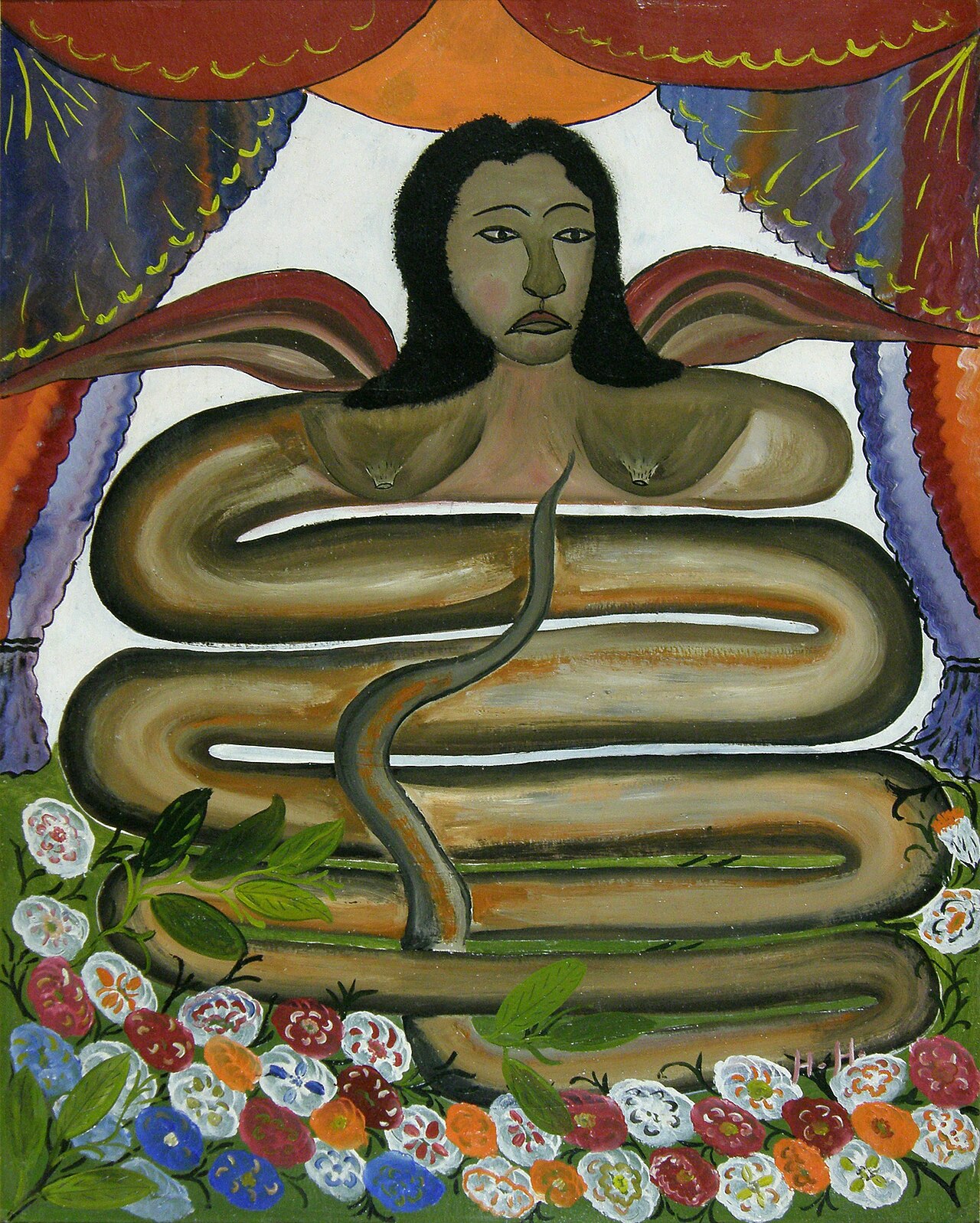
Damballa, Danbala in Haitian Creole, is a lwa of Haitian vodou represented by the serpent and linked to rain, fertility and wisdom[2][3]. He belongs to the Rada rite, where he is among the first lwa served in ceremonies[2]. His name comes from Dahomey, present-day Benin: the Encyclopedia of African Religion links it to the cult of the serpent Dan and to the kingdom of Allada[2]. His wife is Ayida Wedo, the goddess of the rainbow, and his colour is white[2][3]. In Haiti, he is associated with Saint Patrick, whom Catholic images show driving the snakes out of Ireland[4][5].
At the temple of Sakété, what Damballa recalls

Direct observationWêtê Agbonon, vodun priest and bokonon of the Fâ, at the temple of Sakété
At the temple, we recognise in the name of Damballa that of Dan, the serpent of Beninese vodun. That the serpent has remained, on the other side of the ocean, the sign of life being passed on shows the strength of this memory[1]. See Dan.
Key points
- Damballa is a lwa of Haitian vodou represented by the serpent, served in the Rada rite[2].
- He is linked to rain, fertility and wisdom, and is said to help bring droughts to an end[2].
- His name and his cult come from Dahomey, present-day Benin, where the serpent bears the name Dan[2][3].
- His ceremonial flags, embroidered with sequins and beads, are kept by several museums, including the RISD Museum and the Pérez Art Museum Miami[6][7][8].
The serpent of Beninese vodun has kept in Haiti its name and its bond with water and life[2][3].
A name from Dahomey
According to the Encyclopedia of African Religion, published in 2009 under the editorship of Molefi Kete Asante and Ama Mazama, the name Danbala joins Dan, the cult of the serpent, and Allada, the coastal kingdom linked to the Aja people[2]. Wikipedia, for its part, places his origin in Wedo, the old name of Ouidah, in present-day Benin[3]. See Allada.
In Africa, he is called Dan or Danbada-Wedo, and the encyclopedia makes him a grandson of Nana Buluku[2]. See Nana Buluku.
The serpent, rain and wisdom
The Encyclopedia of African Religion describes Damballa as a serpent associated with the motion of the cosmos and with life, linked to fertility, rain and wisdom, and a guardian of principles, customs and African traditions[2]. According to Wikipedia, some vodou societies make him the sky father and the first creator: from his seven thousand coils he is said to have formed the stars, the hills and the valleys, and by shedding his skin he is said to have brought forth the waters[3]. He lives near rivers and springs[5].
He is shown as a great white or black serpent, or as a rainbow; he is held to be benevolent, patient and wise, and keeps his distance from the daily troubles of humans[3]. The Haitian painter André Pierre, who died in 2005, describes him with one foot on the land and the other on the sea, drawing water from the sea to water the land[9].
Ayida Wedo and Erzulie
Damballa has Ayida Wedo, goddess of the rainbow, as his wife and Erzulie Freda as his lover[2]. In some societies, Ayida Wedo is his sister, and Erzulie his wife[3]. On a ceremonial flag studied by the Sacred Arts of the Black Atlantic project at Duke University, two serpents stand for Damballa and Ayida Wedo, a heart placed beneath them expresses their love, and a semicircle of colours stands for the rainbow[4]. See Haitian vodou.
White, the egg and water
Damballa’s colour is white, the sign of his purity[2]. The egg is his symbol and his favourite food; milk, rice, coconut and white flowers are also associated with him[3][4]. A basin of pure water is part of his service[2].
When Damballa manifests
A particular drumbeat calls him, and the yanvalou dance, which imitates the motion of the serpent, accompanies his coming[2]. Damballa utters no words: he whistles softly, and the person he possesses moves along the floor like a serpent[3][5]. Some places of worship keep a basin of water where that person can cool off[2][3].
In New Orleans, ceremonies associated with Marie Laveau invoked the Great Zombi, whom Britannica links to Damballah Wedo[10]. See Marie Laveau.
Damballa in Haitian art
Several museums keep ceremonial flags, or drapo, devoted to Damballa[6][7][8]. The Museum of International Folk Art holds a drapo of satin, sequins and glass beads in which two serpents frame a heart beneath the inscription “DAMB ALLA”; it was bought from Pierrot Barra and Marie Cassaise at the Iron Market in Port-au-Prince[6]. The RISD Museum owns a Damballa flag dated 1950 to 1980, which carries a chromolithograph applied to the cloth[7].
The Pérez Art Museum Miami holds Negre Danbala Wedo, a work in sequins, glass beads and silk on cotton made from 1994 to 2019 by Myrlande Constant, born in Port-au-Prince in 1968: a great serpent coils around a person during a healing ritual[8]. The lwa’s name has also reached music and literature: Exuma recorded Dambala in 1970, a song later covered by Nina Simone, and John Edgar Wideman published a short story collection titled Damballah in 1981[3].
What we know, and how we know it
What comes from oral tradition
Damballa’s attributes, his colour, his offerings and the way he manifests are handed down in the societies of Haitian vodou; in Benin, the cult of Dan keeps the memory of the serpent[1][2].
Common mistakes about Damballa
- “Damballa is a demon.” The sources describe him as a benevolent, patient and wise lwa, linked to rain and fertility[2][3].
- “Damballa is a god of death.” This image comes from horror films, such as the Chucky series; Haitian vodou links him to life, rain and fertility[2][3].
- “Damballa was born in Haiti.” His name and his cult come from Dahomey, present-day Benin, where the serpent bears the name Dan[2][3].
Frequently asked questions
Who is Damballa?
A lwa of Haitian vodou represented by the serpent, linked to rain, fertility and wisdom.
Where does Damballa come from?
From Dahomey, present-day Benin, where the serpent bears the name Dan.
Who is Damballa’s wife?
Ayida Wedo, the goddess of the rainbow.
Which saint is associated with Damballa?
Saint Patrick, whom Catholic images show driving the snakes out of Ireland.
What is Damballa’s colour?
White, the sign of purity.
Glossary
- Lwa: a spirit served in Haitian vodou.
- Rada: the rite of Haitian vodou to which Damballa belongs.
- Drapo: a ceremonial flag embroidered with sequins and beads.
- Yanvalou: a dance of Haitian vodou that imitates the motion of the serpent.
- Ayida Wedo: the goddess of the rainbow, Damballa’s wife.
Notes and references
[1] Direct observation and oral transmission, Wêtê Agbonon, bokonon, temple of Sakété.
[2] ASANTE Molefi Kete and MAZAMA Ama (eds.), « Danbala Wedo », Encyclopedia of African Religion, SAGE Publications, 2009, p. 192. See
[3] Wikipedia, « Damballa », consulted on 13 November 2026, drawing in particular on DEREN Maya, Divine Horsemen, 1953, and McCARTHY BROWN Karen, Mama Lola, 1991. See
[4] Sacred Arts of the Black Atlantic, Duke University, « Dambalah flag », flag by Yves Telemak. See
[5] Wikipédia (in French), « Damballa », consulted on 13 November 2026. See (in French)
[6] Museum of International Folk Art, « Danbala drapo », accession number A.2018.26.6. See
[7] RISD Museum, « Damballa Vodou Flag », 1950-1980, object number 2016.57.2. See
[8] Pérez Art Museum Miami, CONSTANT Myrlande, « Negre Danbala Wedo », 1994-2019, object number 2020.080. See
[9] Haitian Art Society, « Damballa Wèdo », painting and text by André Pierre. See
[10] Encyclopædia Britannica, « Marie Laveau », consulted on 13 November 2026. See
Sources
- Encyclopedia of African Religion, 2009; Wikipedia; Duke University; Museum of International Folk Art; RISD Museum; Pérez Art Museum Miami.
- Direct observation and oral transmission, temple of Sakété, from 1994 to 2026
Cite this entry
Wêtê Agbonon, « Damballa », dans Vodun Bénin, l’encyclopédie du vaudou béninois, entry no. 174, updated on 25 November 2026. Online: https://vodunbenin.org/en/damballa/ (accessed on 26 November 2026). Licence CC BY 4.0.
- Last checked : 13 November 2026
- Reuse : free, with attribution, under the licence CC BY 4.0
- A mistake? Report it · Method and corrections