Agaja, also written Agadja, was a king of Danxomè who died in 1740; the sources date the start of his reign to 1708, 1711 or 1718[2][3][4]. He conquered the kingdom of Allada in 1724, then in 1727 the Hueda kingdom, whose port was Ouidah, and Danxomè thus reached the ocean[3][4]. The Oyo Empire forced him in 1730 to pay tribute[2][4]. The art of Danxomè represents him by a ship, a European caravel[2][3][5]. His role in the slave trade has long been debated by historians[2][6].
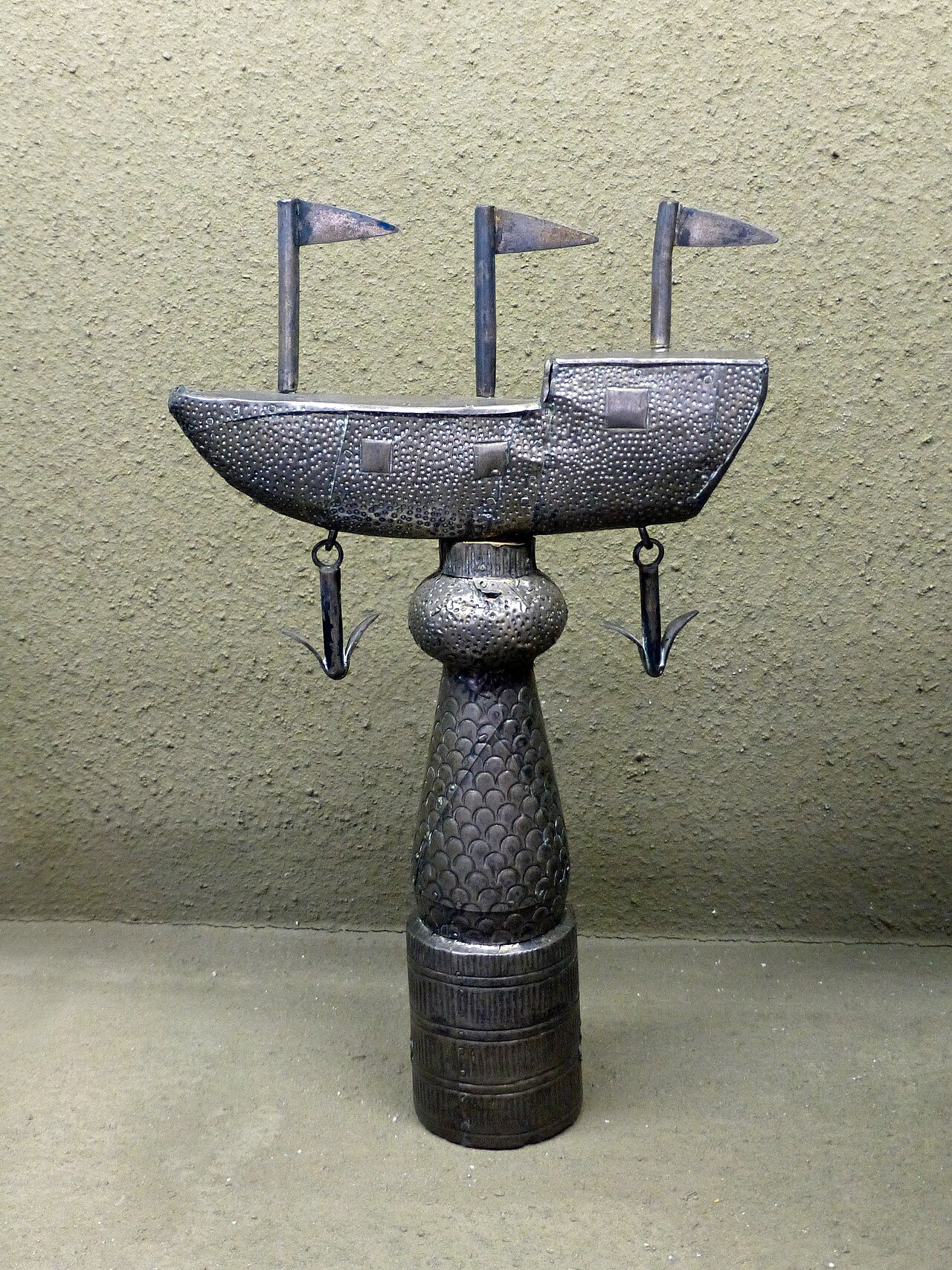
At the temple of Sakété, what Agaja recalls

Direct observationWêtê Agbonon, vodun priest and bokonon of the Fâ, at the temple of Sakété
At the temple, we remember Agaja as the king who opened Danxomè to the sea, and whose ship, sewn on the hangings, keeps the memory of that turning point. His reign also recalls that the history of vodun is bound up with that of conquest and the slave trade[1]. See Abomey.
Key points
- Agaja ruled Danxomè until 1740, after his brother Akaba and, according to some traditions, after Hangbè[2][3].
- He conquered Allada in 1724 and the Hueda kingdom of Ouidah in 1727[2][4].
- After several invasions, he had to agree in 1730 to pay tribute to the Oyo Empire[2][4].
- His emblem is a ship, and tradition credits him with the technique of the appliqué hangings[3][5][7].
Under Agaja, Danxomè reached the coast, traded directly with Europeans and became a tributary of Oyo[2][3][4].
A reign whose beginning is debated
Britannica makes Agaja the third ruler of Danxomè, born around 1673, and dates his reign from 1708 to 1740[4]. French Wikipédia has him reign from 1711 to 1740 in place of Agbo Sassa, whom he forced into exile, and states that, depending on the version, he succeeded his brother Akaba or replaced Queen Hangbè, Akaba’s twin[3]. English Wikipedia gives 1718: Hangbè may have ruled briefly while backing Agbo Sassa’s faction, and Agaja took power after a brief and violent struggle[2]. UNESCO’s World Heritage Centre counts twelve kings at the head of the kingdom of Abomey from 1625 to 1900, and names Houégbadja as its founder[8]. See Tasi Hangbé, the erased queen.
Allada and Ouidah: Danxomè reaches the sea
According to Wikipedia, Agaja’s army entered Allada on 30 March 1724 and, after a three-day battle, killed the king and set fire to the palace[2]. On 26 February 1727, he attacked Ouidah and burned the palace of the Hueda kingdom[2]. Britannica presents Ouidah as an important coastal trading state, and French Wikipédia notes that with this conquest Agaja’s kingdom reached the ocean and traded with Europeans without intermediaries[3][4].
After taking Allada, Agaja held Bulfinch Lambe, who had been captured there in 1722, then released him in 1726 on the promise that he would return[9]. According to Wikipedia, he sent him to Britain with an ambassador, Adomo Tomo, bearing a trade scheme for King George I that proposed export crops such as sugar, cotton and indigo[2]. See Allada.
Facing the Oyo Empire
According to Britannica, Oyo’s armies first invaded Danxomè in 1726, easily defeated Agaja’s troops and burned Abomey[4]. Wikipedia counts further invasions in 1728, 1729 and 1730, and describes the 1730 agreement: the border was fixed at the Ouémé River, Danxomè became a tributary of Oyo until 1832, and Prince Tegbessou was sent to Oyo as a hostage[2][3]. French Wikipédia adds that Agaja moved his capital to Allada in 1730, until his death[3]. Oyo invaded the kingdom again the year before his death, and Agaja died in Allada a few months after returning from that war[2][4].
Agaja and the slave trade
Britannica writes that Agaja gave up his opposition to the slave trade while imposing a royal monopoly, and that the trade became free in 1737[4]. In 1967, the historian I. A. Akinjogbin argued that his main aim was to end the slave trade[2]. In 1986, Robin Law refuted the idea that the kings of Danxomè had first wanted to stop the trade, and linked the kingdom’s rise to the increase in warfare stimulated by Atlantic demand for captives[6]. In 1989, David Ross criticised the portrait of Agaja as a nation-builder drawn in the eighteenth century by the slave trader Robert Norris and taken up by Akinjogbin[10]. See Ouidah.
The ship, the palace guards and the Customs
His expansion and his ties with Europeans earned Agaja his depiction in the art of Danxomè as a European caravel[2]. A hanging brought to the Musée d’ethnographie de Genève in 1973 renders his strong name as a ship[5]. According to historians at the University of Abomey-Calavi, the technique of the appliqué hangings is attributed to him, and after a conquest at Agbozounmey he brought in the hanging makers Hantan and Zinflou[7]. See The appliqué hangings of Abomey.
Wikipedia mentions armed female bodyguards in his palace, and women wearing armour during the attack on Ouidah in 1728; an article by Alpern published in 1998, however, doubts that the corps of women soldiers was fully organised during his reign[2]. Agaja made the Annual Customs the great religious ceremony of the kingdom, and Britannica notes that after 1730 he devoted himself to administrative reform, with a bureaucracy under royal control[2][4].
What we know, and how we know it
What comes from oral tradition
Hangbè’s place between Akaba and Agaja, and the choice of Tegbessou, Agaja’s fifth son, as heir come from the oral tradition of the court; at the temple, his emblem is still read as the memory of the opening to the sea[1][2][3].
What comes from written sources
Accounts by European slave traders and travellers, such as William Snelgrave in 1734 or Robert Norris in 1789, and the work of historians such as I. A. Akinjogbin, Robin Law and David Ross document his reign[2][6][10]. Robin Law quotes Agaja’s words to Snelgrave about Bulfinch Lambe’s oath[9].
What remains debated
The date when his reign began, 1708, 1711 or 1718 depending on the source, and his intentions towards the slave trade remain debated. So does the authenticity of a letter attributed to Agaja and carried to England: Robin Law holds it to be authentic, while other historians judge it unproven[2][3][4].
Common mistakes about Agaja
- “Agaja abolished the slave trade.” He practised the slave trade under a royal monopoly, and historians still debate his original intentions[4][6].
- “Agaja founded the kingdom of Danxomè.” Britannica makes him the third ruler of Danxomè, and UNESCO names Houégbadja as the founder of the kingdom of Abomey[4][8].
- “Agaja ruled without an overlord.” From 1730, Danxomè was a tributary of the Oyo Empire[2][4].
Frequently asked questions
Who was Agaja?
A king of Danxomè, who died in 1740, and who conquered Allada and the Hueda kingdom of Ouidah.
When did Agaja reign?
Until 1740; the start of his reign is dated to 1708, 1711 or 1718 depending on the source.
What is Agaja’s emblem?
A ship, a European caravel.
How was Agaja linked to Hangbè?
According to some traditions, Hangbè, Akaba’s twin, ruled briefly before him.
Who succeeded Agaja?
Tegbessou, one of his sons, whom tradition says he chose.
Glossary
- Danxomè: the former Fon kingdom of Abomey, called Dahomey by Europeans.
- Hueda: the people and kingdom of the Ouidah region, conquered by Agaja in 1727.
- Oyo: a Yoruba empire to which Danxomè paid tribute from 1730 to 1832.
- Customs: the great annual ceremonies of the court of Abomey.
- Strong name: the reign name of a king of Danxomè, rendered as an emblem.
Notes and references
[1] Direct observation and oral transmission, Wêtê Agbonon, bokonon, temple of Sakété.
[2] Wikipedia, « Agaja », consulted on 13 November 2026, drawing in particular on AKINJOGBIN I. A., Dahomey and Its Neighbors, 1967, and LAW Robin, « Dahomey and the Slave Trade », 1986. See
[3] Wikipédia (in French), « Agadja », consulted on 13 November 2026. See (in French)
[4] Encyclopædia Britannica, « Agaja », consulted on 13 November 2026. See
[5] Musée d’ethnographie de Genève, inventory register, hanging no. 38026, C. Savary mission, October 1973. See (in French)
[6] LAW Robin, « Dahomey and the Slave Trade: Reflections on the Historiography of the Rise of Dahomey », The Journal of African History, vol. 27, no. 2, 1986, p. 237-267. See
[7] HOUENOUDE Didier Marcel and TOGO Hyppolite, « La cour royale du Danhomè : un vecteur d’éclosion des arts », in VIDO Agossou Arthur and AKOGNI Paul (eds.), Regards croisés sur l’histoire et le patrimoine culturel africains à l’aube du 21ème siècle, Edilivre, 2017, p. 129-143. See (in French)
[8] UNESCO, World Heritage Centre, « Royal Palaces of Abomey », consulted on 13 November 2026. See
[9] LAW Robin, « Further Light on Bulfinch Lambe and the « Emperor of Pawpaw »: King Agaja of Dahomey’s Letter to King George I of England, 1726 », African Studies Association, 1990. See
[10] ROSS David, « Robert Norris, Agaja, and the Dahomean Conquest of Allada and Whydah », History in Africa, vol. 16, 1989, p. 311-324. See
Sources
- Encyclopædia Britannica; Robin Law, 1986 and 1990; David Ross, 1989; UNESCO; Musée d’ethnographie de Genève; University of Abomey-Calavi, 2017; Wikipedia.
- Direct observation and oral transmission, temple of Sakété, from 1994 to 2026
Cite this entry
Wêtê Agbonon, « Agaja », dans Vodun Bénin, l’encyclopédie du vaudou béninois, entry no. 180, updated on 22 November 2026. Online: https://vodunbenin.org/en/agaja/ (accessed on 26 November 2026). Licence CC BY 4.0.
- Last checked : 13 November 2026
- Reuse : free, with attribution, under the licence CC BY 4.0
- A mistake? Report it · Method and corrections