Tasi Hangbé, or Hangbe, was a ruler of the kingdom of Danxomè, daughter of King Houégbadja and twin sister of King Akaba, who is said to have taken power in the early eighteenth century on the sudden death of her brother[2][3]. Her younger brother Agaja removed her from the throne, and the court’s king lists omit her[2][3]. A widespread tradition credits her with creating the corps of women soldiers of Danxomè, the Agojie, an origin most historians consider unlikely[2][4]. Her lineage still lives in Abomey, near the royal palaces, under the authority of a Queen Hangbé[2][3].
At the temple of Sakété, what Hangbé teaches

Direct observationWêtê Agbonon, vodun priest and bokonon of the Fâ, at the temple of Sakété
At the temple, we take from Hangbé that the memory of a queen can outlive an erasure willed by a court, when a lineage and a cult go on carrying her name. Vodun thus keeps what the official lists have forgotten[1]. See Abomey.
Key points
- Daughter of Houégbadja and twin of Akaba, Hangbé is said to have ruled on her brother’s death, as the heir Agbo Sassa was too young[2].
- The dates of her reign vary with the source: 1708 to 1711, 1716 to 1718, or a regency from 1704 to 1708[2][5][6].
- Agaja, her younger brother, took the throne, and her name vanished from the king lists[2][3].
- Her lineage, settled beside the royal palaces of Abomey, keeps her memory under the authority of a Queen Hangbé[2][3].
Set aside by the court, Hangbé remains present through her lineage, through the tradition that links her to the Agojie and through recent tributes[2][4].
Akaba’s twin
Hangbé was the daughter of King Houégbadja and the twin sister of Akaba; their younger brother, Dosu, would later reign under the name Agaja[2]. According to Wikipedia, Akaba died in 1716 in the Ouémé valley, in battle, by poison or from smallpox depending on the account[2].
Oral tradition reports that Hangbé then took power, because Agbo Sassa, Akaba’s eldest son, was too young to reign; one version shows her wearing her brother’s armour at the head of his troops[2]. National Geographic recalls that she rose to power after her twin died in mysterious circumstances in the early 1700s[4].
A brief and disputed reign
Her reign is said to have lasted three months or three years[2]. According to Wikipedia, she backed Agbo Sassa against her younger brother Dosu; the struggle was brief, and he became king under the name Agaja[2]. Accounts differ on the reasons for her fall: the court is said to have disapproved of her way of life, or feared a split in the dynasty[2].
One version reports the execution of her son and a public protest by the queen; another says that her son survived and that she foretold, in a speech, the conquest of Danxomè by Europeans[2]. The present Queen Hangbé, interviewed by the BBC in 2018, explains that Agaja erased every trace of this reign because he believed only men should hold the throne[3].
Erased from the king list
Hangbé appears in none of the court’s king lists, after a deliberate erasure of her memory that her sex may have encouraged[2]. The Worldwide Guide to Women in Leadership notes her absence from the official lists, while considering it generally agreed that she ruled[6].
At the museum in Abomey, the bronze sceptres of the rulers are displayed in order of reign, and none belongs to her; some historians go as far as to doubt that she existed[3]. See Récades.
Hangbé and the Agojie
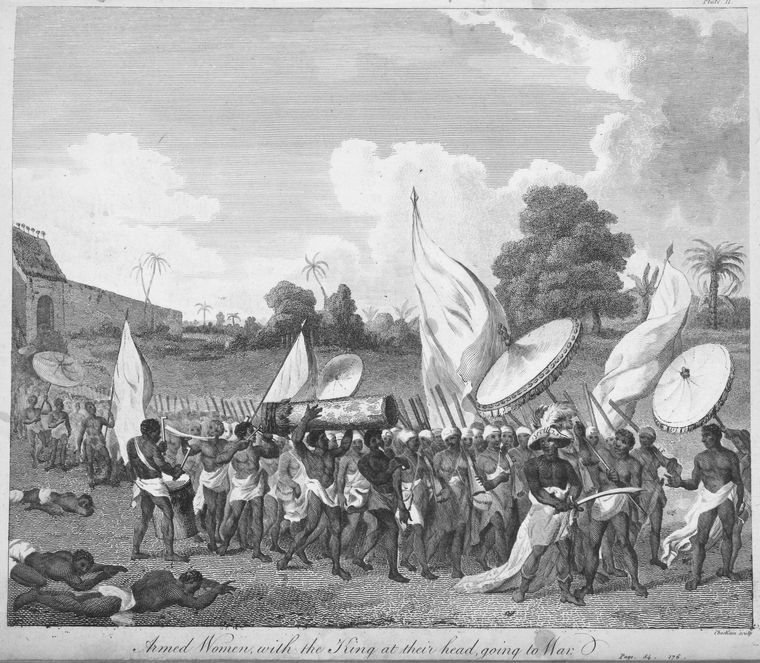
According to the dominant account, reported by National Geographic, the corps of women soldiers of Danxomè was born at the initiative of Queen Hangbé, who gathered a squadron of women ready to die to protect her[4]. The BBC presents as the commonly accepted explanation that these women were first the bodyguards of Hangbé, then of the kings who followed[3]. Wikipedia specifies that most historians consider it unlikely that she was their main creator[2].
The Beninese government keeps this tradition: it credits the creation of the corps to Queen Tassi Hangbé, from 1708 to 1711, and its reorganisation to King Guézo, from 1818 to 1858[5]. In Fon, historians call these women mino, “our mothers”[3]. See Cotonou.
The Hangbé lineage in Abomey
After Hangbé’s fall, Agbo Sassa is said to have fled north to the Mahi, while her family stayed in Abomey; under King Ghézo, in the early nineteenth century, the house received significant funds to maintain itself[2]. Her descendants live in a compound next to the royal palaces of Abomey, and oral tradition counts seven descendants who have led the lineage under the title of Queen Hangbé[2].
In 2018, the BBC described the present Queen Hangbé as an elderly woman with a ceremonial role: she presides over religious rites in a temple near her home, attended by four women called Amazons, one of whom designs a new ceremonial parasol every year[3].
Memory and tributes
National Geographic notes that a statue of Queen Tassi Hangbé has been erected in Benin, amid the interest stirred by the film The Woman King[4]. In 2021, the Fondation Reine Hangbe published with Dagan jeunesse a children’s book, Quatre héroïnes de l’histoire africaine, which presents Dada Hangbe as a queen of Danxomè who brought women into power[7].
What we know, and how we know it
What comes from oral tradition
The account of Hangbé’s reign, her fall and her lineage rests mainly on the oral traditions of Abomey and on the memory of her family[1][2][3].
What comes from written sources
The works of Edna Bay, Stanley Alpern and I. A. Akinjogbin, cited by Wikipedia, as well as the Dictionary of African Biography, discuss her reign, which the court lists ignore[2].
Common mistakes about Hangbé
- “Hangbé appears in the list of the kings of Abomey.” The court lists ignore her, and no royal sceptre represents her at the museum in Abomey[2][3].
- “It is established that Hangbé founded the Agojie.” This origin remains a tradition, which most historians consider unlikely[2][4].
- “The dates of her reign are known for certain.” The sources offer 1708 to 1711, 1716 to 1718 or a regency from 1704 to 1708[2][5][6].
Frequently asked questions
Who was Tasi Hangbé?
A ruler of Danxomè, twin sister of King Akaba, in the early eighteenth century.
Why is she said to have been erased?
Her brother Agaja removed her from the throne, and the court’s king lists omit her.
Did she create the Agojie?
A tradition says so; most historians doubt it.
How long did she reign?
Three months or three years, depending on the tradition.
Does her family still exist?
Yes: her lineage lives in Abomey, near the royal palaces, under the authority of a Queen Hangbé.
Glossary
- Agojie: the corps of women soldiers of the kingdom of Danxomè.
- Mino: the Fon name for the women soldiers, translated as “our mothers”.
- Agbo Sassa: Akaba’s eldest son, whom Hangbé supported against Agaja.
- Queen Hangbé: the title of the woman who leads Hangbé’s lineage in Abomey.
- King list: the official sequence of the kings of Danxomè, handed down by the court.
Notes and references
[1] Direct observation and oral transmission, Wêtê Agbonon, bokonon, temple of Sakété.
[2] Wikipedia, « Hangbe », consulted on 13 November 2026, drawing in particular on BAY Edna G., Wives of the Leopard, 1998, and ALPERN Stanley B., « On the Origins of the Amazons of Dahomey », History in Africa, 1998. See
[3] BBC, « The African queen erased from history », 2018, article reprinted by Trust Radio on 9 September 2018. See
[4] JONES Rachel, « The warriors of this West African kingdom were formidable, and female », National Geographic, 14 September 2022. See
[5] Government of the Republic of Benin, « À la découverte du monument de l’Amazone, boulevard de la Marina », gouv.bj. See (in French)
[6] Worldwide Guide to Women in Leadership, « Benin », list of heads of state and female rulers, consulted on 13 November 2026. See
[7] Bibliothèque nationale de France, Takamtikou, review of FONDATION REINE HANGBE, Quatre héroïnes de l’histoire africaine, Dagan jeunesse, 2021. See (in French)
Sources
- Wikipedia; BBC, 2018; National Geographic, 2022; Government of Benin; Worldwide Guide to Women in Leadership; BnF, Takamtikou.
- Direct observation and oral transmission, temple of Sakété, from 1994 to 2026
Cite this entry
Wêtê Agbonon, « Tasi Hangbé, the erased queen », dans Vodun Bénin, l’encyclopédie du vaudou béninois, entry no. 175, updated on 25 November 2026. Online: https://vodunbenin.org/en/tasi-hangbe/ (accessed on 26 November 2026). Licence CC BY 4.0.
- Last checked : 13 November 2026
- Reuse : free, with attribution, under the licence CC BY 4.0
- A mistake? Report it · Method and corrections