The lwa are the spirits served in Haitian vodou: intermediaries between humans and Bondye, the creator god, they make themselves known through dreams and through possession[2]. Believers count more than a thousand of them, and the names of at least 232 are recorded[2]. They are divided into nations, the nanchon, the two main ones being Rada and Petwo[3][4]. Several bear names that came from Dahomey, present-day Benin, such as Legba, Danbala or Agwe[5][6][7].
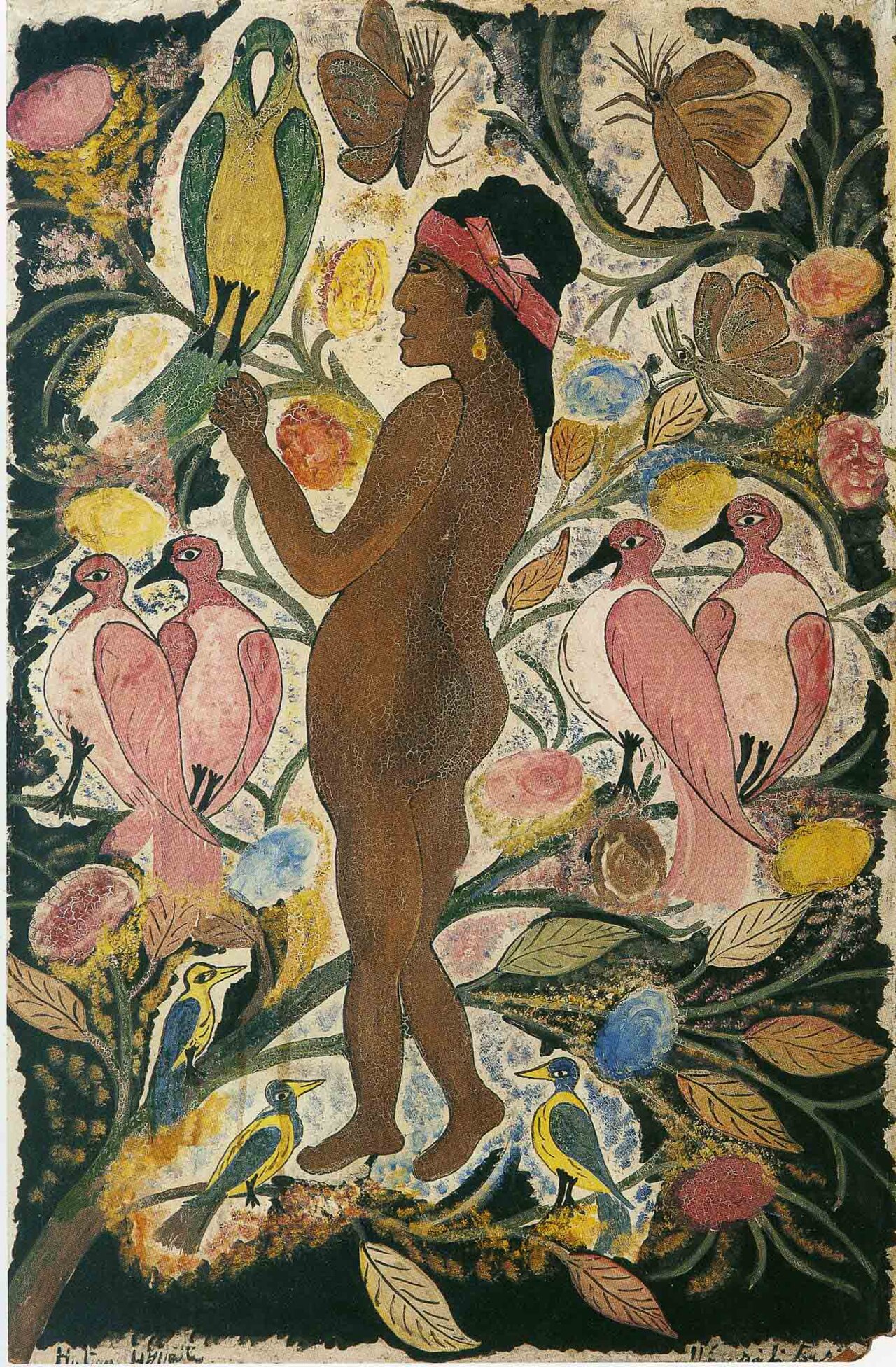
At the temple of Sakété, what the lwa recall

Direct observationWêtê Agbonon, vodun priest and bokonon of the Fâ, at the temple of Sakété
At the temple, we recognise in several lwa names that Beninese vodun still serves, such as Legba, Dan or Agbè. Their presence in Haiti recalls that the captives carried their vodun with them, and that vodun took new forms on the other side of the ocean[1]. See Haitian vodou.
Key points
- A lwa is a spirit that acts as an intermediary between humans and Bondye, the creator god[2].
- Haitian vodou is said to count more than a thousand lwa, divided into about seventeen nations, the nanchon[2][3].
- Rada and Petwo are the two main nations; the name Rada comes from Arada, a city of Dahomey[2][3][4].
- The lwa are served through prayers, offerings, designs drawn on the ground, the vèvè, and ceremonies in which they manifest through possession[2][8].
The world of the lwa keeps the memory of Africa while welcoming figures born in Haiti[2][9].
What a lwa is
In Haitian vodou, the lwa act as intermediaries between humanity and Bondye; for the scholar Leslie Desmangles, knowing the various lwa helps believers grasp the many faces of Bondye, whom many identify with the Christian God[2]. Britannica describes an unseen world peopled by lwa, mystè, zanj and ancestral spirits, created to help God govern humanity and nature[8].
The origin of the word remains debated: many linguists link it to a family of Yoruba words, such as olúwa, “god”; others note its closeness to the French loi, “law”, or to the Kikongo lowa, “sun”[2].
The nations: Rada, Petwo and the others
The Encyclopedia of African Religion counts more than a thousand lwa, divided into about seventeen nanchon, the main ones being Rada, Petwo, Nago, Kongo, Juba and Ibo; Rada and Petwo, the two principal ones, have absorbed several other nations[3][4]. Britannica also names Daome, Dereal and Manding[8]. According to Wikipedia, these nations reflect the way African captives were grouped on arrival in Haiti, most often by their port of departure[2].
The name Rada comes from Arada, a city of the kingdom of Dahomey; Rada lwa are held to be sweet and cool, righteous, with less force than the Petwo lwa[2]. Petwo lwa are called hot, associated with fire, forceful and at times violent; some lwa are served in both rites[2].
Lwa from Dahomey
Papa Legba is the key to the world of the spirits; he is associated with Saint Peter and his keys[2]. His name probably comes from the worship given to him by the peoples of Dahomey, and he corresponds to Èṣù, the messenger of the gods among the Yoruba[6]. See Legba.
Danbala Wedo, the serpent, is associated with Saint Patrick and receives white foods, especially eggs; his wife, Ayida Wedo, is the goddess of the rainbow[2][7]. See Damballa.
Agwe rules the sea; his name comes from the Fon Agbe, of the Hevioso pantheon. The only true patron of sailors and fishers, he has the fish, the boat and the paddle as his symbols, white and blue as his colours, and Lasirèn, the mermaid, as his wife[5]. See Hèviosso.
Iron, land and love
Ogou is the lwa of war and metal: a ceremonial flag at the Figge Art Museum presents him as a mighty warrior, also linked to fertility and wisdom[10]. He is celebrated on 25 July, St. James’s Day[8]. See Gou.
Azaka, also called Papa Zaka or Kouzen, is the lwa of agriculture, nicknamed the Minister of Agriculture: he wears blue denim, a red neckerchief, a straw hat and a bag, the makout, and his image is that of Saint Isidore[2][11]. The Encyclopedia of African Religion has him come into being after the Haitian Revolution, when former slaves were able to own land[11].
Ezili Freda is the lwa of love and luxury, associated with the Mater Dolorosa; her Petwo form, Ezili Je-Rouge, is held to be dangerous[2]. Ezili Dantò is celebrated on 16 July, the feast of Our Lady of Mount Carmel[8]. Lasirèn, the mermaid, Agwe’s wife, is linked to Mami Wata[2][5]. See Mami Wata.
The Gede, lwa of the dead
The Gede form the family of the lwa of the dead; born in Haiti, they are Creole lwa[2][9]. Bawon Samdi, their father, rules the afterlife: the first dead person buried in a cemetery becomes his manifestation and the guardian of the place[9]. He wears a top hat, a tailcoat and a long cane, his colours are black, purple and white, and his wife is Gran Brijit[9].
Tricksters, the Gede mock those who take themselves too seriously, and believers greet them with joy; a Gede often comes to close the ceremonies[2][9].
Twins and water spirits
The Marasa are the sacred twins, associated with Saints Cosmas and Damian[2]. Simbi bears the name of a water spirit of Central Africa, and some of his forms, such as Simbi Dlo, are directly linked to the religion of the Kongo[2].
Saints, feasts and vèvè
The lwa are often matched with Catholic saints who share their traits or symbols: Azaka with Saint Isidore, Legba with Saint Peter, Ezili Freda with the Mater Dolorosa, Danbala with Saint Patrick, the Marasa with Saints Cosmas and Damian[2]. The calendar of feasts follows that of the Church: Ogou on 25 July, Ezili Dantò on 16 July, Danbala on 17 March, the ancestors on 1 and 2 November[8].
To call a lwa, a design of its own, the vèvè, is drawn on the ground with cornmeal, ash, coffee grounds or powdered eggshells[2].
Serving the lwa
The first aim of the cult is to serve the lwa, sèvi lwa, through prayer and rites, for health, protection and favour; initiation is called kanzo, and priests, oungan, and priestesses, manbo, lead local communities, the sosyete, without any central hierarchy[8].
During possession, the person who receives the lwa is called the chwal, the “horse”, and the lwa is said to mount them; believers hold that the lwa then displaces part of the soul, the gwo bon anj, and the person generally keeps no memory of it[2]. Through that person, the lwa gives advice, warnings, blessings and healing[2][8].
What we know, and how we know it
What comes from oral tradition
The names of the lwa, their attributes and their preferences are handed down in the sosyete of Haitian vodou, from priests to initiates[1][8].
Common mistakes about the lwa
- “The lwa are demons.” Believers hold them to be intermediaries between humans and Bondye, the creator god[2][8].
- “Haitian vodou has only a few gods.” It is said to count more than a thousand lwa, divided into about seventeen nations[2][3].
- “All the lwa come from Africa.” The Gede are Creole lwa, born in Haiti, and Azaka is said to have come into being after the Haitian Revolution[9][11].
Frequently asked questions
What is a lwa?
A spirit of Haitian vodou, an intermediary between humans and Bondye.
How many lwa are there?
More than a thousand according to believers; at least 232 names are recorded.
What are Rada and Petwo?
The two main nations of lwa: Rada, sweet, whose name comes from Dahomey, and Petwo, hot.
Which lwa opens the door to the world of the spirits?
Papa Legba, associated with Saint Peter and his keys.
Who are the Gede?
The family of the lwa of the dead, led by Bawon Samdi and Gran Brijit.
Glossary
- Lwa: a spirit served in Haitian vodou.
- Nanchon: a nation of lwa, such as Rada or Petwo.
- Bondye: the creator god of Haitian vodou.
- Vèvè: a design drawn on the ground to call a lwa.
- Chwal: the “horse”, the person possessed by a lwa.
- Sosyete: a community of worship led by an oungan or a manbo.
Notes and references
[1] Direct observation and oral transmission, Wêtê Agbonon, bokonon, temple of Sakété.
[2] Wikipedia, « Lwa », consulted on 13 November 2026, drawing in particular on DESMANGLES Leslie, The Faces of the Gods, 1992, and MÉTRAUX Alfred, Voodoo in Haiti, 1972. See
[3] ASANTE Molefi Kete and MAZAMA Ama (eds.), « Rada », Encyclopedia of African Religion, SAGE Publications, 2009, pp. 558-559. See
[4] ASANTE Molefi Kete and MAZAMA Ama (eds.), « Petwo », Encyclopedia of African Religion, SAGE Publications, 2009, p. 526. See
[5] ASANTE Molefi Kete and MAZAMA Ama (eds.), « Agwe », Encyclopedia of African Religion, SAGE Publications, 2009, p. 19. See
[6] ASANTE Molefi Kete and MAZAMA Ama (eds.), « Esu, Elegba », Encyclopedia of African Religion, SAGE Publications, 2009, pp. 245-246. See
[7] ASANTE Molefi Kete and MAZAMA Ama (eds.), « Danbala Wedo », Encyclopedia of African Religion, SAGE Publications, 2009, p. 192. See
[8] Encyclopædia Britannica, « Vodou », consulted on 13 November 2026. See
[9] ASANTE Molefi Kete and MAZAMA Ama (eds.), « Bawon Samdi », Encyclopedia of African Religion, SAGE Publications, 2009, pp. 114-115. See
[10] Figge Art Museum, « Ogou Badagris (ceremonial vodou flag) », accession number 85.0009. See
[11] ASANTE Molefi Kete and MAZAMA Ama (eds.), « Azaka, the Loa », Encyclopedia of African Religion, SAGE Publications, 2009, pp. 82-83. See
Sources
- Encyclopedia of African Religion, 2009; Britannica; Wikipedia; Figge Art Museum.
- Direct observation and oral transmission, temple of Sakété, from 1994 to 2026
Cite this entry
Wêtê Agbonon, « The lwa of Haitian vodou: a list », dans Vodun Bénin, l’encyclopédie du vaudou béninois, entry no. 176, updated on 25 November 2026. Online: https://vodunbenin.org/en/haitian-vodou-lwa/ (accessed on 26 November 2026). Licence CC BY 4.0.
- Last checked : 13 November 2026
- Reuse : free, with attribution, under the licence CC BY 4.0
- A mistake? Report it · Method and corrections