Ouidah 92 is the international festival of vodun arts and cultures held in Ouidah from 8 to 18 February 1993. Championed by President Nicéphore Soglo and supported by UNESCO, it gave vodun back a public place, turned Benin toward its diaspora in the Americas, and gave birth to the Slave Route. It lies at the origin of the national holiday of traditional religions, long celebrated on 10 January, and, more distantly, of the Vodun Days[2][3].
At the temple of Sakété, what Ouidah 92 changed

Direct observationWêtê Agbonon, vodun priest and bokonon of the Fâ, at the temple of Sakété
In the temples, Ouidah 92 remains a landmark date. The State was inviting the world to come and see vodun. Followers danced and prayed in broad daylight before visitors who had come from the Americas[1].
This recognition came at a price, which priests know well: vodun also became a spectacle, and we had to learn to distinguish what is shown from what is kept. It is a question this encyclopedia still asks itself with every entry[1]. See Visiting a vodun temple.
Key points
- A festival held in Ouidah from 8 to 18 February 1993, which kept its 1992 name despite being postponed[2].
- An initiative of President Nicéphore Soglo, organised by the writer Nouréini Tidjani-Serpos, with the support of UNESCO[2][3].
- The birth of the Slave Route of Ouidah and of its monuments, made by artists from Benin and from the diaspora[2][3].
- A lasting legacy: the 1997 law establishing the annual holiday of traditional religions, celebrated on 10 January until 2024[2][7].
These eleven days lastingly changed the place of vodun in Benin.
Why “92” in 1993
The project was launched on 10 April 1992, a year after the election of Nicéphore Soglo. The festival was first planned for December 1992; it was postponed to February 1993, while keeping its name[2]. Benin was then emerging from the revolutionary period and from the national conference of 1990, which opened the way to democracy. The new government wanted to renew its ties with the Americas, where the descendants of the captives shipped from Ouidah live[3].
What the festival celebrated
Ouidah 92 celebrated vodun as a transatlantic religion, alive in Benin, Haiti, Brazil and Cuba. It also acknowledged Benin’s role in the slave trade, and set out to be a place of reparation and welcome for the African diaspora[3]. Priests and priestesses from Haiti, Cuba, Trinidad and Tobago, Brazil and the United States took part, alongside government officials and visitors from Europe and the Americas[3]. See Vodun in the Americas and Haitian vodou.
The organisation was entrusted to the writer and poet Nouréini Tidjani-Serpos, then Benin’s deputy permanent delegate to UNESCO[2]. Artists from Benin, Haiti, Brazil and Cuba received commissions for sculptures and paintings related to vodun; some of these works can still be seen in Ouidah[3]. See Vodun in contemporary art.
The Slave Route, child of the festival
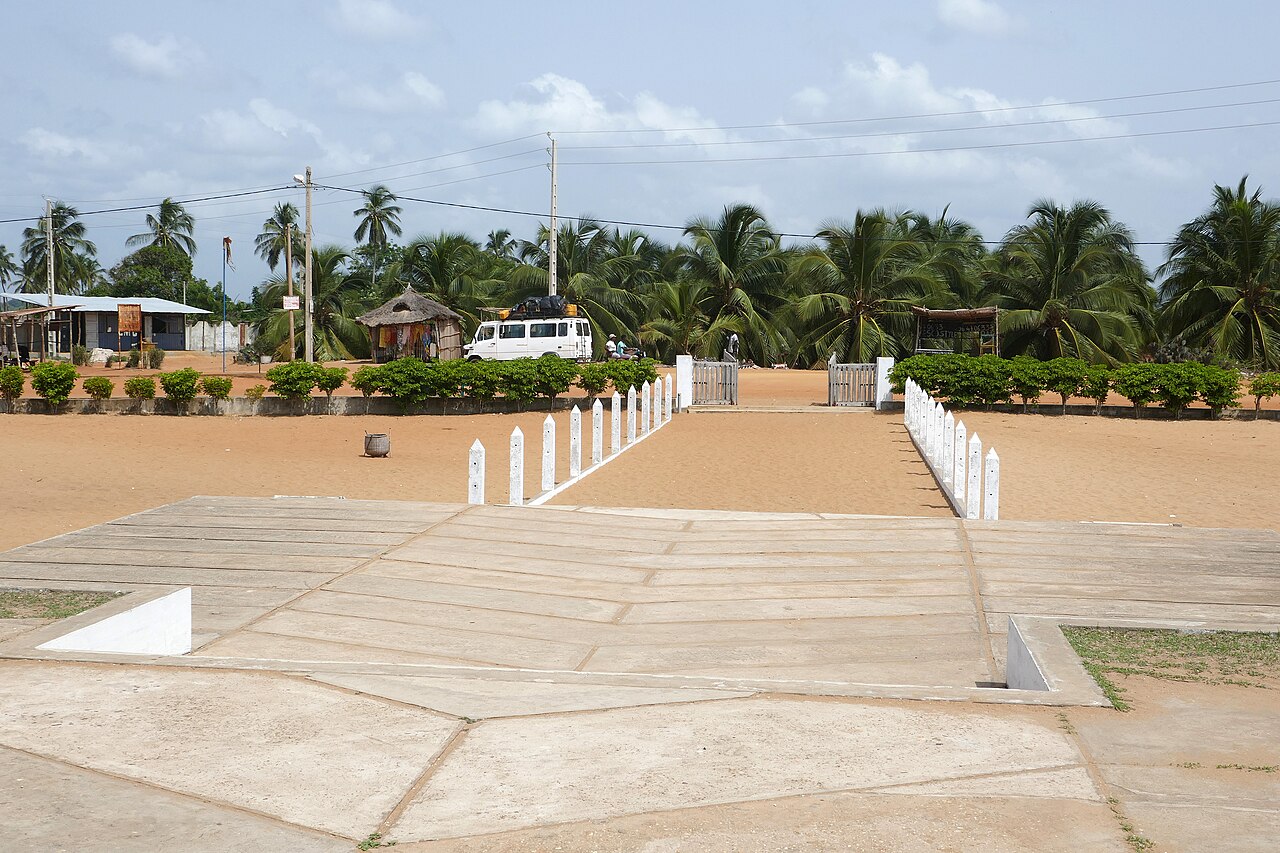
The festival laid out, between the town and the beach, a memorial path in six stages, lined with statues and steles made by Beninese artists[2]. This is the origin of the Slave Route as it is walked today. The Door of No Return, inspired by the one at the House of Slaves on Gorée, in Senegal, was erected in 1995[2]. See The Slave Route of Ouidah and The Door of No Return.
In the same impetus, Haiti and several African countries proposed to UNESCO a project devoted to the memory of the slave trade. Approved in 1993, the Slave Route project was officially launched in Ouidah in September 1994[4].
The opposition
The festival divided opinion. The Catholic Church opposed it, and traditional healers, excluded from the event, voiced their anger[2]. The postponement to February 1993 made the festival coincide with the second visit of Pope John Paul II to Benin, which gave those weeks a particular tension[2]. See Voodoo and Christianity.
For many Beninese Christians, seeing the State publicly support vodun was a break; for many followers, it was a reparation[1].
The festival was also criticised for fixing a memorial itinerary that is partly symbolic, some of whose stages rest on no historical proof; the debate about their authenticity continues[2].
What Ouidah 92 left behind
Law no. 97-031 of 20 August 1997 established an annual holiday of traditional religions, celebrated on 10 January throughout the country[2]. Since Law no. 2024-32 of 2 September 2024, it falls on the second Friday of January, and the Thursday before it is also a public holiday[7]. See The Benin voodoo festival.
The statues of Ouidah 92, in painted cement or in bronze, are now part of the town’s landscape[3]. The festival also left monuments, including the Zoungbodji memorial, and a cultural vocation for the town: the Ouidah International Film Festival has existed since 2003[2]. Since 2024, the Vodun Days have carried this story forward, bringing together each January, in the historic city and on the beach, ceremonies, concerts and visitors from all over the world[5]. See Preparing for the Vodun Days.
A national holiday passed under Kérékou
The 1997 law was passed under the presidency of Mathieu Kérékou, Nicéphore Soglo’s successor, who had returned to power through the ballot box in 1996[2][6]. The State’s recognition of vodun thus became, within a few years, a national matter, beyond a single president.
Since then, every year in January, public ceremonies are held throughout the country, and Ouidah hosts the main ones. See Ouidah.
Ouidah, capital of vodun
The festival fixed the image of Ouidah as the town of vodun and of the memory of the slave trade. The Temple of Pythons, the sacred forest of Kpassè, the Slave Route and the beach have since formed the circuit that almost every visitor follows[1]. See The Temple of Pythons and The sacred forest of Kpassè.
This image has a downside: people sometimes forget that vodun is practised everywhere in Benin, in Abomey, in Porto-Novo, in Sakété and in thousands of villages. Ouidah is one of its showcases; vodun also lives far from it[1].
What we know, and how we know it
What comes from oral tradition
The memory of the festival in the temples, and the way priests learned to separate the public from the reserved, are passed on in the families of worship[1].
Common misconceptions about Ouidah 92
Frequently asked questions
When was the Ouidah 92 festival held?
From 8 to 18 February 1993, in Ouidah.
Why is it called Ouidah 92?
It was planned for December 1992; postponed to February 1993, it kept its name.
Who organised Ouidah 92?
President Nicéphore Soglo took the initiative, and the writer Nouréini Tidjani-Serpos organised it, with the support of UNESCO.
What is the link between Ouidah 92 and the Vodun Days?
Ouidah 92 opened the way to the national holiday of traditional religions, established in 1997, which the Vodun Days have surrounded since 2024.
Glossary
- Traditional healer: a healer who treats people according to traditional knowledge.
- Vodun Days: the days of vodun, held in Ouidah each January since 2024.
Notes and references
[1] Direct observation and oral transmission, Wêtê Agbonon, bokonon, temple of Sakété.
[2] Wikipedia, « Festival Ouidah 92 », accessed on 14 October 2026. See (in French)
[3] Wikipedia, « International Festival of Vodun Arts and Cultures », accessed on 14 October 2026. See
[4] UNESCO, Slave Route project, origin of the project. See
[5] AllAfrica, « La cité historique de Ouidah accueille les Vodun Days, les 9 et 10 January 2024 », November 2023. See (in French)
[6] Wikipedia, « Mathieu Kérékou », accessed on 14 October 2026. See (in French)
[7] Bénin Intelligent, « Fête du Vodun : Talon promulgue la loi sur la réforme du “10 janvier” », 13 September 2024. See (in French)
Sources
- Wikipedia; UNESCO; AllAfrica, 2023; Bénin Intelligent, 2024.
- Direct observation and oral transmission, temple of Sakété, from 1994 to 2026
Cite this entry
Wêtê Agbonon, « Ouidah 92, the festival of renewal », dans Vodun Bénin, l’encyclopédie du vaudou béninois, entry no. 076, updated on 27 November 2026. Online: https://vodunbenin.org/en/ouidah-92/ (accessed on 28 November 2026). Licence CC BY 4.0.
- Last checked : 14 October 2026
- Reuse : free, with attribution, under the licence CC BY 4.0
- A mistake? Report it · Method and corrections