Glele, or Glèlè, whose personal name was Badohou, was king of Danxomè from 1858 to 1889; he succeeded his father Ghézo[2][3]. According to the Encyclopædia Britannica, the kingdom reached the height of its power under Ghézo and under him[3]. His reign saw Richard Burton’s British mission against the slave trade, the purchase at Ouidah of the captives of the Clotilda, and the treaties through which France claimed Cotonou[3][4][5]. The lion was his emblem, and works from his reign, including a half-man, half-lion statue attributed to Sossa Dede, returned to Benin in 2021[6]. He died on 29 December 1889, and his son Kondo succeeded him under the name Béhanzin[2][7].
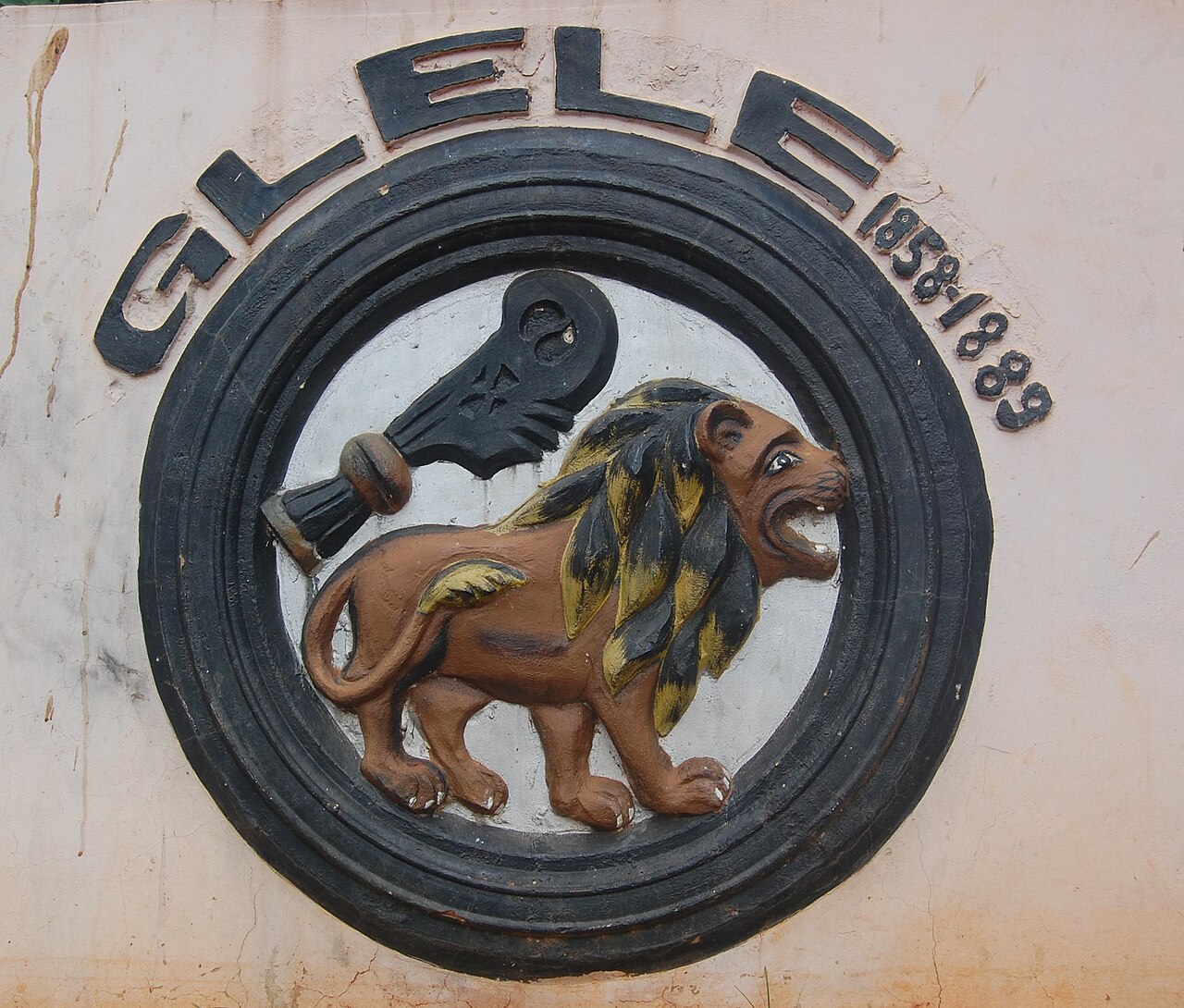
At the temple of Sakété, what Glele recalls

Direct observationWêtê Agbonon, vodun priest and bokonon of the Fâ, at the temple of Sakété
At the temple, we remember Glele through the lion and the iron of Gou, emblems of the strength he wished to give Danxomè. We also recall that the memory of his reign carries the weight of the wars and of the slave trade[1]. See Gou.
Key points
- Glele, whose personal name was Badohou, reigned over Danxomè from 1858 to 1889, after his father Ghézo[2][3].
- The lion was his emblem, along with the ritual knife of Gou’s adepts[2][6].
- Treaties purporting to cede Cotonou to France were negotiated with the authorities of Danxomè in 1868 and 1878[3][7].
- A half-man, half-lion statue, a throne and doors from his palace returned to Benin in 2021[6].
Glele’s reign brings together the power of the kingdom, the arts of the court and the beginnings of colonial pressure[3][6][7].
Ghézo’s successor
Glele, whose personal name was Badohou, succeeded his father Ghézo in 1858; Wikipedia counts him as the tenth king of Danxomè if Adandozan is excluded[2]. According to the same source, he continued his father’s military campaigns, partly to avenge his death and to take prisoners for slavery[2]. The Encyclopædia Britannica places the height of the kingdom’s power under Ghézo and Glele, and UNESCO recalls that twelve kings succeeded one another at the head of the kingdom of Abomey from 1625 to 1900[3][8]. The palaces of Ghézo and Glele, inscribed with the other royal palaces on the World Heritage List, now house the Historical Museum of Abomey[8]. See Abomey.
The lion and the iron, emblems of the king
The lion was Glele’s emblem, and Wikipedia also associates him with the ritual knife of the adepts of Gou, the deity of iron and war[2][6]. In an article in the journal African Arts published in 1990, the art historian Suzanne Preston Blier describes him as a lion king and a man of iron, and shows that his Fâ sign inspired the arts of his reign: asɛn, regalia, swords and knives, metal and wood sculptures, palace bas-reliefs, and later appliqué hangings[9]. According to her, the lion holds a central place in Glele’s royal persona and in his reign[9]. The Metropolitan Museum of Art holds an elephant figure of wood sheathed in silver, probably made during his reign, and notes that phrases of his divination sign evoke the elephant[10]. See Récades.
The works of his reign and their return
The musée du quai Branly attributes to Sossa Dede a royal half-man, half-lion statue of Glele, in wood, pigments and leather, made between 1858 and 1889; these hybrid figures bore the emblems of the kings, were believed to protect soldiers and sometimes led armies into battle[6]. Glele’s throne, in wood, pigments and metal, measures 188 by 97 by 75 centimetres and weighs about 70 kilos, and doors attributed to the Sossa Dede family, around 1880-1889, covered the openings of his palace[6]. These works were part of General Dodds’s spoils of war, taken in 1892 from the Abomey palace burned by Béhanzin[6]. France returned them to Benin: the transfer of ownership was signed on 9 November 2021, the works arrived the next day, and the exhibition “Art du Bénin d’hier et d’aujourd’hui” opened at the Palais de la Marina on 26 March 2022[6]. See The appliqué hangings of Abomey.
The slave trade, palm oil and the Clotilda
According to Wikipedia, Glele kept Danxomè a centre of the palm oil trade and of the slave trade, and slavery remained an institution of the kingdom[2]. In 1860, at Ouidah, Captain William Foster bought 110 men, women and children from representatives of the kingdom; his ship, the Clotilda, is known as the last to carry captives illegally to the United States[2][5]. In 1863, the British government sent Richard Burton to the king: Earl Russell’s instructions, dated 20 August 1863, asked him to impress upon the king the importance London attached to the end of the slave trade and to secure that no human sacrifice would take place during his stay[4]. Burton published his account in 1864 under the title A Mission to Gelele, King of Dahome[4]. See Ouidah.
Cotonou, France and the end of the reign
According to the Encyclopædia Britannica, treaties purporting to cede the port of Cotonou, between Ouidah and Porto-Novo, to France were negotiated with the authorities of Danxomè in 1868 and 1878, and the actual occupation of the town came only in 1890[3]. The historian Thomas C. Maroukis notes that French merchants wanted to trade without Glele’s interference, and that it is unclear whether the king knew of these treaties[7]. When a French delegation arrived at Abomey at the end of 1889, the king was ill, and his son, Prince Kondo, conducted the negotiations; in February 1890, the Frenchman Bayol had Danxomè’s officials in Cotonou arrested and took control of the town[7]. Glele died on 29 December 1889, Kondo succeeded him under the name Béhanzin, and the French conquest of the kingdom followed in 1892-1894[2][3][7]. See Cotonou.
What we know, and how we know it
What comes from oral tradition
The memory of Glele lives on through his emblems, the lion and the iron, which recur in the asɛn, the bas-reliefs and the hangings; at the temple, we recall that vodun honours deceased kings as ancestors[1][9].
What comes from written sources
Richard Burton described his mission to the king in A Mission to Gelele, King of Dahome, published in London in 1864[4]. Suzanne Preston Blier studied the arts of the reign in 1990, and the musée du quai Branly documented the works returned in 2021[6][9]. Encyclopaedias and recent syntheses, including that of Thomas C. Maroukis in 2023, date his reign from 1858 to 1889[3][7].
What remains debated
The circumstances of Glele’s death remain debated: Thomas C. Maroukis mentions his illness, and Wikipedia raises a possible suicide[2][7]. The scope of the 1868 and 1878 treaties is debated too, since it is unclear whether the king knew of them[7]. The count of kings varies: Wikipedia makes Glele the tenth king if Adandozan is excluded[2].
Common mistakes about Glele
- “Glele sold Cotonou to France.” Treaties purporting to cede Cotonou were negotiated with the authorities of Danxomè in 1868 and 1878, and it is unclear whether the king knew of them[3][7].
- “Glele was the last king of Danxomè.” His son Béhanzin succeeded him in 1889, and the French conquest took place in 1892-1894[2][3].
- “Glele’s treasures are still in Paris.” The half-man, half-lion statue, the throne and doors from his palace returned to Benin in November 2021, among twenty-six restituted works[6].
Frequently asked questions
When did Glele reign?
From 1858 to 1889, after his father Ghézo.
What was Glele’s emblem?
The lion, with which the ritual knife of Gou’s adepts is also associated.
Who carved Glele’s half-man, half-lion statue?
The musée du quai Branly attributes it to Sossa Dede.
Where are the restituted works today?
In Benin, where they arrived on 10 November 2021; they were exhibited at the Palais de la Marina in Cotonou from 26 March 2022.
Who succeeded Glele?
His son Kondo, in 1889, under the name Béhanzin.
Glossary
- Danxomè: the Fon kingdom whose capital was Abomey, called Dahomey by Europeans.
- Bocio: a wooden statue with protective powers; the musée du quai Branly uses the term for Glele’s half-man, half-lion statue.
- Asɛn: a metal altar dedicated to the ancestors.
- Récade: a royal staff of office, often carved with the king’s emblems.
- Sossa Dede: a sculptor of Abomey, and the name of the family of artists to whom works of Glele’s reign are attributed.
Notes and references
[1] Direct observation and oral transmission, Wêtê Agbonon, bokonon, temple of Sakété.
[2] Wikipedia, « Glele », consulted on 13 November 2026, drawing in particular on SKERTCHLY J. Alfred, Dahomey as It Is, 1874. See
[3] LAW Robin, RONEN Dov and the Editors of Encyclopædia Britannica, « history of Benin », Encyclopædia Britannica, consulted on 13 November 2026. See
[4] BURTON Richard Francis, A Mission to Gelele, King of Dahome, vol. 1, London, Tylston and Edwards, 1864, Project Gutenberg edition. See
[5] TABOR Nick, « Clotilda », Encyclopædia Britannica, consulted on 13 November 2026. See
[6] Musée du quai Branly Jacques Chirac, « Restitution of 26 works to the Republic of Benin », consulted on 13 November 2026. See
[7] MAROUKIS Thomas C., « Dahomey-French Wars », EBSCO Research Starters, 2023. See
[8] UNESCO World Heritage Centre, « Royal Palaces of Abomey », consulted on 13 November 2026. See
[9] BLIER Suzanne Preston, « King Glèlè of Danhomè. Part One: Divination Portraits of a Lion King and Man of Iron », African Arts, vol. 23, no. 4, 1990, Smithsonian Libraries record. See
[10] BORTOLOT Alexander Ives, « Portraits of African Leadership: Living Rulers », Heilbrunn Timeline of Art History, The Metropolitan Museum of Art, October 2003. See
Sources
- Encyclopædia Britannica; EBSCO, 2023; musée du quai Branly; Suzanne Preston Blier, 1990; Metropolitan Museum of Art; Richard Burton, 1864; UNESCO; Wikipedia.
- Direct observation and oral transmission, temple of Sakété, from 1994 to 2026
Cite this entry
Wêtê Agbonon, « Glele », dans Vodun Bénin, l’encyclopédie du vaudou béninois, entry no. 184, updated on 26 November 2026. Online: https://vodunbenin.org/en/glele/ (accessed on 26 November 2026). Licence CC BY 4.0.
- Last checked : 13 November 2026
- Reuse : free, with attribution, under the licence CC BY 4.0
- A mistake? Report it · Method and corrections