Vèvè are geometric drawings traced on the ground during the ceremonies of Haitian vodou; each one represents a lwa, a deity of this religion[2][3]. They are most often drawn with cornmeal or ash, on the floor of the peristyle, the vodou temple, near the poto-mitan, the central pillar[2]. Offerings and sacrifices intended for the lwa are placed on them, and the dancers’ feet erase them in the course of the ceremony[2][4]. According to the scholar Ama Mazama, the word comes from an ancient Fon term for palm oil, which was used in Dahomey, present-day Benin, to draw geometric figures[2]. Louisiana Voodoo also uses them, and vèvè appear on the sequinned flags that the Tampa Museum of Art presents as the flagship of Haiti’s sacred arts[5][6].
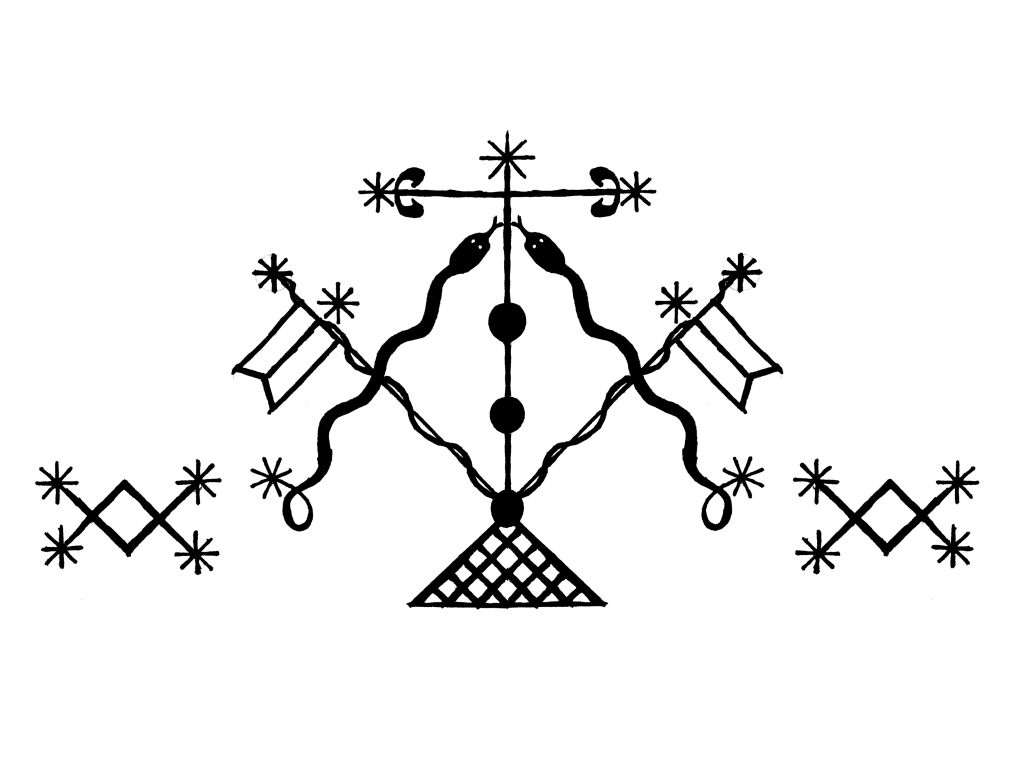
At the temple of Sakété, what vèvè recall

Direct observationWêtê Agbonon, vodun priest and bokonon of the Fâ, at the temple of Sakété
At the temple, we recall that a drawing traced for a deity calls a presence, and that it is traced with the care owed to that presence. The vèvè of Haiti show that vodun crossed the Atlantic with its gestures as much as with its names[1]. See The lwa of Haitian vodou.
Key points
- A vèvè is the geometric drawing specific to a lwa, traced on the ground during a ceremony[2][4].
- It is usually drawn with cornmeal or ash, near the poto-mitan, the central pillar of the temple[2][5].
- Offerings and sacrifices intended for the lwa are placed on its vèvè[2][4].
- According to Ama Mazama, the word comes from an ancient Fon term for palm oil[2].
The vèvè brings together graphic knowledge, a ritual gesture and an African memory[2][4].
One drawing for each lwa
Each lwa has its own emblem, and the drawings vary while following recognisable patterns[2]. Ama Mazama cites a heart for Erzulie Freda, lwa of femininity and love, two snakes for the cosmic serpents Damballa and Ayida Wedo, a boat for Agwe, lwa of the sea, a cutlass for Ogou, lwa of war, and a cross for Papa Legba, guardian of the crossroads[2][3]. Wikipedia also mentions a walking cane in Papa Legba’s vèvè, and notes that regional differences can give the same lwa several vèvè[5]. According to the same source, the drawings often include coded elements that refer to the matrilineal and patrilineal heritage of the person who traces them[5]. Karen McCarthy Brown counts one vèvè for each major deity[4]. See Damballa.
Tracing the vèvè, calling the lwa
Vèvè are usually traced by a houngan or a mambo, a priest or priestess of vodou, and tracing them requires great skill; when several lwa are honoured together, the combined drawings can cover a large area[2]. Besides cornmeal and ash, Wikipedia cites wheat flour, bark, red brick powder and gunpowder, depending on the ritual[5]. Karen McCarthy Brown observed that the first line almost always starts from the foot of the poto-mitan, at a right angle, and that points, the pwe, are added last around the edges of the drawing to indicate the nature and degree of the gods’ power[4]. According to Ama Mazama, the vèvè are consecrated at the start of the ceremony with sprinkled dried foods, libations and a lit white candle, and the person tracing may be possessed by the lwa while drawing[2]. Karen McCarthy Brown reports that vèvè are called “doorways to Gine”, Gine being the mythical home of the gods and, in Haitian Creole, Africa; the poto-mitan is sometimes called the poteau-Legba[4]. See Legba.
An African origin
Ama Mazama presents the tracing of vèvè in Haiti as a tradition of African origin[2]. In Dahomey, present-day Benin, geometric figures such as squares and rectangles were drawn on the ground with palm oil, and the word vèvè is said to come from an ancient Fon term for this oil[2][3]. Ritual emblems drawn on the ground also exist in Central Africa, so the Haitian practice may bring these two heritages together[2]. Wikipedia, for its part, mentions the Kongo cosmogram and the nsibidi script, and some scholars note similar practices among the Taíno and the Arawak, whom Africans encountered in Haiti[2][5]. See Haitian vodou.
From the ground to the flags
Vèvè reach beyond Haiti: Louisiana Voodoo uses them, with offerings such as coffee and sweets associated with the spirit, and they are reproduced as screenprints, paintings, patchwork, wall hangings and banners[5]. Drapo, the ritual flags of vodou, depict lwa or their vèvè, and each carries some 2,000 to 20,000 sequins and beads sewn by hand; the Tampa Museum of Art cites Clotaire Bazile, Silva Joseph and Edgar Jean-Louis among the first-generation artists[6]. According to the World Museum in Liverpool, which holds fourteen sequinned flags, these flags adorn the altars of the spirits or are worn over the shoulders during ceremonies; the museum presents Silva Joseph as a master flag maker and an oungan[7]. The Museum of International Folk Art in Santa Fe holds a Damballa flag of synthetic satin, plastic sequins and glass beads, bought at the Iron Market in Port-au-Prince[8]. See Ogou.
What we know, and how we know it
What comes from oral tradition
Knowledge of the vèvè, which the Riches Karayib site describes as a codified ritual language passed down from generation to generation, is kept by those who trace them, usually houngan and mambo; at the temple, we recall that the gesture of tracing commits the one who makes it[1][2][9].
What comes from written sources
Milo Rigaud described vèvè as figures of astral forces in Secrets of Voodoo, published in 1969, and a trilingual collection of 587 pages, mostly illustrations, Ve-ve : diagrammes rituels du voudou, appeared in New York around 1974[5][10]. Karen McCarthy Brown studied them as both images of the cosmos and images of the self, and Ama Mazama devoted an entry of the Encyclopedia of African Religion to them in 2009[2][4]. In 2023, Roxane Ledan published Vèvè Vodou Haïti, with 81 previously unpublished photographs, 38 of them taken by Milo Rigaud[9].
What remains debated
The origin of vèvè remains debated: Ama Mazama retains a Fon term and the meeting of West African and Central African heritages, Wikipedia mentions the Kongo cosmogram and the nsibidi script, and some scholars compare vèvè with Taíno and Arawak practices[2][5]. Karen McCarthy Brown also likens vèvè to mandalas in their visual appearance[4]. The right to trace them varies: according to Riches Karayib, in the Artibonite only high-ranking initiates, sometimes ranking above houngan and mambo, are authorised to do so[9].
Common mistakes about vèvè
- “A vèvè is just a decorative motif.” The vèvè represents a lwa: it is traced to call the lwa during the ceremony, and the offerings intended for it are placed on it[2][4].
- “Vèvè are permanent drawings.” Traced in cornmeal or ash, they fade under the dancers’ feet in the course of the ceremony[4].
- “Each lwa has a single vèvè, identical everywhere.” The drawings follow recognisable patterns, vary from region to region, and the same lwa may have several vèvè[2][5].
Frequently asked questions
What is a vèvè?
A geometric drawing traced on the ground, representing a lwa of Haitian vodou.
What is a vèvè drawn with?
Most often cornmeal or ash; other powders are used depending on the ritual.
Who traces vèvè?
Usually a houngan or a mambo, a priest or priestess of vodou.
Where does the word vèvè come from?
According to Ama Mazama, from an ancient Fon term for palm oil.
Are vèvè found outside Haiti?
Yes: Louisiana Voodoo uses them, and they are reproduced on flags, paintings and wall hangings.
Glossary
- Vèvè: a geometric drawing traced on the ground to represent and call a lwa.
- Lwa: a deity of Haitian vodou.
- Poto-mitan: the central pillar of the vodou temple, through which the lwa are believed to enter the world of the living.
- Houngan and mambo: priest and priestess of Haitian vodou.
- Drapo: a ritual vodou flag, embroidered with sequins and beads.
Notes and references
[1] Direct observation and oral transmission, Wêtê Agbonon, bokonon, temple of Sakété.
[2] MAZAMA Ama, « Vèvè », in ASANTE Molefi Kete and MAZAMA Ama (eds.), Encyclopedia of African Religion, Thousand Oaks, SAGE, 2009, pp. 686-687, DOI 10.4135/9781412964623.n438. See
[3] MAZAMA Ama, « Vèvè », Encyclopædia Britannica, consulted on 13 November 2026. See
[4] BROWN Karen McCarthy, « The Center and the Edges: God and Person in Haitian Society », The Journal of the Interdenominational Theological Center, pp. 22-39. See
[5] Wikipedia, « Veve », consulted on 13 November 2026, drawing in particular on RIGAUD Milo, Secrets of Voodoo, 1969. See
[6] Tampa Museum of Art, « Sequin Arts: The Flagmakers of Haiti », 21 November 2022. See
[7] National Museums Liverpool, « Vodou Flags », World Museum, consulted on 13 November 2026. See
[8] Museum of International Folk Art, « Danbala drapo », accession number A.2018.26.6. See
[9] Riches Karayib, « Vèvè Vodou Haïti: a fundamental work on the sacred symbols of Haitian spirituality », 28 May 2025. See
[10] Ve-ve : diagrammes rituels du voudou, New York, French and European Publications, [1974?], 587 pp., record in the Texas A&M University Libraries catalogue. See
Sources
- Encyclopedia of African Religion, 2009; Encyclopædia Britannica; Karen McCarthy Brown, Journal of the I.T.C.; Tampa Museum of Art, 2022; National Museums Liverpool; Museum of International Folk Art; Riches Karayib, 2025; Wikipedia.
- Direct observation and oral transmission, temple of Sakété, from 1994 to 2026
Cite this entry
Wêtê Agbonon, « Vèvè, the sacred drawings of vodou », dans Vodun Bénin, l’encyclopédie du vaudou béninois, entry no. 183, updated on 25 November 2026. Online: https://vodunbenin.org/en/veve/ (accessed on 26 November 2026). Licence CC BY 4.0.
- Last checked : 13 November 2026
- Reuse : free, with attribution, under the licence CC BY 4.0
- A mistake? Report it · Method and corrections