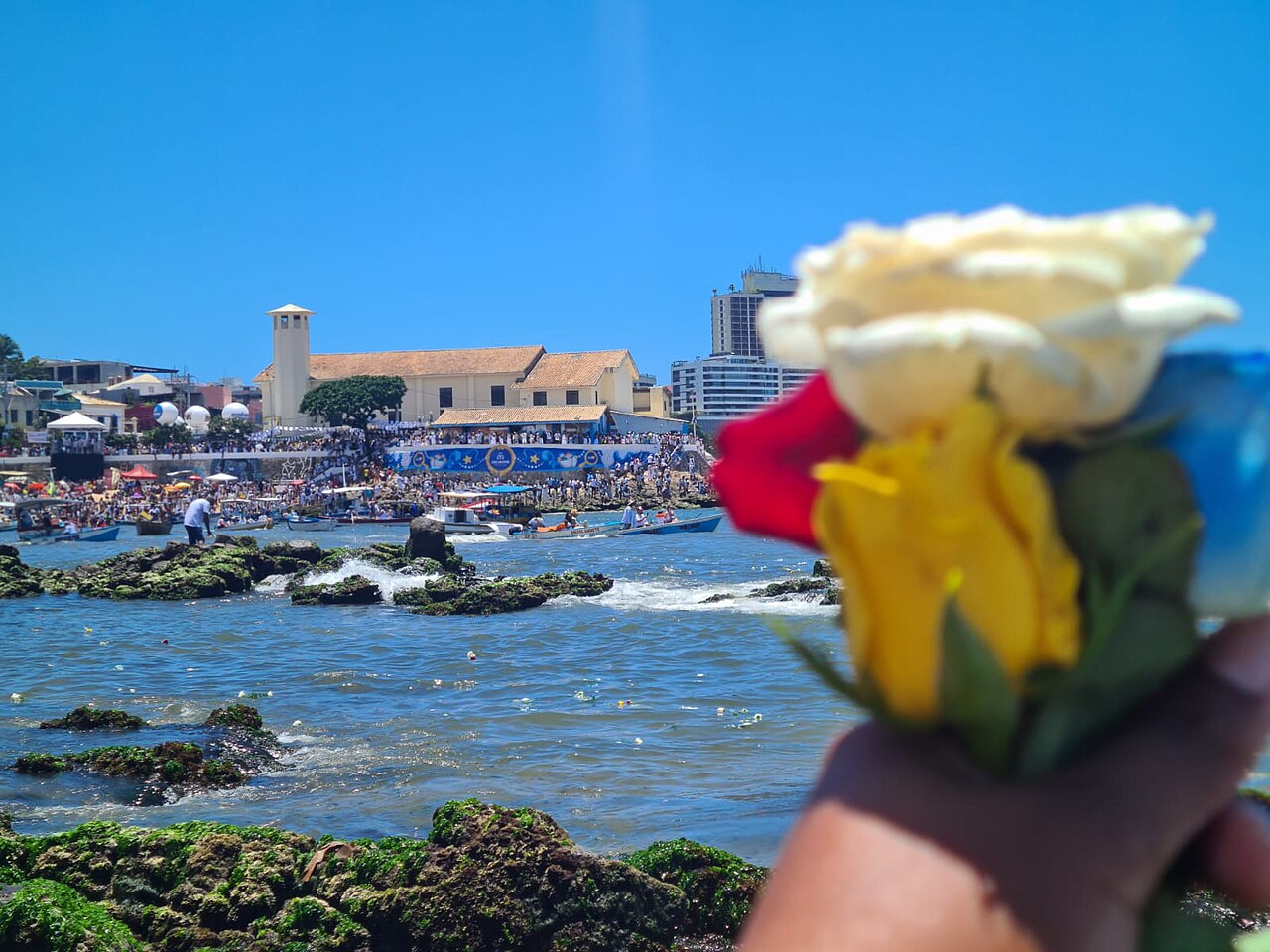
Yemọja is a Yoruba orisha, a deity of fertility and of waters, whom Britannica presents as the giver of life and the spiritual mother of all the orisha[2][3]. Her name means “mother whose children are the fish”[2][4]. She is the owner of the Ogun River, unmatched in size in Yorubaland, and her principal shrine stands in Abeokuta, Nigeria[2][3]. In Cuba she became Yemayá, and in Brazil Iemanjá, the queen of the ocean[3][4]. Every 2 February, Salvador da Bahia celebrates her on the beach of Rio Vermelho[5][6].
At the temple of Sakété, what Yemọja recalls

Direct observationWêtê Agbonon, vodun priest and bokonon of the Fâ, at the temple of Sakété
At the temple, we recognise in Yemọja a mother of the waters, and we find in her cult the bond between water, birth and the protection of children that vodun also knows. That her name has crossed the ocean to Salvador and Montevideo shows the strength of this memory, which the vodun of Benin shares with the Yoruba world[1]. See Vodun in the Americas.
Key points
- Yemọja is a Yoruba orisha of fertility and waters, mother of the orisha according to Britannica[3].
- Her name means the mother whose children are fish[2].
- She rules over the Ogun River, and her principal shrine is in Abeokuta[2][3].
- She became Yemayá in Cuba and Iemanjá in Brazil, where she is celebrated on 2 February and 31 December[3][4][6].
A deity of a river in Yorubaland, Yemọja became, on the other side of the Atlantic, the queen of the sea[2][4].
The mother of the orisha
According to the Encyclopedia of African Religion, published in 2009 under the editorship of Molefi Kete Asante and Ama Mazama, Olódùmarè charged Yemọja with helping the orisha Obàtálá form human beings, and several stories show her turning into a river after other orisha insulted her over this[2]. According to another belief, her waters broke and caused a flood that formed the rivers, and the first humans came from her womb[4].
Britannica often portrays her as the wife of various male orisha, and reports other stories in which she raised many children without having given birth[3]. French Wikipédia gives her Aganju as husband and Orungan as son, and has fifteen orisha born from her, including Ogun, Olokun, Shopona and Shango[6]. See Ogou.
The Ogun River and Abeokuta
Britannica and the Encyclopedia of African Religion make Yemọja the owner of the Ogun River, unmatched in size in Yorubaland, and place her principal shrine in Abeokuta, capital of Ogun State; her worship is said to have begun in Shaki[2][3]. She is also honoured near almost any stream, spring or well[4]. Wikipedia presents her as the leader of the other river deities, including Ọ̀ṣun, Erinlè, Ọbà and Yewá, and sometimes associates her with Olókun, the deity of the sea[4].
A protecting mother
Wikipedia makes Yemọja the protector of women, especially pregnant women, of parents, of children’s safety, of love and of healing, and writes that she is said to cure infertility; her anger can be as destructive as rivers in flood[4]. Solimar Otero and Toyin Falola, who devoted a collective volume to her in 2013, link Yemọja, in Afro-Atlantic traditions, to motherhood and women, to the arts and to family life[7].
Colours, stones and emblems
Her colours are light blue and white, and her number is seven; her symbols are water, the moon, cowries, shells and sea stones[4]. Sacred stones, the ota, kept in river water inside a calabash, stand for her in her African shrines; her animals are the duck, the vulture, the snake and the small snail[2]. She is linked to the fish-gill facial marks worn by initiates into her priesthood[2]. See The colours of vodun.
Yemayá and Iemanjá, queen of the sea
In Cuba, Santería honours her as Yemayá, mother of all living things and owner of the seas; she is associated with Our Lady of Regla, whose procession takes place around 7 September in Havana[3][4]. In Brazil, Iemanjá is one of the orixás of Candomblé and Umbanda; she is called queen of the ocean and associated with Our Lady of Navigators and Our Lady of the Conception[4].
According to Brasil de Fato, Salvador has celebrated her in Rio Vermelho since 1924: the main gift leaves from the fishermen’s colony and is taken out to sea, about three nautical miles from the coast, and the city listed the festival as cultural heritage in 2020[5]. The newspaper A Tarde notes that the first year, 1923 or 1924, remains uncertain, and that the fishermen, after a first failure, consulted the mãe de santo Julia Bogum, who taught them to make the offering according to African traditions[8]. On 31 December, crowds dressed in white offer flowers to the sea on Brazil’s beaches, and in Montevideo, on 2 February, worshippers launch small boats laden with offerings at sunset from Ramírez Beach[4][6].
The Sacred Arts of the Black Atlantic project at Duke University presents, under the title “Yemọja. Goddess of the River Ògùn”, a set made up of a bowl, a doll, a fan and an iron mermaid[9]. See Mami Wata.
What we know, and how we know it
What comes from oral tradition
The stories about Yemọja, her ties with the other orisha and her emblems are handed down through the itan, the sacred Yoruba narratives, and by the priests of her cult; at the temple, we recognise in her a mother of the waters, of the kind vodun also honours[1][3].
Common mistakes about Yemọja
- “Yemọja was born in Brazil.” She comes from Yorubaland, where the Ogun River is her domain and Abeokuta her principal shrine[2][3].
- “Yemọja is only a goddess of the sea.” In Yorubaland she rules over the Ogun River and over fertility; the sea is her domain in Cuba and Brazil[3][4].
- “Yemọja and the Virgin Mary are one figure.” Her followers associate her with figures of the Virgin, such as Our Lady of Regla in Cuba or Our Lady of Navigators in Brazil[4].
Frequently asked questions
Who is Yemọja?
A Yoruba orisha of fertility and waters, mother of the orisha.
What does the name Yemọja mean?
The mother whose children are fish.
Are Yemọja, Yemayá and Iemanjá the same deity?
Yes: these are her names in Yorubaland, in Cuba and in Brazil.
When is Iemanjá celebrated?
On 2 February in Salvador and Montevideo, and on 31 December on Brazil’s beaches.
What are Yemọja’s colours?
Light blue and white.
Glossary
- Orisha: a deity of the Yoruba religion.
- Itan: a sacred narrative of the Yoruba tradition.
- Ota: a sacred stone that represents the orisha in its shrine.
- Candomblé: an Afro-Brazilian religion that honours the orixás.
- Santería: an Afro-Cuban religion, also called regla de ocha.
Notes and references
[1] Direct observation and oral transmission, Wêtê Agbonon, bokonon, temple of Sakété.
[2] ASANTE Molefi Kete and MAZAMA Ama (eds.), « Yemonja », Encyclopedia of African Religion, SAGE Publications, 2009, p. 735-736. See
[3] Encyclopædia Britannica, « Yemonja », consulted on 13 November 2026. See
[4] Wikipedia, « Yemoja », consulted on 13 November 2026, drawing in particular on DE LA TORRE Miguel A., Santería, 2004, and MAGALHÃES Elyette Guimarães de, Orixás da Bahia, 2003. See
[5] Brasil de Fato, article on the Iemanjá festival in Salvador, 2 February 2026. See (in Portuguese)
[6] Wikipédia (in French), « Yemaya », consulted on 13 November 2026. See (in French)
[7] OTERO Solimar and FALOLA Toyin (eds.), Yemoja: Gender, Sexuality, and Creativity in the Latina/o and Afro-Atlantic Diasporas, SUNY Press, 2013. See
[8] JORGE Gilson, « Colônia de Pescadores celebra centenário da entrega de oferendas », A Tarde, 29 January 2023. See (in Portuguese)
[9] Sacred Arts of the Black Atlantic, Duke University, « Yemọja. Goddess of the River Ògùn », number D123. See
Sources
- Encyclopedia of African Religion, 2009; Encyclopædia Britannica; Otero and Falola, SUNY Press, 2013; Duke University; Brasil de Fato, 2026; A Tarde, 2023; Wikipedia.
- Direct observation and oral transmission, temple of Sakété, from 1994 to 2026
Cite this entry
Wêtê Agbonon, « Yemọja », dans Vodun Bénin, l’encyclopédie du vaudou béninois, entry no. 181, updated on 25 November 2026. Online: https://vodunbenin.org/en/yemoja/ (accessed on 26 November 2026). Licence CC BY 4.0.
- Last checked : 13 November 2026
- Reuse : free, with attribution, under the licence CC BY 4.0
- A mistake? Report it · Method and corrections